Decoding FBA Infeasibility: A Comprehensive Guide for Biomedical Researchers and Drug Developers
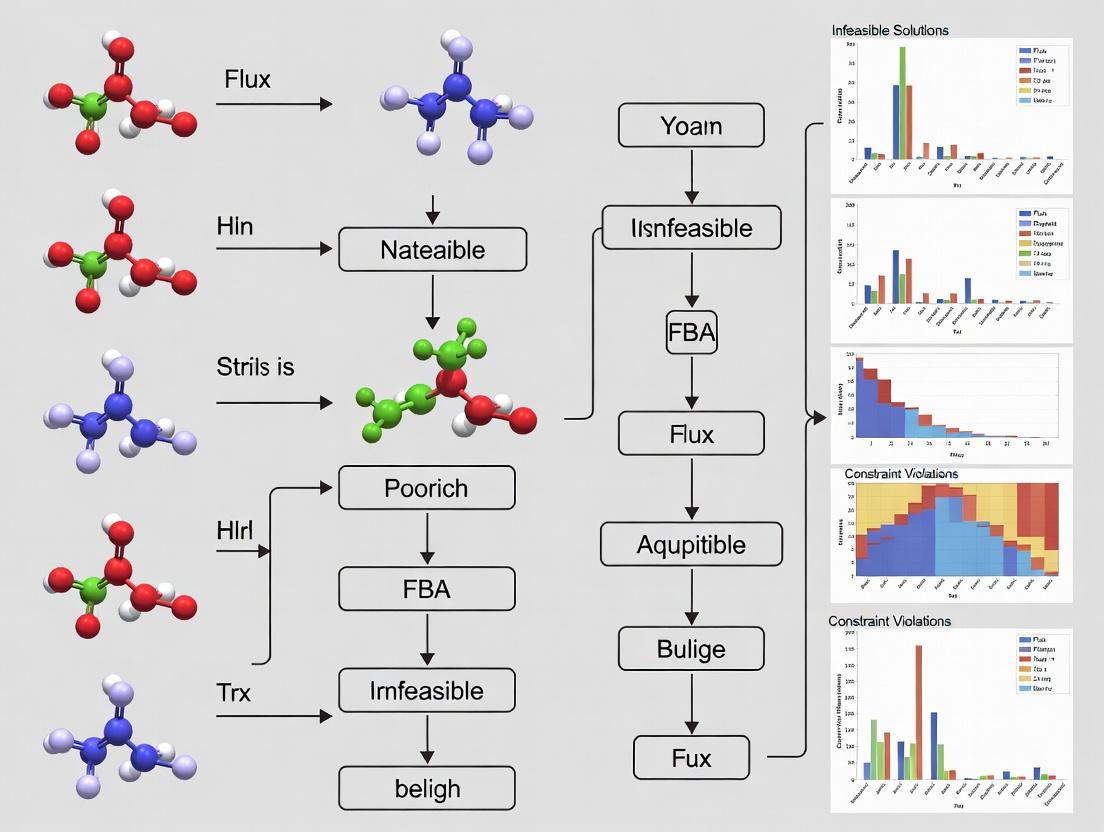
Flux Balance Analysis (FBA) is a cornerstone of constraint-based metabolic modeling, but infeasible solutions remain a major roadblock.
Decoding FBA Infeasibility: A Comprehensive Guide for Biomedical Researchers and Drug Developers
Abstract
Flux Balance Analysis (FBA) is a cornerstone of constraint-based metabolic modeling, but infeasible solutions remain a major roadblock. This article provides a systematic framework for researchers and drug development professionals to diagnose, troubleshoot, and resolve FBA infeasibility. We explore foundational causes, methodological best practices, step-by-step debugging protocols, and validation techniques to ensure robust, biologically relevant predictions for applications in target discovery and metabolic engineering.
Understanding FBA Infeasibility: Root Causes and Biological Implications
Troubleshooting Guides
Guide 1: Initial Diagnostic Steps for an Infeasible FBA Model
Q1: My Flux Balance Analysis (FBA) solver returns an "infeasible solution" error. What are the first things I should check?
A: An infeasible solution indicates that the mathematical solver cannot find a flux vector that satisfies all constraints of your model simultaneously. This means the solution space defined by your stoichiometric matrix, bounds, and additional constraints is empty. Follow this initial diagnostic workflow:
- Verify Model File Integrity: Check for formatting errors (e.g., extra tabs, missing headers) in your SBML or spreadsheet file. Use a validator like the SBML Online Validator.
- Check Reaction/Gene Annotation Consistency: Ensure all reaction identifiers are unique and correctly referenced in gene-protein-reaction (GPR) rules.
- Review Default Bounds: Confirm that exchange reaction bounds are set correctly for your simulation medium. A common mistake is having all exchanges closed (
lb = 0). - Test Model with a Simple Objective: Try maximizing or minimizing ATP maintenance (e.g.,
ATPM) or a central carbon uptake reaction before using a complex objective like biomass production.
Guide 2: Systematic Constraint Relaxation Protocol
Q2: I've checked the basics, and my model is still infeasible. How can I identify the conflicting constraints?
A: You need to perform constraint relaxation analysis. This method identifies the minimum set of constraints that must be relaxed to achieve feasibility.
Experimental Protocol:
- Define the Infeasible Problem: Your original problem is
S * v = 0, withlb <= v <= ub. - Introduce Relaxation Variables: For each constrained reaction
i, add positive relaxation variablesp_iandn_ito its bounds:lb_i - n_i <= v_i <= ub_i + p_i - Formulate the Minimization Problem: The new objective is to minimize the sum of all relaxation variables (weighted if desired):
min Σ (p_i + n_i). - Solve and Analyze: The solution will show non-zero values for
p_iorn_ionly for the constraints causing infeasibility. These are your "conflicting" or "blocked" reactions. - Interpret Results: Reactions with high required relaxation indicate areas of the model that may have incorrect stoichiometry, directionality, or are improperly constrained in the given context.
Table 1: Example Output from Constraint Relaxation Analysis
| Reaction ID | Original LB | Original UB | Relaxation (n_i) | Relaxation (p_i) | Suggested Action |
|---|---|---|---|---|---|
| EXglcDe | -10 | 0 | 0 | 8.5 | Lower bound is too restrictive. Allow greater uptake (LB < -10). |
| BIOMASSEciML1515 | 0.1 | 1000 | 0.05 | 0 | Biomass demand cannot be met. Check precursor synthesis. |
| PDH | 0 | 1000 | 3.2 | 0 | Reaction may be incorrectly annotated as irreversible. |
Frequently Asked Questions (FAQs)
Q: What is the fundamental mathematical difference between an "infeasible" and a "suboptimal" solution? A: An infeasible solution means no solution exists that satisfies all constraints. The solution space is empty. A suboptimal solution is a valid, feasible point that simply does not optimize the objective function as effectively as another feasible point would.
Q: Can an incorrect biomass objective function cause infeasibility? A: Yes. If the biomass reaction contains a metabolite that cannot be synthesized by the network under the given conditions (a "dead-end metabolite"), forcing its production by setting a lower bound > 0 on the biomass reaction will make the problem infeasible.
Q: How do loopless FBA constraints sometimes create infeasible models? A: Loopless constraints eliminate thermodynamically infeasible cycles. However, if the model contains incorrectly annotated reversible reactions or incomplete pathways, adding these strict thermodynamic constraints can render an otherwise feasible model infeasible by removing necessary cyclic flux modes.
Q: What solver-specific parameters should I adjust when encountering infeasibility? A:
- Tolerance (
feasTol): Increase the feasibility tolerance (e.g., from 1e-9 to 1e-6) in solvers like Gurobi or CPLEX. This allows minor constraint violations, which can help identify "near-feasible" problems. - Presolve: Turn presolve options off. While presolve simplifies problems, it can sometimes incorrectly declare a model infeasible prematurely.
- Scaling: Enable numerical scaling to handle poorly conditioned matrices with extremely large/small coefficients.
Visualization: FBA Infeasibility Diagnostic Workflow
Title: Diagnostic Workflow for FBA Infeasibility
Title: Root Cause Taxonomy of FBA Infeasibility
The Scientist's Toolkit: Key Research Reagent Solutions
Table 2: Essential Tools for FBA Infeasibility Diagnostics
| Tool/Reagent | Function/Description | Example/Resource |
|---|---|---|
| Constraint Relaxation Algorithm | Identifies the minimal set of bound violations needed for feasibility. Core diagnostic tool. | Implemented in cobra.util (COBRApy) as create_easy_minimal_adjustment_model. |
| Flux Variability Analysis (FVA) | Determines the minimum and maximum possible flux through each reaction in a feasible space. Identifies blocked reactions. | Use cobra.flux_analysis.flux_variability_analysis. |
| Loop Detection & Removal Tools | Identifies thermodynamically infeasible cycles that may cause infeasibility with loopless constraints. | cobra.flux_analysis.find_loop (COBRApy) or fastcc (MATLAB COBRA). |
| Metabolic Network Gap-filling Tool | Suggests reactions to add from a database to resolve dead-ends and enable flux. | cobra.flux_analysis.gapfill (COBRApy) or meneco (standalone). |
| High-Quality Biochemical Database | Reference for correct reaction stoichiometry, directionality, and metabolite formulas. | MetaNetX, BiGG Models. |
| Linear Programming Solver | The computational engine for solving FBA. Understanding its parameters is key. | Gurobi, CPLEX, or open-source alternatives like GLPK or HiGHS. |
| SBML Validator | Checks model file for syntactic and semantic errors that can lead to infeasibility. | SBML.org Online Validator. |
Technical Support Center: FBA Infeasible Solution Troubleshooting
This support center provides targeted guidance for researchers encountering infeasibility in Flux Balance Analysis (FBA) models, a critical issue in metabolic network analysis for drug target identification and biotechnology.
Troubleshooting Guides
Guide 1: Diagnosing the Origin of Infeasibility
- Step 1: Verify the Objective Function. Ensure the biomass or production reaction is correctly defined and present.
- Step 2: Check Model Boundaries. Confirm all exchange flux lower (
LB) and upper (UB) bounds are physiologically consistent (e.g., irreversible reactions haveLB=0). - Step 3: Analyze Blocked Reactions. Use Flux Variability Analysis (FVA) to identify reactions incapable of carrying non-zero flux.
- Step 4: Perform Sequential Constraint Relaxation. Systematically relax constraints on uptake, ATP maintenance, and growth requirements to identify the most restrictive.
Guide 2: Resolving Network Gap Issues
- Step 1: Identify Dead-End Metabolites. Detect metabolites that are only produced or only consumed within the network.
- Step 2: Evaluate Network Connectivity. Ensure all components of the objective function are connected to the core network.
- Step 3: Incorporate Missing Reactions. Consult genomic and bibliomic data to add transport or missing pathway reactions.
- Step 4: Validate with Known Growth Data. Test model feasibility against experimentally observed growth phenotypes.
Frequently Asked Questions (FAQs)
Q1: My FBA model returns an "infeasible solution" error when I add a gene knockout. What does this mean and how do I proceed? A: An infeasible solution after a knockout indicates the model's constraints cannot all be satisfied simultaneously, often meaning the knockout is lethal under the given conditions. To proceed:
- Verify the knockout was correctly implemented (reaction bounds set to zero).
- Check if the model can produce essential biomass precursors without the knocked-out reaction.
- Use a
compute_ΔFBAorRobustKnock-like approach designed for strain design, which explicitly handles lethality.
Q2: How can I distinguish between a genuine biological lethality and a modeling artifact causing infeasibility? A: Follow this diagnostic protocol:
- Modeling Artifact Check: Relax the biomass objective requirement (set it as a constraint, not the objective) and attempt to maximize ATP production or a central carbon flux. If the model is still infeasible, it's likely an artifact.
- Biological Lethality Check: If the model is feasible with a relaxed biomass, compare Flux Balance Analysis (FBA) under wild-type and mutant conditions. A significant, non-zero wild-type biomass with zero mutant biomass suggests biological lethality.
- Literature Validation: Cross-reference the knockout with essentiality databases (e.g., DEG) for your organism.
Q3: What are the most common stoichiometric matrix errors leading to infeasibility? A: Common errors include:
- Mass/Charge Imbalance: Reactions that do not conserve elemental mass or charge.
- Duplicate Reactions: Identical reactions with different IDs causing redundancy.
- Incorrect Directionality: Assigning wrong reversibility to irreversible reactions.
- Orphan Metabolites: Metabolites that participate in only one reaction.
Table 1: Common Constraint Sources of Infeasibility in Metabolic Models
| Constraint Type | Typical Default Value | Impact if Mis-specified | Recommended Diagnostic Action |
|---|---|---|---|
| ATP Maintenance (ATPM) | 3-8 mmol/gDW/hr (E. coli) | Overestimation blocks growth | Reduce gradually to find feasible threshold |
| O2 Uptake | ~20 mmol/gDW/hr | Underestimation can block aerobic growth | Set to experimental measurement |
| Glucose Uptake | -10 to -20 mmol/gDW/hr | Limitation may cause infeasibility with high demands | Set according to culture condition |
| Biomass Component Synthesis | Fixed coefficients | Incorrect stoichiometry creates internal bottlenecks | Review biosynthesis pathway flux |
Table 2: Results of Sequential Relaxation on an Infeasible E. coli iJO1366 Mutant Model
| Relaxed Constraint | Original Bound | Relaxed Bound | Feasibility Achieved? | Max Biomass (1/hr) |
|---|---|---|---|---|
| None (Infeasible) | - | - | No | 0.00 |
| ATP Maintenance (ATPM) | LB = 3.15 | LB = 1.50 | No | 0.00 |
| Phosphate Uptake | LB = -20.0 | LB = -30.0 | Yes | 0.45 |
| Proton Gradient Maintenance | Fixed | Unconstrained | Yes | 0.62 |
Experimental Protocols
Protocol: Identifying Gap-Filling Reactions via Genetic Algorithms
- Objective: Automatically propose a minimal set of reactions to add from a universal database (e.g., MetaCyc) to restore model feasibility.
- Methodology:
- Define the infeasible core model (
S_core) and a universal reaction database (S_db). - Formulate a mixed-integer linear programming (MILP) problem where binary variable
y_iindicates selection of reaction i fromS_db. - Objective Function: Minimize
Σ y_i(minimal number of added reactions). - Constraints: Force the combined network (
S_core+ selectedS_dbreactions) to achieve a positive biomass flux (v_biomass > ε). - Solve using a solver like Gurobi or CPLEX. The solution
y_iindicates the essential gap-filling reactions.
- Define the infeasible core model (
Protocol: Thermodynamic Feasibility Integration to Resolve Loops
- Objective: Eliminate thermodynamically infeasible cycles (TICs) that can cause numerical instability and artifacts.
- Methodology:
- Perform Flux Balance Analysis on your model.
- Use the
find_loopfunction (in COBRApy) or CycleFreeFlux to identify flux-carrying cycles. - Apply thermodynamic constraints by adding a free energy variable
μ_jfor each metabolite. - For each reaction i, add the constraint:
Σ μ_j * S_ji ≤ -ε * v_i(whereS_jiis the stoichiometric coefficient). This enforces that flux direction aligns with negative free energy change. - Re-solve the constrained FBA problem.
Diagrams
Title: FBA Infeasibility Diagnostic Decision Tree
Title: Gap-Filling Algorithm Concept for Model Feasibility
The Scientist's Toolkit: Research Reagent Solutions
Table 3: Essential Tools for FBA Model Debugging and Validation
| Item / Solution | Function / Purpose | Example (if applicable) |
|---|---|---|
| COBRA Toolbox (MATLAB) | Primary software suite for constraint-based modeling, simulation, and analysis. | optimizeCbModel, fastFVA, gapFind functions. |
| COBRApy (Python) | Python version of COBRA, enabling integration with machine learning and bioinformatics pipelines. | cobra.flux_analysis.variability and cobra.flux_analysis.gapfilling. |
| MEMOTE | Automated framework for comprehensive and standardized genome-scale model testing and quality assurance. | Generates a quality report scoring stoichiometry, annotations, and basic functionality. |
| GBacktrace (Gurobi) | Commercial solver feature that identifies an irreducible subset of conflicting constraints (IIS) in an infeasible LP. | Critical for pinpointing the exact conflicting bounds/reactions in a large model. |
| MetaNetX / BioModels | Curated repositories of biochemical network models and reconciliation tools for cross-database mapping. | Used to compare model structures and import missing reactions. |
| CarveMe | Automated pipeline for genome-scale model reconstruction; includes a universal reaction database for gap-filling. | Can rebuild a model from scratch to compare with the problematic one. |
| Essential Gene Databases (DEG) | Database of essential genes to validate predicted lethality from knockouts. | Distinguishes between modeling artifacts and true biological essentials. |
Technical Support Center: FBA Infeasible Solution Troubleshooting
FAQs & Troubleshooting Guides
Q1: My Flux Balance Analysis (FBA) model returns an "infeasible solution" error when I try to simulate growth on my target medium. What are the most likely primary biological causes?
A: The three primary biological culprits are:
- Gaps: Missing metabolic reactions or transport steps that prevent the synthesis of an essential biomass component.
- Loops: Thermally infeasible cycles (often energy-generating, such as ATP -> ADP + Pi cycling without a net reaction) that violate the second law of thermodynamics.
- Thermodynamic Inconsistencies: Directionality constraints (reversibility/irreversibility) assigned to reactions that contradict known biochemical thermodynamics under physiological conditions.
Q2: How can I systematically diagnose which type of culprit (Gap, Loop, or Thermodynamic Inconsistency) is causing my specific infeasibility?
A: Follow this diagnostic workflow:
- Simplify the Problem: Remove all non-essential constraints (e.g., knockouts, non-physiological flux bounds). Can the model produce biomass on a complete, rich medium? If not, a major gap exists.
- Check for Loops: Use a loopless FBA constraint or a dedicated algorithm (e.g., CycleFreeFlux) to identify energy-generating cycles. Temporarily apply these constraints. If feasibility is restored, loops are the issue.
- Analyze Network Connectivity: For growth on a specific medium, use gap-finding algorithms (e.g.,
gapFind) to trace the inability to produce biomass precursors from the available nutrients. - Review Reaction Directions: Compare your model's reaction reversibility assignments with a trusted biochemical database (e.g., MetaCyc, BRENDA). Inconsistent assignments can block feasible flux space.
Q3: What are the recommended experimental protocols to validate and correct a suspected metabolic gap in my model?
A: Protocol for Gap-Filling & Validation
Objective: To identify and experimentally confirm missing metabolic functionality.
Materials: (See Research Reagent Solutions table below)
Methodology:
- In Silico Prediction: Use a gap-filling algorithm (e.g., in CobraPy or ModelSEED) constrained by genomic evidence to propose a set of candidate reactions (R_cand) to restore model growth.
- Genomic/Transcriptomic Correlation: Check for associated gene loci or expression signals for candidate reactions in your organism.
- Enzyme Activity Assay:
- Prepare cell lysate from your organism grown under relevant conditions.
- Design an assay mixture containing the predicted substrate for the candidate reaction, necessary cofactors (NAD(P)H, ATP, etc.), and lysate.
- Measure product formation over time using appropriate techniques (HPLC, spectrophotometry, coupled enzyme assays).
- Genetic Complementation: If a homolog from another organism is the candidate, attempt to express it in a mutant of a model organism (e.g., E. coli) that lacks the native function. Growth restoration supports the predicted activity.
- Model Update: Incorporate the validated reaction, with correct gene-protein-reaction (GPR) rules and directionality, into your metabolic reconstruction.
Q4: How do I resolve thermodynamically infeasible loops in a computationally efficient manner?
A: Implement the Loopless FBA (ll-FBA) constraint protocol.
Protocol: Applying Loopless Constraints
- Pre-requisite: A stoichiometric matrix S and a solved standard FBA solution vector v.
- Calculate Null Space: Compute the null space (kernel) of S. These basis vectors represent all steady-state flux distributions.
- Identify Cycle Vectors: Basis vectors where all non-zero components form a closed cycle with no external input/output are loop vectors.
- Add Thermodynamic Constraint: For each reaction i, introduce a continuous variable g_i (potential). For every reaction, add the constraint:
- If vi > 0, then gj - gi < 0 (for reaction i: substrate j -> product k).
- If vi < 0, then gj - gi > 0.
- This is implemented using big-M constraints to make it linear: gj - gi <= M(1 - yi) and gj - gi >= -M(1 - zi), with binary variables y, z indicating flux direction.
- Solve ll-FBA: Solve the modified optimization problem (maximize biomass) subject to original and new loopless constraints. This eliminates solutions with thermodynamically infeasible cycles.
Q5: Are there standardized metrics or tools to quantify the severity of thermodynamic inconsistencies in a genome-scale model?
A: Yes. The following table summarizes key diagnostic metrics and tools.
| Metric/Tool Name | Purpose | Typical Output/Value | Interpretation |
|---|---|---|---|
| Energy Balance Analysis (EBA) | Checks for internal production of energy (ATP, etc.) without substrate input. | Number of detected internal energy cycles. | >0 indicates thermodynamically infeasible loops. |
| ThermoKernel (or MODUBA) | Evaluates reaction directionality against a consistent thermodynamic potential landscape. | List of reactions with inconsistent directionality. | Highlights reactions to manually curate for reversibility. |
| Flux Variance Analysis | Analyzes the feasible flux range of each reaction under optimal growth. | Minimum and maximum flux (vmin, vmax) for each reaction. | A reaction with vmin > 0 and vmax < 0 is internally conflicted (sign of infeasibility). |
checkMassChargeBalance (CobraPy) |
Validates elemental and charge balance of each reaction equation. | Boolean for each reaction. | Unbalanced reactions can cause thermodynamic and feasibility artifacts. |
The Scientist's Toolkit: Research Reagent Solutions
| Item | Function in Troubleshooting FBA Infeasibility |
|---|---|
| CobraPy (Python Package) | Primary software for constraint-based modeling. Contains functions for FBA, loopless FBA, gapFill, and flux variability analysis. |
| ModelSEED / KBase | Web-based platform for automated model reconstruction, gapfilling, and simulation. Useful for rapid hypothesis generation. |
| MEMOTE (Model Test Suite) | Standardized testing framework for genome-scale models. Generates a quality score and identifies stoichiometric, thermodynamic, and metabolic gaps. |
| BioNumbers Database | Curated repository of key biological numbers. Provides essential reference data for setting realistic flux bounds and kinetic constants. |
| Specified Growth Media | Chemically defined media kits essential for testing model predictions of auxotrophies and nutrient utilization. |
| ATP Determination Kit (Luminescence) | Measures cellular ATP levels experimentally. Critical for validating or disproving predicted ATP-generating loops in vivo. |
| LC-MS/MS System | For extracellular metabolomics (measuring uptake/secretion rates) and intracellular metabolomics (constraining thermodynamic potentials). |
Diagnostic Workflow for Infeasible FBA Models
Loopless FBA Constraint Logic
Gap-Filling Experimental Validation Workflow
Troubleshooting Guides & FAQs
This technical support center is designed to assist researchers in diagnosing and resolving common issues leading to Flux Balance Analysis (FBA) infeasible solutions within metabolic models, framed within ongoing research on systematic troubleshooting methodologies.
FAQ: Identifying and Resolving Annotation Errors
Q1: How can I identify if gene-protein-reaction (GPR) annotation errors are causing model infeasibility?
A: Infeasibility often arises from incorrect GPR associations, leading to dead-end metabolites. Perform a gap-filling analysis using tools like modelSEED or RAVEN Toolbox. Quantify the number of dead-end metabolites before and after curation. A significant reduction (e.g., >20%) post-curation strongly indicates annotation errors were a root cause.
Q2: What is a reliable protocol to verify metabolite and reaction identifiers against a standard database?
A: Follow this protocol:
1. Extract Identifiers: Export all metabolite (e.g., cpd00027) and reaction (e.g., rxn00045) IDs from your model (SBML file).
2. Map to Standard: Use the MetaNetX web service or API (https://www.metanetx.org) to map your IDs to the MNXref namespace.
3. Identify Mismatches: The service returns a mapping table. Reactions/metabolites failing to map or mapping to multiple candidates require manual inspection.
4. Manual Curation: For ambiguous mappings, consult primary literature or the BRENDA enzyme database to confirm the correct stoichiometry and participants.
FAQ: Diagnosing Compartmentalization Problems
Q3: My model becomes feasible only when I ignore compartmentalization. How do I pinpoint the problematic transport reactions?
A: This is a classic symptom of missing or incorrect transport. Implement a compartment-free version of your model and systematically reintroduce compartments.
1. Create a Compartment-Agnostic Model: Merge all instances of the same metabolite across compartments into a single pool.
2. Re-introduce Compartments: Add back compartments one by one (e.g., cytosol, mitochondria), along with their known transport systems, from a database like TCDB (Transporter Classification Database).
3. Test Feasibility: After adding each compartment's transporters, run FBA. The step where the model becomes infeasible indicates the compartment with missing exchange.
Q4: Are there quantitative metrics for compartmentalization completeness? A: Yes. Calculate the following for your model and compare against a high-quality reference (like Recon3D):
| Metric | Formula | Target Threshold (Eukaryotic Model) |
|---|---|---|
| Transport Reaction Coverage | (Number of Model Transport Reactions) / (Number in Reference) | > 0.85 |
| Compartment-Specific Dead-Ends | Count of dead-end metabolites per compartment (e.g., Cytosol, Mitochondria) | Should be < 5 per compartment |
| Inter-Compartmental Connectivity | Ratio of cross-compartment reactions to total reactions | 0.15 - 0.25 |
FAQ: Correcting Missing Transport
Q5: What is a systematic method for inferring missing transport reactions? A: Use the following experimental protocol for gap-filling transport: Protocol: Computational Gap-Filling for Transporters
- Input: An infeasible, compartmentalized genome-scale model and a growth medium definition.
- Define Universal Transport Reaction Set: Generate a database of all possible transport reactions for the model's metabolites using template reactions (e.g., proton symport, antiport, ATP-driven pumps).
- Run Gapfilling Optimization: Use a tool like
CarveMeor thegapfillfunction inCobrapy. Formulate an optimization problem that minimizes the number of transport reactions added from the universal set to restore model growth. - Biochemical Validation: Manually check the top-scoring suggested transport reactions against genomic evidence (e.g., check for transporter genes in your organism's genome using BLAST against TCDB) and literature support.
Q6: How do I distinguish between a missing transport reaction and an incorrect biomass objective function (BOF)?
A: Perform a Nutrient Requirement Analysis.
1. Set all exchange reactions to allow uptake.
2. Sequentially set each exchange reaction to only allow secretion (i.e., block uptake).
3. Run FBA with the BOF. If blocking the uptake of a specific metabolite (e.g., co2[e]) causes infeasibility, but that metabolite is not a known biomass precursor, your BOF may be incorrect. If blocking it does not cause infeasibility, but your model still can't grow on a realistic medium, transport for that metabolite into a critical compartment is likely missing.
The Scientist's Toolkit: Research Reagent Solutions
| Item / Resource | Function in Troubleshooting FBA Infeasibility |
|---|---|
| MetaNetX Web Service | Maps and reconciles metabolite/reaction identifiers across hundreds of source databases to resolve annotation conflicts. |
| Transport Classifcation Database (TCDB) | Provides a curated list of known transporter proteins and their reaction mechanisms to hypothesize missing transport. |
| Cobrapy (Python Package) | Core FBA simulation library used to perform gapfilling, flux variability analysis (FVA), and dead-end metabolite detection. |
| RAVEN Toolbox (MATLAB) | Suite for model reconstruction, curation, and includes strong functions for semi-automated gap-filling of reactions and transport. |
| MEMOTE (Model Testing Suite) | Runs a standardized battery of tests on an SBML model, generating a report on stoichiometric consistency, mass/charge balance, and annotation completeness. |
| BiGG Models Database | Source of high-quality, curated genome-scale models to use as references for reaction and compartmentalization structure. |
Mandatory Visualizations
Troubleshooting Workflow for FBA Infeasibility
Compartmentalization & Missing Transport Causing Infeasibility
Technical Support Center: Troubleshooting FBA Model Infeasibility
Frequently Asked Questions (FAQs)
Q1: What does an "infeasible solution" error mean in the context of Flux Balance Analysis (FBA) for drug target prediction? A1: An infeasible solution indicates that the constraints applied to your metabolic model are mathematically contradictory, making it impossible to find a steady-state flux distribution. In drug discovery, this often arises when gene knockout simulations (mimicking drug inhibition) are combined with essential growth or production requirements that the compromised network can no longer meet. The solver cannot satisfy all constraints simultaneously, leading to a null solution. This is critical because an infeasible result for a gene knockout may be misinterpreted as the gene being "essential" and thus a good drug target, when in reality the model constraints themselves may be biologically unrealistic or incorrectly specified.
Q2: During a drug target screening simulation, my model becomes infeasible only for certain gene knockouts. How do I diagnose the issue? A2: This is a common scenario. Follow this diagnostic protocol:
- Check Biomass Objective Function (BOF): The infeasible knockout may disrupt a reaction absolutely required to produce a biomass precursor. Verify the connectivity of the network post-knockout using flux variability analysis (FVA) in a minimal medium.
- Review Thermodynamic Constraints: Ensure all defined energy maintenance (ATPM) and non-growth associated maintenance (NGAM) demands are still feasible. An infeasibility can occur if the knockout disrupts substrate-level phosphorylation while ATPM is set too high.
- Examine Transport and Exchange Bounds: Confirm that the simulated knockout organism can still uptake all essential nutrients (e.g., carbon, nitrogen, phosphate sources) defined in the medium. The knockout may have indirectly blocked a transport reaction.
- Identify Conflicting Constraints: Use "relaxation" algorithms (available in COBRApy and similar toolboxes) to identify which constraints (lower/upper bounds, reaction deletions) are in conflict. The tool will report the minimal set of constraints that must be relaxed to achieve feasibility.
Q3: My genome-scale metabolic model (GEM) is infeasible even in the wild-type (no knockout) state. What are the primary causes? A3: A wild-type infeasibility points to fundamental model errors. Primary causes include:
- Irreversibility Errors: A reaction annotated as irreversible in the direction that consumes a metabolite, but is the only source for that metabolite.
- Blocked Reactions and Dead-End Metabolites: Metabolites that are only produced or only consumed, breaking network connectivity. This is especially common in lipid and secondary metabolism pathways.
- Incorrect Compartmentalization: Metabolites present in multiple compartments (e.g., cytosolic and mitochondrial ATP) without adequate transport reactions linking them.
- Mass/Charge Imbalance: Stoichiometrically unbalanced reactions prevent mass conservation, violating the steady-state assumption (Sv=0).
Q4: How can infeasible models lead to false positive or false negative drug target predictions? A4:
- False Negative (Missing a Viable Target): If a model is incorrectly constrained (e.g., overly restrictive nutrient uptake), a knockout of a genuinely essential gene may appear infeasible. Researchers may incorrectly discard this gene as a target due to a "model artifact" rather than biology.
- False Positive (Pursuing a Poor Target): Conversely, model errors (e.g., missing isozymes or alternative pathways) may allow a network to remain feasible after a gene knockout. The model predicts non-essentiality, suggesting a poor target, while in vivo experiments show the gene is essential. Resources are wasted validating a misleading prediction.
Q5: What are the best practices for fixing an infeasible model to improve target prediction reliability? A5: Implement a systematic curation workflow:
- Gap-filling: Use tools like
ModelSEEDorCarveMeto systematically identify and fill metabolic gaps based on genomic evidence and available experimental data (e.g., growth on specific substrates). - Demand Analysis: Critically evaluate all non-growth associated demand reactions. Remove those without strong experimental justification.
- Sink Reaction Audit: Sink reactions (allowing metabolite output) should be justified (e.g., for metabolite dilution due to cell growth). Uncontrolled sinks can create unrealistic cycles.
- Consistency Testing: Use algorithms like
tINIT(for human models) orCHECKinRAVEN Toolboxto ensure model functionality matches known tissue-specific or organism-specific capabilities. - Iterative Validation: Constantly refine model constraints (exchange bounds, growth rates) using experimental data from literature or high-throughput phenotyping.
Experimental Protocols for Diagnosing Infeasibility
Protocol 1: Systematic Identification of Conflicting Constraints Objective: To identify the minimal set of constraints causing infeasibility in a gene knockout simulation. Methodology:
- Load your metabolic model (e.g., in SBML format) into COBRApy (
cobrapy). - Apply the desired gene knockout(s) using
model.genes.get_by_id('GENE_ID').knock_out(). - Attempt to optimize for the objective (e.g., biomass). If infeasible, proceed.
- Use the
cobra.flux_analysis.variability.find_blocked_reactions(model)function to list all blocked reactions in the current constrained state. - Employ the
cobra.flux_analysis.variability.find_essential_genes(model)function to see if the knockout has created an unexpectedly large set of essential genes. - Utilize the relaxation analysis function. Example pseudo-code:
- The
relaxation_infotable will show which reaction bounds had to be relaxed and by what amount to achieve feasibility. Analyze these reactions biologically.
Protocol 2: Gap-Filling and Network Validation Using Experimental Growth Data Objective: To cure systemic infeasibilities and ensure the model accurately reflects known growth phenotypes. Methodology:
- Data Compilation: Create a table of known experimental growth outcomes (True/False) for your organism across multiple carbon, nitrogen, and sulfur sources (e.g., from Biolog assays or literature).
- Simulation: For each growth condition, set the appropriate exchange reaction bounds (open for available nutrients) and simulate growth.
- Comparison: Generate a confusion matrix comparing predicted vs. experimental growth.
- Gap-Filling: For false negatives (model predicts no growth, but experiment shows growth), use an automated gap-filling tool. Example using the
ModelSEEDAPI orCarveMe:
- Iterate: The tool will propose adding missing reactions from a universal database. Curate these suggestions based on genomic evidence (e.g., blastp for homologous genes).
- Re-test: Re-run the growth prediction simulations to assess improvement in accuracy.
Data Presentation
Table 1: Common Causes of FBA Infeasibility and Impact on Drug Target Prediction
| Cause of Infeasibility | Technical Description | Potential Impact on Target Prediction | Diagnostic Tool/Method |
|---|---|---|---|
| Overly Restrictive Medium | Exchange bounds for essential nutrients (e.g., CoA, specific amino acids) are closed. | False Negative: Essential gene knockout appears infeasible, target is overlooked. | Compare with permissive medium; Flux Variability Analysis (FVA). |
| Missing Isozyme/Alternative Pathway | Model lacks known redundant reaction(s) for a metabolic step. | False Positive: Knockout remains feasible, target deemed non-essential. | Compare with literature, genomic context tools like eggNOG. |
| Incorrect Reaction Reversibility | An irreversible reaction is the sole consumer/producer of a key metabolite. | Wild-type Infeasibility: All predictions are invalid. | Use cobra.flux_analysis.find_blocked_reactions. |
| Unbalanced Energy Maintenance | ATP maintenance demand (ATPM) is set higher than the network's post-knockout capacity. | False Negative: Knocks out energy metabolism genes appear infeasibly lethal. | Relax ATPM constraint and re-simulate; compare with experimental yield data. |
| Dead-End Metabolite | A metabolite is produced but has no consumption reaction (or vice versa). | Wild-type Infeasibility / False Positives: Disrupts connectivity. | Metabolite dependency graph; cobra.flux_analysis.find_essential_metabolites. |
Table 2: Summary of Model Curation Tools for Resolving Infeasibility
| Tool/Software Package | Primary Function | Applicable Model Type | Key Output for Troubleshooting |
|---|---|---|---|
| COBRApy (v0.26.0+) | Constraint-based reconstruction and analysis. | General (Microbial, Mammalian) | Relaxation analysis, flux variability, blocked reaction identification. |
| RAVEN Toolbox (v2.0) | Reconstruction, simulation, and curation. | General, emphasis on Eukaryotes | CHECK function for stoichiometric consistency, gapFind. |
| CarveMe (v1.5.1) | Automated reconstruction & gap-filling. | Draft Genome-Scale Models | Automatically generates gap-filled models from a genome. |
| ModelSEED API | Web-based reconstruction and gap-filling. | Primarily Microbial | Proposes candidate reactions to restore growth. |
| MEMOTE (v0.13.0) | Quality assessment and report generation. | Standardized SBML Models | Comprehensive report on model consistency, including mass/charge balance. |
Visualizations
Workflow for Diagnosing Infeasible Knockout Simulations
How Model Errors Cause Misleading Target Predictions
The Scientist's Toolkit: Research Reagent Solutions
Table 3: Essential Tools and Reagents for Validating FBA-Based Target Predictions
| Item Name | Category | Function & Relevance to Troubleshooting |
|---|---|---|
| Biolog Phenotype MicroArray Plates | Experimental Validation | Provides high-throughput experimental growth data on ~1000 carbon/nitrogen sources. Critical for validating and gap-filling model predictions to resolve infeasibilities. |
| CRISPR-Cas9 Knockout Library | Experimental Validation | Enables genome-wide testing of gene essentiality predictions in the actual organism. The gold standard for identifying false positives/negatives from model simulations. |
| COBRApy (Python Package) | Software Toolbox | The primary computational environment for running FBA, performing knockout simulations, relaxation analysis, and flux variability analysis to diagnose infeasibility. |
| MEMOTE Test Suite | Software Toolbox | Automatically assesses model quality (mass/charge balance, stoichiometric consistency) to identify structural problems that cause infeasibility. |
| Universal Metabolic Database (e.g., MetaCyc, KEGG) | Curation Resource | Provides a curated reference of biochemical reactions and pathways for manual or automated (gap-filling) correction of model errors. |
| Isotope-Labeled Substrates (e.g., 13C-Glucose) | Experimental Validation | Used in 13C Metabolic Flux Analysis (MFA) to measure in vivo fluxes. Data can constrain and validate FBA models, ensuring predictions (and target identifications) are physiologically relevant. |
| Defined Minimal Media Kits | Experimental Reagent | Allows researchers to precisely replicate the in silico medium conditions in the lab, directly testing if model infeasibility matches real biological non-growth. |
Best Practices for Building and Constraining Feasible Metabolic Models
Troubleshooting Guides & FAQs
Q1: During the final model validation phase, my curated model returns an "FBA Infeasible Solution" error. What are the primary systemic causes?
A1: An FBA infeasible solution within the context of GENRE (GENome-scale metabolic Network REconstruction)-based curated models typically indicates a violation of mass, energy, or thermodynamic constraints. The primary causes are:
- Irreversibility Mismatch: A reaction annotated as irreversible in the model directionally conflicts with a required flux for biomass production or a defined experimental condition.
- Blocked Reactions/Gaps: Missing transport reactions or pathway gaps prevent metabolite exchange or internal cycling, trapping metabolites.
- Incorrect Biomass Objective Function (BOF): The defined biomass composition is not mass-balanced, or essential precursors cannot be synthesized.
- Inconsistent Compartmentalization: Metabolites are present in compartments without transport mechanisms, or reactions span compartments illogically.
- Faulty Constraint Application: Experimentally measured uptake/secretion rates (constraints) are applied incorrectly, creating a contradictory scenario.
Q2: What is a systematic, step-by-step protocol to diagnose the root cause of an infeasibility error?
A2: Follow this sequential diagnostic workflow:
Protocol 1: Infeasibility Diagnostic Cascade
- Relax All Constraints: Remove all user-defined medium and flux bounds. If feasible, the problem lies in the applied constraints.
- Check the Biomass Reaction: Set the BOF as the sole objective with rich medium. If infeasible, the BOF or core metabolism is faulty.
- Perform Gap-finding Analysis: Use algorithms (e.g.,
gapFind/gapFill) to identify dead-end metabolites and minimal reaction sets to enable connectivity. - Analyze the Stoichiometric Matrix: Compute the left null space to identify mass-imbalanced reactions and the null space to find linearly dependent constraints.
- Use Infeasibility Minimization Solvers: Employ tools like
CPLEXIISS orGUROBIFeasRelax to identify the minimal set of conflicting constraints (the "IIS" – Irreducible Inconsistent Subsystem).
Q3: How can I resolve a detected "Irreducibly Inconsistent Subsystem" (IIS)?
A3: An IIS is a minimal set of constraints that are mutually contradictory. Resolution requires manual curation:
- Cross-reference with Literature: Validate the experimental constraints (e.g., nutrient uptake rate) for the specific organism under your modeled condition.
- Verify Reaction Annotations: Re-examine the database evidence (e.g., MetaCyc, BRENDA) for reaction directionality (EC number) and compartment.
- Inspect Metabolite Charge/Formula: Ensure all metabolites in the conflicting subsystem have correct and consistent chemical formulas and protonation states for the compartment pH.
Key Experimental Protocols Cited
Protocol 2: Computational Validation of Reaction Thermodynamics Objective: To flag thermodynamically infeasible cycles in the curated model. Methodology:
- Generate Formation Energies: Use component contribution method (e.g., with
eQuilibrator) to estimate standard Gibbs free energy (ΔfG'°) for all metabolites. - Apply Loopless Constraints: Implement the
looplessFBA approach (ll-FBA) by adding constraints to prevent net flux around stoichiometrically balanced cycles without a thermodynamic driving force. - Test for Feasibility: Run FVA (Flux Variability Analysis) with loopless constraints. If the model becomes infeasible, identify cycles that become blocked, indicating possible annotation errors in reaction reversibility.
Protocol 3: Experimentally-Grounded Constraint Setting for Growth Simulation Objective: To apply accurate, non-contradictory constraints from experimental data. Methodology:
- Quantify Uptake/Secretion Rates: Use metabolomics (LC-MS) and isotopologue tracing (e.g., 13C-glucose) to measure absolute extracellular fluxes in chemostat or batch culture.
- Calculate ATP Maintenance (ATPM): Derive from measured growth yield and estimated biosynthetic costs, or from carbon-limited chemostat experiments at different dilution rates.
- Apply as Bounds: Input measured uptake rates (e.g., glucose, O2) as upper bounds. Apply measured secretion rates (e.g., CO2, acetate) as lower bounds. Set the ATPM demand reaction to the calculated value.
- Perform Sensitivity Analysis: Systematically vary each constraint by ±10% to identify which measurements induce infeasibility when slightly perturbed, indicating a high-confidence conflict zone.
Data Presentation
Table 1: Common FBA Infeasibility Causes & Diagnostic Tools
| Cause Category | Specific Fault | Diagnostic Tool/Algorithm | Expected Output for Diagnosis |
|---|---|---|---|
| Stoichiometric | Mass Imbalance | checkMassBalance (COBRA) |
List of reactions violating ∑Sᵢⱼ = 0 |
| Topological | Dead-end Metabolite | findDeadEnds (COBRA) |
List of metabolites with no production/consumption paths |
| Thermodynamic | Internal Cycle | looplessFBA / Thermodynamic FBA |
Identification of Energy Generating Cycles (EGCs) |
| Constraint-based | Conflicting Bounds | findIIS / FeasRelax (Solvers) |
Minimal set of conflicting linear constraints |
Table 2: Research Reagent Solutions for Key Validation Experiments
| Reagent / Tool | Function in Model Curation & Validation | Example Product/Catalog |
|---|---|---|
| 13C-Labeled Substrate | Enables experimental flux measurement via MFA (Metabolic Flux Analysis) to validate in silico flux predictions. | [1,2-13C]Glucose, CLM-1396 (Cambridge Isotopes) |
| Genome-Scale Model | Base reconstruction for manual curation. | AGORA (for mammals), CarveMe (for microbes) |
| Constraint-Based Reconstruction and Analysis (COBRA) Toolbox | Primary software suite for FBA, gap-filling, and infeasibility troubleshooting. | COBRApy (Python) or the MATLAB toolbox |
| Stoichiometric Matrix Analysis Package | Performs advanced linear algebra diagnostics (null space, left null space). | scipy.linalg (Python) or null (MATLAB) |
| Thermodynamic Parameter Database | Provides estimated ΔfG'° values for metabolites. | eQuilibrator API (equilibrator.weizmann.ac.il) |
Mandatory Visualizations
Troubleshooting Guides & FAQs for FBA Infeasibility
Q1: My Flux Balance Analysis (FBA) model returns an "infeasible solution" error when I apply uptake/secretion constraints. What does this mean, and what is the first step I should take?
A1: An infeasible solution indicates that the set of applied constraints (e.g., glucose uptake < 10 mmol/gDW/h, ATP maintenance > 8 mmol/gDW/h) creates a solution space where no flux distribution satisfies all constraints simultaneously. The first step is to perform a Reaction Deletion Analysis to identify the specific conflicting constraint(s). Use the findBlockedReaction or FVA (Flux Variability Analysis) functions in your toolbox (e.g., COBRApy) with the infeasible model to pinpoint reactions forced to carry impossible fluxes.
Q2: How do I systematically determine which of my applied uptake bounds is causing the infeasibility? A2: Implement a Sequential Constraint Relaxation protocol. Start with a proven feasible model (e.g., with only growth medium constraints). Add your new experimental bounds one by one, re-solving after each addition. The bound that triggers the infeasibility error is the primary culprit. Log results in a table for clarity.
Table 1: Sequential Constraint Addition Tracking
| Step | Constraint Added | Max Growth Rate (h⁻¹) | Status | Conflicting Reaction (if any) |
|---|---|---|---|---|
| Base Model | Glucose uptake ≤ 18.5 mmol/gDW/h | 0.42 | Feasible | - |
| Step 1 | Valine secretion = 0.5 mmol/gDW/h | 0.42 | Feasible | - |
| Step 2 | ATP maintenance ≥ 12.0 mmol/gDW/h | 0.0 | Infeasible | ATPM |
Q3: I have metabolomics data showing a secretion rate for a metabolite, but applying it as a lower bound causes infeasibility. How should I proceed? A3: This is a common issue where measured extracellular fluxes may be inconsistent with the network's stoichiometry. Follow this Experiment-Data Reconciliation Protocol:
- Verify Network Completeness: Ensure all pathways for the metabolite's production/consumption are present and correct in the model.
- Check Mass & Charge Balance: Confirm the reaction(s) involving the metabolite are balanced.
- Apply as Upper Bound First: Instead of a fixed (equality) bound, apply the measured rate as an upper bound (secretion ≤ X). If feasible, the model may be using a more efficient pathway.
- Perform Multi-Omics Integration: Use transcriptomics to apply constraints on reaction capacity (via enzyme constraints) rather than hard output flux bounds, which can resolve conflicts.
Q4: What are the most common sources of error when defining realistic exchange bounds from experimental data? A4:
- Unit Discrepancies: Confusing mmol/L with mmol/gDW/h. Always normalize measurements to cell dry weight and time.
- Ignoring Essential Nutrients: Over-constraining uptake of essential amino acids, ions, or vitamins below the minimum required for maintenance.
- Energy Balance Neglect: Applying high production bounds for metabolites without providing adequate ATP and redox (NAD(P)H) flux.
- Unbalanced Secretion Pairs: Constraining the secretion of a compound (e.g., acetate) without allowing for the co-uptake of a required counter-ion (e.g., H+) if the transport is modeled as an antiport.
Diagram: Workflow for Diagnosing Infeasibility from Uptake/Secretion Bounds
The Scientist's Toolkit: Key Reagent Solutions for Constraint Validation
Table 2: Essential Research Reagents & Computational Tools
| Item / Tool | Function in Context |
|---|---|
| Cell Culture Media (Defined) | Provides known, controllable nutrient concentrations to establish baseline uptake constraints. Essential for chemostat experiments. |
| NIST Traceable Metabolite Standards | For calibrating HPLC/MS for accurate extracellular metabolite concentration measurements (secretion/uptake rates). |
| ¹³C-labeled Substrates (e.g., [U-¹³C] Glucose) | Enable precise measurement of intracellular flux distributions via ¹³C-MFA, used to validate/enforce realistic flux bounds. |
| COBRA Toolbox (MATLAB) | Suite for constraint-based modeling. Functions like testFeasibility and relaxRxnBounds are critical for infeasibility diagnosis. |
| COBRApy (Python) | Python implementation of COBRA methods. Essential for scripting automated constraint testing and reconciliation pipelines. |
| MEMOTE (Model Testing) | Framework for comprehensive genome-scale model quality assessment, checking for mass/charge imbalances that cause infeasibility. |
| Flux Sampling Algorithms | (e.g., ACHRS) Used to explore the full feasible solution space after applying bounds, ensuring they are not overly restrictive. |
Diagram: Common Causes of Infeasible Bounds
Troubleshooting Guides & FAQs
This technical support center provides targeted guidance for resolving common issues encountered when integrating transcriptomic and proteomic data to diagnose and correct Flux Balance Analysis (FBA) infeasible solutions, a core challenge in metabolic network modeling for drug development.
FAQ 1: Data Integration & Preprocessing
Q1: My integrated transcriptomics and proteomics data leads to an irreconcilable conflict when applied as constraints, causing immediate FBA infeasibility. What are the first steps to diagnose this?
A: Infeasibility at this stage often indicates a fundamental mismatch between the two data types or erroneous preprocessing. Follow this diagnostic protocol:
- Correlation Analysis: Calculate Spearman correlation between transcript (FPKM/TPM) and corresponding protein (iPSM/LFQ intensity) levels across all genes. A genome-wide correlation below 0.4-0.5 suggests major technical/biological discordance requiring investigation.
- Check Data Normalization: Ensure both datasets are independently normalized using robust methods (e.g., DESeq2 for RNA-Seq, median normalization for proteomics).
- Identify Outlier Genes: Flag genes where the transcript-protein fold-change difference exceeds ±3 log2 units. These are primary suspects for causing infeasible constraints.
Table 1: Common Causes of Transcript-Proteomic Discordance Leading to FBA Infeasibility
| Cause | Symptom | Corrective Action |
|---|---|---|
| Post-Transcriptional Regulation | High transcript, low protein for specific enzymes. | Use proteomic data as primary constraint; relax or omit transcriptomic constraint for those reactions. |
| Protein Turnover Rates | Systemic low correlation. | Incorporate protein half-life data if available; apply temporal lag models. |
| Technical Artifacts | Missing protein data for highly expressed transcripts. | Use ensemble methods (GIMME, iMAT) that tolerate missing data rather than hard bounds. |
Experimental Protocol: Data Integration for Constraint Setting
- Input: Normalized transcriptomics (T) and proteomics (P) matrices.
- Method:
- Map Omics IDs to Model Reaction (via Gene-Protein-Reaction rules).
- Convert abundances to relative enzyme capacity scores (ECS). For each enzyme
i:ECS_i = min(max_score, (P_i / P_max) * scaling_factor). Transcript data can inform an uncertainty range. - Set reaction flux bounds (
v):lower_bound <= v_j <= ECS_j * Vmax_j.
- Output: A constrained genome-scale metabolic model (GMM) ready for FBA.
FAQ 2: Resolving Infeasibility via Omics-Driven Model Refinement
Q2: After applying omics constraints, my FBA problem is infeasible. The solver indicates a conflict in the network. How can I use my omics data to identify and fix the problematic reactions?
A: Use your data to guide an iterative refinement loop instead of arbitrary adjustments.
- Perform Flux Variability Analysis (FVA) on the unconstrained model to establish physiologically possible ranges.
- Identify Conflicting Constraints: Reactions where the omics-derived upper bound is lower than the FVA-derived lower bound are key infeasibility drivers.
- Prioritize Reactions for Adjustment: Rank conflicts by the severity of bound mismatch and the confidence/abundance level from your proteomics data. Low-abundance proteins with high flux demands are top priorities.
- Investigate & Adjust: Biologically validate each high-priority conflict using the pathway diagram below.
Diagram Title: Omics-Guided Workflow to Resolve FBA Infeasibility
Experimental Protocol: Omics-Guided Gap Filling
- Objective: Add missing transport or bypass reactions suggested by data.
- Method:
- From infeasibility diagnostics, isolate blocked metabolites in critical constrained pathways.
- Cross-reference with transcriptomics: If genes for alternative isozymes or transporters in adjacent pathways are highly expressed, propose adding that reaction to the model.
- Test candidate reactions by iteratively adding them and checking feasibility restoration.
- Validation: The added reaction should be supported by literature and the model's predictive capability should improve against experimental growth/data.
FAQ 3: Leveraging Discordance for Biological Insight
Q3: Can the transcriptomic-proteomic discordance itself, which often causes infeasibility, be used constructively?
A: Yes. Systematic discordance is not noise but biological insight. It can guide more advanced constraint types.
- Identify Patterns: Use clustering (e.g., k-means) on the transcript-protein residual matrix. Clusters showing "High Transcript, Low Protein" may indicate active post-translational degradation or regulation.
- Formulate Soft Constraints: Instead of hard bounds, use proteomic data to define probabilistic constraints (e.g., in ME-Models) or define objective functions that minimize deviation from proteomic data, weighted by confidence.
- Inform Dynamic FBA: Use transcriptomic data as a proxy for capacity change potential and proteomics for the current state, refining temporal models.
Table 2: Research Reagent Solutions for Omics-FBA Integration
| Reagent / Tool | Function in Omics-Guided FBA Troubleshooting |
|---|---|
| LC-MS/MS Grade Trypsin | Essential for generating high-coverage, quantitative proteomics data to set reliable enzyme capacity constraints. |
| UMAP/T-SNE Algorithms | Dimensionality reduction tools for visualizing integrated omics data clusters to identify systemic discordance patterns. |
| Cobrapy Package (Python) | Enables FBA, FVA, and infeasibility diagnostics (e.g., find_blocked_reactions) on constrained metabolic models. |
| fastGapFill Algorithm | Systematically proposes biologically plausible network additions to resolve gaps causing infeasibility. |
| PANTHER Database | Pathway enrichment analysis of discordant genes/proteins to identify which metabolic subsystems are misregulated. |
Diagram Title: Omics Data Integration and FBA Troubleshooting Cycle
Technical Support Center
Troubleshooting Guide
Issue 1: Model Returns "Infeasible Solution" Upon First Simulation
- Potential Cause: The model contains unbalanced reactions (mass, charge, or energy).
- Diagnosis: Run a stoichiometric consistency check. Use the
checkMassChargeBalancefunction (in COBRA Toolbox) or equivalent in your software. Look for reactions flagged with non-zero imbalance. - Resolution: For each flagged reaction, consult the biochemical literature or databases (e.g., MetaCyc, BRENDA) to verify the correct, balanced stoichiometry. Correct the reaction formula in the model's
Smatrix.
Issue 2: Energy-Generating Cycles (EGCs) Causing Unrealistic ATP Yield
- Potential Cause: The network contains thermodynamically infeasible loops that generate energy or metabolites without input.
- Diagnosis: Perform a loopless FBA analysis or add thermodynamic constraints. Check for cycles involving ATP hydrolysis/synthesis or cofactor recycling that are not properly constrained.
- Resolution: Apply loop law constraints or identify and manually block the reactions contributing to the EGC by setting their upper and lower bounds to zero as a test.
Issue 3: Growth Requirement Not Met Despite Rich Medium
- Potential Cause: Imbalanced transport or exchange reactions preventing metabolite uptake.
- Diagnosis: Verify the mass and charge balance of all exchange and sink reactions. A common error is defining a transport reaction that does not account for proton symport/antiport or energy requirements.
- Resolution: Reconstruct transport mechanisms from genomic evidence, ensuring proper co-transported ions (e.g., H+, Na+) are included in the reaction stoichiometry.
Frequently Asked Questions (FAQs)
Q1: Why are mass and charge balance verification critical for FBA?
A: Flux Balance Analysis (FBA) is grounded in the conservation of mass and charge. An unbalanced reaction violates physical laws, making the entire stoichiometric matrix (S) inconsistent. This is a primary source of infeasible solutions in constraint-based modeling, as the system cannot reach a steady state.
Q2: My model is elementally balanced but still produces infeasible solutions. What's the next step?
A: Check for energy balance and thermodynamic feasibility. Use tools like checkEnergyBalance (MEMOTE suite) to identify energy-generating cycles. Also, verify that your objective function (e.g., biomass reaction) is properly formulated and balanced.
Q3: How often should I perform these pre-FBA checks? A: These checks are mandatory after any model reconstruction, curation, or major modification. They should be integrated into the model development workflow before any predictive simulation is performed.
Q4: Are there automated tools for these checks?
A: Yes. The COBRA Toolbox for MATLAB/Python, the MEMOTE testing suite, and the modelSEED framework include functions for mass/charge balance and stoichiometric consistency testing. However, manual biochemical validation is often required to correct identified issues.
Q5: What is the most common source of charge imbalance? A: The most common source is incorrect accounting for proton (H+) stoichiometry in redox, transport, and hydrolysis reactions. Always verify the charged state of metabolites at physiological pH (e.g., ATP is ATP4-).
Table 1: Common Stoichiometric Imbalances and Corrections
| Imbalanced Reaction (Example) | Element/Charge Imbalance | Typical Correction |
|---|---|---|
A + B -> C |
Missing elements on one side | Add appropriate cofactor or side product (e.g., H2O, H+, CO2). |
ATP + D -> ADP + E |
Charge: -4 left, -3 right | Add a phosphate group (Pi) or adjust proton count. |
Fext <-> F (Transport) |
Mass: External vs. Internal | Add transport mechanism (e.g., symport with H+). |
| Biomass Equation | All elements | Ensure sum of elements in precursors equals elements in biomass components. |
Table 2: Output of a Typical Stoichiometric Consistency Check
| Reaction ID | Name | Mass Imbalance (Formula) | Charge Imbalance |
|---|---|---|---|
| RXN-001 | Phosphofructokinase | None | 0 |
| RXN-002 | Generic Transport | H2O | +1 |
| RXN-003 | Biotin Synthase | S | 0 |
| BIOMASS | Core Biomass | None | 0 |
Experimental Protocols
Protocol 1: Automated Mass and Charge Balance Verification
Method: Using the COBRA Toolbox in MATLAB.
- Load the genome-scale metabolic model:
model = readCbModel('model.xml'); - Run the balance check:
[massImbalance, chargeImbalance, imBalancedMass, imBalancedCharge] = checkMassChargeBalance(model); - Reactions with non-empty
imBalancedMassor non-zeroimBalancedChargerequire curation. - Cross-reference each imbalanced reaction with a trusted database (e.g., KEGG RPAIR) for correct stoichiometry.
- Correct the model's
Smatrix accordingly:model.S(:, reactionIndex) = correctedStoichiometryVector; - Re-run the check until no imbalances remain.
Protocol 2: Detecting Energy-Generating Cycles (EGCs)
Method: Loopless FBA Constraint Addition.
- Solve a standard FBA maximizing ATP hydrolysis (or biomass).
- If the solution is infeasible or yield is unrealistically high, suspect EGCs.
- Apply the Loopless FBA method (Schellenberger et al., 2011):
- Introduce new variables for metabolite chemical potential (µ).
- Add constraints:
(model.S') * µ = 0for all internal metabolites. - Add constraints linking flux direction to potential differences for irreversible reactions.
- Re-solve FBA. A finite, realistic solution indicates resolved EGCs.
- Alternatively, use the
findLoopfunction (COBRA Toolbox) to identify specific cyclic flux paths.
Visualizations
Title: Pre-FBA Verification and Troubleshooting Workflow
Title: Examples of Unbalanced vs. Balanced Transport Reactions
The Scientist's Toolkit
Table 3: Key Research Reagent Solutions for Metabolic Model Curation
| Item | Function in Pre-FBA Checks |
|---|---|
| COBRA Toolbox (MATLAB/Python) | Primary software suite for running mass/charge balance checks, loop detection, and applying thermodynamic constraints. |
| MEMOTE Testing Suite | Automated framework for comprehensive model quality assessment, including stoichiometric and thermodynamic tests. |
| MetaCyc / BRENDA Databases | Authoritative sources for verified biochemical reaction stoichiometries, cofactors, and enzyme properties. |
| KEGG RPAIR / RCLASS | Resource for checking substrate-product transformation patterns and grouping balanced reaction rules. |
| ModelSEED / KBase | Web-based platforms providing automated model reconstruction with built-in balance checking and gap-filling. |
| Thermodynamic Databases (e.g., eQuilibrator) | Provide estimated Gibbs free energies of formation (ΔfG°) to constrain reaction directions and identify infeasible cycles. |
| SBML File Validator | Ensures the model file is syntactically correct before any biochemical checks are performed. |
FBA Infeasible Solution Troubleshooting Guide
Common Error: "Model Infeasible" after Gene/Reaction Knockout
Q: After setting a reaction flux to zero for a knockout simulation, the solver returns 'infeasible.' What does this mean and how can I resolve it? A: An infeasible solution typically means the model's constraints cannot be satisfied simultaneously, often because the knockout renders the production of an essential biomass component impossible. This is a common outcome in pathogen research when targeting essential genes.
- Diagnose: Use
FVA(Flux Variability Analysis) on the wild-type model to identify reactions essential for growth under your simulated conditions. - Resolve: The infeasibility may be the biologically correct result, confirming gene essentiality. To proceed, you may need to:
- Relax unrealistic constraints (e.g., unnecessarily tight ATP maintenance).
- Verify the medium composition allows for alternate metabolic routes.
- Check for "loop" reactions that can carry infinite flux and constrain them.
Common Error: Unrealistic Growth Yield in Knockout Simulation
Q: My in silico knockout shows near-wild-type growth, but experimental data shows severe attenuation. What might be wrong? A: This discrepancy often stems from model incompleteness or incorrect regulation.
- Check Model Gaps: Ensure the model includes all known essential pathways for the pathogen. Gaps can allow unrealistic bypasses.
- Incorporate Regulatory Constraints: Standard FBA does not account for gene regulation. Use rFBA (regulatory FBA) if regulatory network data is available, or manually constrain known repressed pathways.
- Validate Medium: Confirm your in silico medium matches the experimental culture conditions exactly, including oxygen, carbon sources, and ion availability.
FAQ: General Setup and Interpretation
Q: What is the most critical step in setting up a reliable knockout simulation? A: Curating the biomass objective function (BOF). The BOF must accurately represent the pathogen's macromolecular composition (DNA, RNA, protein, lipids, etc.) for the specific growth condition. An incorrect BOF leads to false predictions of essentiality.
Q: How do I choose between single-gene and double-gene knockout simulations for drug target identification? A: Start with single knockouts to identify essential genes (potential drug targets). Use double knockouts to identify synthetic lethal pairs, which can inform combination therapy strategies to combat resistance.
Q: Can I use FBA knockout simulations to predict antibiotic efficacy? A: Yes, but with caveats. You can simulate the inhibition of a target enzyme by constraining its flux. Correlate the predicted growth deficit with experimental MIC (Minimum Inhibitory Concentration). The simulation is most useful for ranking potential targets rather than predicting absolute efficacy.
Key Experimental Protocols for Validation
Protocol 1: In Vitro Validation of Predicted Essential Genes (CRISPR Interference)
Objective: Experimentally test gene essentiality predicted by FBA knockout simulation.
- Design sgRNAs targeting the gene of interest and a non-essential control gene.
- Clone sgRNAs into an inducible CRISPRi plasmid suitable for your pathogen.
- Transform the plasmid into the wild-type pathogen strain.
- Plate transformed cells on solid media with and without inducer (e.g., anhydrous tetracycline).
- Compare colony formation units (CFU) after 24-48 hours.
- Quantitative Data: A reduction in CFU by ≥3-log10 upon induction indicates gene essentiality.
Protocol 2: Measuring Growth Kinetics for Model Refinement
Objective: Generate quantitative data to constrain the FBA model's growth predictions.
- Inoculate pathogen in biological triplicate into the defined medium used in your model.
- Incubate in a plate reader or spectrophotometer with continuous shaking.
- Measure OD600 every 15-30 minutes for 16-24 hours.
- Calculate the maximum growth rate (µ_max) from the exponential phase.
- Use µ_max as a constraint for the
R_biomassreaction in your FBA model to improve prediction accuracy.
Data Tables
Table 1: Comparison of FBA Solver Performance for Knockout Simulations
| Solver | Speed (Relative) | Handling of Infeasibility | Suited for Large Models | Notes |
|---|---|---|---|---|
| COBRApy (glpk) | Medium | Good | Yes | Free; good for beginners |
| COBRApy (gurobi) | Very Fast | Excellent | Yes | Requires license; industrial standard |
| MATLAB COBRA (soplex) | Fast | Very Good | Yes | Requires MATLAB license |
| OpenCOBRA (cbc) | Slow | Adequate | Limited | Free; can struggle with complex models |
Table 2: Common Causes of Infeasibility in Pathogen FBA Models
| Cause | Symptom | Solution |
|---|---|---|
| Incorrect Medium Definition | Missing essential uptake reaction for a nutrient present in vitro. | Add exchange reaction for the missing compound. |
| Overly Restrictive Bounds | A required secretion product is blocked (lower_bound = 0). |
Allow secretion or identify the correct sink. |
| Network Gap | No pathway exists to synthesize an essential biomass precursor. | Use gap-filling algorithms (e.g., gapfill in ModelSEED). |
| Energy Generating Cycle | Unconstrained loop allows infinite ATP production. | Add thermodynamic constraints or manually block a loop reaction. |
Visualizations
Title: FBA Knockout Simulation and Troubleshooting Workflow
Title: Common Causes and Fixes for FBA Infeasibility
The Scientist's Toolkit: Key Research Reagent Solutions
| Item/Reagent | Function in FBA Knockout Studies |
|---|---|
| Curated Genome-Scale Metabolic Model (GEM) | The in silico representation of the pathogen's metabolism. Must be condition-specific (e.g., Mycobacterium tuberculosis H37Rv in macrophages). |
| COBRA Toolbox (MATLAB) or COBRApy (Python) | Software suites containing the algorithms to load models, apply constraints, perform knockouts, and solve FBA problems. |
| Defined Chemical Medium | A precisely formulated growth medium with known concentrations. Critical for setting accurate exchange reaction bounds in the model. |
| CRISPRi Knockdown System | Enables experimental validation of gene essentiality predicted by in silico knockouts, especially in non-model pathogens. |
| Flux Analysis Validation Data (e.g., 13C-Labeling) | Experimental fluxomics data used to validate and refine the FBA model's predictions, increasing its predictive power for knockouts. |
Step-by-Step Diagnostic and Repair Workflow for Infeasible FBA Models
Technical Support Center: Troubleshooting Infeasible FBA Models
FAQ & Troubleshooting Guide
Q1: My Flux Balance Analysis (FBA) model returns an infeasible solution (solver status: 'infeasible'). What are the first diagnostic steps? A: An infeasible model indicates that the defined constraints (e.g., growth, uptake rates) contradict each other or the network's stoichiometry. Perform this initial diagnostic workflow:
- Check Model Integrity: Use
cobra.io.validate_model(model)to check for mass and charge imbalances. - Relax Bounds: Temporarily relax all reaction bounds (e.g., set lower/upper bounds to -1000 and 1000) and re-solve. If feasible, the issue is in your constraints.
- Perform Flux Variability Analysis (FVA) on key exchange reactions with relaxed bounds to identify permissible ranges.
- Systematically tighten bounds back to physiologically relevant values to find the conflicting constraint.
Q2: How can Flux Variability Analysis (FVA) specifically help diagnose an infeasible model? A: FVA calculates the minimum and maximum possible flux for each reaction under given constraints. In diagnostics:
- If the computed minimum flux is greater than the maximum flux for any reaction, you have identified a direct contradiction.
- Run FVA on exchange/demand reactions with progressively tighter bounds to find where the feasible range collapses to an empty set.
- Compare FVA results (
fva.minimum,fva.maximum) against the original model bounds (reaction.lower_bound,reaction.upper_bound) to spot violations.
Q3: What COBRApy functions are essential for infeasibility analysis, and how do I use them? A: Key functions and their diagnostic protocols are:
| Function/Tool | Purpose in Diagnostics | Example Protocol |
|---|---|---|
cobra.flux_analysis.flux_variability_analysis |
Identifies reactions with zero feasible range under current constraints. | fva_result = flux_variability_analysis(model, reaction_list=model.exchanges, fraction_of_optimum=0.8) |
model.optimize() & solution.status |
Returns solver status ('optimal', 'infeasible'). | solution = model.optimize(); print(solution.status) |
cobra.util.create_elementary_flux_modes |
Can help find minimal sets of reactions causing infeasibility (computationally intensive). | Use on a core subsystem to pinpoint conflicts. |
| Irrreversible Cycle (CycleFree) FVA | Special FVA that prevents thermodynamically infeasible cycles, a common infeasibility source. | from cobra.flux_analysis import find_cyclic_entrainment; cycle_free_fva(...) |
Q4: I've identified a set of reactions causing infeasibility. How do I resolve it? A: Follow this protocol based on a common infeasibility scenario: ATP maintenance flux conflicting with nutrient uptake.
- Isolate the Conflict: FVA shows reaction
ATPM(lower bound: 8.0) and exchange reactionEX_glc__D_e(upper bound: -10) cannot be satisfied simultaneously. - Infeasibility Analysis: Use linear programming to find a Minimal Irreducible Infeasible Set (MIIS). COBRApy can interface with solvers (CPLEX, Gurobi) that provide IIS reports.
- Adjustment: Based on literature, adjust the
ATPMlower bound to a more realistic value (e.g., from 8.0 to 3.0) or increase glucose uptake potential. - Validate: Re-run FBA and FVA to confirm feasibility is restored and flux ranges are physiological.
The Scientist's Toolkit: Research Reagent Solutions
| Item / Solution | Function in FBA Diagnostics |
|---|---|
| COBRApy Library (v0.26.3+) | Python toolbox for constraint-based modeling, providing core FBA, FVA, and gap-filling functions. |
| Commercial LP/QP Solver (Gurobi, CPLEX) | High-performance solver with advanced diagnostic features like Irreducible Infeasible Set (IIS) identification. |
| Jupyter Notebook | Interactive environment for prototyping diagnostic scripts and visualizing results. |
| Biomass Composition Data | Literature-derived coefficients to validate and constrain the biomass objective function. |
| Experimental Flux Data (e.g., 13C-MFA) | Used to validate and constrain model fluxes, grounding in silico predictions in in vivo measurements. |
| BiGG/ModelSEED Database | Repository for validated biochemical network reconstructions to compare model structure. |
Diagnostic Workflow & Pathway Diagrams
Diagram 1: Core Diagnostic Workflow for Infeasible FBA
Diagram 2: Common Infeasibility Loop: ATP Demand vs. Uptake
Identifying Minimal Infeasible Subsystems (MIS) and Irreducible Inconsistent Sets (IIS)
Troubleshooting Guides & FAQs
Q1: During Flux Balance Analysis (FBA), my model returns an infeasible solution. What are the first steps I should take? A1: An infeasible solution indicates that no steady-state flux distribution satisfies all constraints. Your first step is to identify the conflicting constraints. Use the following protocol:
- Apply an IIS finder (e.g.,
findIISin COBRApy,computeIISin CPLEX) to your linear programming (LP) problem. - The solver will return a minimal set of constraints (bounds and linear equations) that, together, are infeasible.
- Isolate these constraints (e.g., reaction bounds, ATP maintenance requirement) for manual inspection.
Q2: What is the practical difference between a Minimal Infeasible Subsystem (MIS) and an Irreducible Inconsistent Set (IIS)? A2: In the context of constraint-based modeling, the terms are often used interchangeably. Technically, an IIS refers specifically to an infeasible set of constraints in a linear program. An MIS is a broader term that can apply to any system of constraints. For FBA, identifying an IIS pinpoints the irreducible core of conflicting reaction bounds, uptake/secretion requirements, and metabolic tasks.
Q3: How can I programmatically find an IIS in my metabolic model using common tools? A3: Here is a detailed protocol using the COBRA Toolbox in MATLAB:
Open the .ilp file to see the list of conflicting constraints.
Q4: After identifying an IIS, how do I resolve the infeasibility to proceed with my FBA simulation? A4: Follow this systematic debugging workflow:
- Review Reaction Bounds: Check if any reaction lower bound is set higher than its upper bound.
- Check Demand Reactions: Ensure metabolites produced by demand or sink reactions are actually produced by the network.
- Verify Exchange Reactions: Confirm that all essential nutrients are provided via open exchange reactions.
- Inspect Genetic Constraints: If using a GIMME/iMAT approach, check that gene-expression-derived constraints are not overly restrictive.
- Relax Constraints: Iteratively relax the bounds of constraints in the IIS until feasibility is achieved, noting which changes are biologically justifiable.
Q5: Are there metrics to quantify the "size" or "severity" of an infeasibility? A5: Yes, while the IIS itself is binary, you can analyze its components. The table below summarizes key quantitative metrics for comparing IISs across model versions or conditions:
Table 1: Quantitative Metrics for Analyzing Identified IISs
| Metric | Description | Typical Range in Genome-Scale Models |
|---|---|---|
| Number of Constraints | Total constraints (rows + bounds) in the IIS. | 3 - 20 |
| Number of Reaction Bounds | Count of conflicting lower/upper reaction bounds. | Often 2-5 |
| Number of Linear Equations | Count of conflicting mass-balance (S*v=0) equations. | Often 1-3 |
| Core Reaction Frequency | How often a reaction appears in IISs across multiple tests. | N/A |
Key Experimental Protocols
Protocol 1: Systematic Identification of Thermodynamically-Induced Infeasibilities Method: Integrate loopless (Thermodynamic Constraints) with FBA.
- Formulate the Loopless FBA problem (ll-FBA).
- If the problem is infeasible, pass the full constraint set to an IIS solver.
- The resulting IIS will contain both mass balance (
S*v = 0), flux bounds (lb <= v <= ub), and the loopless condition (g^T * v = 0,M*g = ln(v)). - This isolates reactions where prescribed flux directions conflict with thermodynamic loop law.
Protocol 2: Comparative IIS Analysis for Model Curation Method: Identify common infeasibility drivers across model versions.
- Generate IIS for the infeasible condition in Model v1.0 and v2.0.
- Map the constraints in each IIS to reaction IDs, metabolite names, and subsystem classifications.
- Perform a set overlap analysis (e.g., Venn diagram) to identify infeasibilities resolved in v2.0 and new ones introduced.
- This pinpoints the impact of curation efforts on model functionality.
Visualizations
Title: FBA Infeasibility Troubleshooting Workflow Using IIS
Title: Example IIS Formed by Conflicting Metabolic Constraints
The Scientist's Toolkit: Research Reagent Solutions
Table 2: Essential Tools for FBA Infeasibility Analysis
| Tool/Reagent | Function in IIS/MIS Research | Example/Provider |
|---|---|---|
| Linear Programming (LP) Solver with IIS | Core computational engine for solving FBA and identifying irreducible inconsistent sets. | CPLEX, Gurobi, COIN-LP. |
| COBRA Toolbox | MATLAB suite for constraint-based modeling. Contains utilities to format models for IIS computation. | https://opencobra.github.io/cobratoolbox/ |
| COBRApy | Python version of the COBRA toolbox, enabling IIS finding via findIIS. |
https://opencobra.github.io/cobrapy/ |
| .ilp File Format | Standard text-based output format from solvers listing all constraints in the identified IIS. | Human-readable for manual inspection. |
| Model Curation Database | Resource to check reaction directionality, metabolite charges, and gene-protein-reaction rules. | MetaNetX, BiGG Models, ModelSEED. |
| Thermodynamic Data | Estimated ΔG' values for reactions used to apply thermodynamic constraints and detect loops. | eQuilibrator API. |
Technical Support Center: FBA Infeasible Solution Troubleshooting
Frequently Asked Questions (FAQs)
Q1: My Flux Balance Analysis (FBA) model returns an "infeasible solution" error when I try to simulate growth, even with a complete medium. What are the first steps I should take? A1: An infeasible solution indicates that the model's constraints cannot all be satisfied simultaneously. Begin with these core checks:
- Verify Reaction Bounds: Ensure all exchange reaction bounds are correctly set (e.g.,
EX_glc_e: lower bound = -10 for uptake). - Check for "Blocked" Currency Metabolites: Manually inspect mass and charge balance for ubiquitous metabolites like ATP, H2O, or cofactors, which are common culprits for inadvertent creation/destruction.
- Run a Flux Variability Analysis (FVA) on demand reactions to identify which essential metabolites cannot be produced.
Q2: How can I systematically identify the network gaps causing infeasibility? A2: Implement a systematic gap-filling workflow. Start with manual curation using biochemical databases, then proceed to automated algorithms.
- Generate a Minimal Medium Formulation to reduce complexity.
- Use the
gapfind/gapfillfunctions in COBRA Toolbox to propose missing reactions based on a reference database (e.g., MetaCyc). - Validate proposed solutions by checking for genetic evidence in your organism and ensuring thermodynamic feasibility.
Q3: What are the key differences between MEMOTE and metaGEM for model quality assessment and gap-filling? A3: These tools serve complementary roles in the troubleshooting pipeline.
Table 1: Comparison of MEMOTE and metaGEM in Model Troubleshooting
| Feature | MEMOTE | metaGEM |
|---|---|---|
| Primary Purpose | Quality assessment & reproducibility of genome-scale metabolic models (GEMs). | Reconstruction of GEMs directly from metagenome-assembled genomes (MAGs). |
| Core Function | Runs a standardized test suite (mass/charge balance, stoichiometric consistency, annotation completeness). | Automated pipeline for draft model creation, simulation, and community analysis. |
| Role in Gap-Filling | Identifies potential gaps (e.g., through consistency tests) but does not fill them. | Performs automated gap-filling during reconstruction to ensure a functional model. |
| Best Used For | Benchmarking model quality before/after manual curation and gap-filling. | High-throughput generation of draft models for microbial communities. |
Q4: After automated gap-filling with an algorithm like that in metaGEM, my model is feasible but includes biochemically unlikely reactions. How should I proceed? A4: Automated solutions require manual vetting. Follow this protocol:
- Prioritize Proposed Reactions: Rank added reactions by their associated penalty score (if available) or by the number of gap-filled metabolites they resolve.
- Cross-Reference with KEGG or BioCyc: Check for enzyme commission (EC) number support in closely related taxa.
- Test Alternative Pathways: Manually add a different, biochemically supported reaction from the literature and re-test feasibility. The goal is to find the most parsimonious, biologically justified solution.
Experimental Protocol: Systematic Gap-Filling and Validation
Protocol: Resolving FBA Infeasibility via Iterative Gap-Filling Objective: To identify and fill metabolic gaps in a GEM causing infeasible FBA solutions, resulting in a functional, biochemically justified model.
Materials & Reagents:
- Software: COBRA Toolbox, Python (cobrapy), MEMOTE, metaGEM pipeline.
- Databases: ModelSEED, MetaCyc, KEGG, BRENDA.
- Input Data: Infeasible genome-scale metabolic model (SBML format), genomic context data (optional).
Procedure:
- Pre-Troubleshooting Assessment: Run MEMOTE on your model. Review the "Stoichiometric Consistency" and "Mass & Charge Balance" scores to identify structurally problematic reactions.
- Define Constraints & Objective: Set a biologically relevant objective (e.g., biomass production) and apply a minimal medium condition to simplify the problem space.
- Perform Gap Analysis: Use the
gapfindfunction to list metabolites that cannot be produced from the defined medium. - Execute Automated Gap-Filling: Use the
gapfillfunction with a universal biochemical database (e.g.,seed). It will propose a minimal set of reactions (Radd) to resolve infeasibility.
- Curate Proposed Reactions: For each reaction in R_add, search literature and genomic data for supporting evidence. Replace non-supported reactions with equivalent, evidence-backed alternatives.
- Validate and Benchmark: Re-run FBA to confirm feasibility. Re-run MEMOTE to quantify improvement in model quality scores.
- Context-Specific Validation (if applicable): For models of microbial communities (as in metaGEM), validate gap-filled reactions by checking for corresponding gene abundance in metagenomic data.
The Scientist's Toolkit: Key Research Reagent Solutions
Table 2: Essential Resources for Metabolic Model Gap-Filling
| Item | Function | Example/Source |
|---|---|---|
| COBRA Toolbox | Primary software environment for constraint-based modeling and gap-filling algorithms. | https://opencobra.github.io/cobratoolbox |
| MEMOTE Suite | Standardized testing platform for assessing and reporting GEM quality before/after repairs. | https://memote.io |
| metaGEM Pipeline | Automated workflow for building and simulating community models from metagenomic data. | https://github.com/franciscozorrilla/metaGEM |
| MetaCyc Database | Curated database of metabolic pathways and enzymes used as a reference for reaction addition. | https://metacyc.org |
| ModelSEED Database | Comprehensive biochemistry database and service for rapid model reconstruction & gap-filling. | https://modelseed.org |
| KEGG REST API | Programmatic access to the KEGG database for mapping genes and checking pathway completeness. | https://www.kegg.jp/kegg/rest/ |
Visualization: Gap-Filling Troubleshooting Workflow
Title: FBA Infeasibility Troubleshooting Logic
Title: Manual vs Automated Gap-Filling Pathways
Resolving Energy-Generating Cycles (EGCs) and Thermodynamic Loops
Technical Support Center
Troubleshooting Guide: FBA Infeasibility Caused by EGCs
Issue: Flux Balance Analysis (FBA) returns an infeasible solution or an unbounded flux, often indicating the presence of Energy-Generating Cycles (EGCs) or "Type III" thermodynamic loops in the metabolic network reconstruction. These are network artifacts that permit the net production of ATP (or other energy currencies) without the input of carbon or redox potential, violating the laws of thermodynamics.
Root Cause: Gaps in network connectivity, missing regulatory constraints, or incorrect reaction directionality can create cyclic pathways that generate energy in silico.
Troubleshooting Steps:
- Diagnosis: Use FVA (Flux Variability Analysis) to identify reactions with infinite flux ranges. Check for closed loops in the subnetworks of these reactions.
- Identification: Apply algorithms (e.g., CycleFreeFlux) to detect the specific set of reactions forming the EGC.
- Resolution: Apply thermodynamic constraints, correct reaction directionality, or add missing transport or exchange reactions to break the cycle.
FAQs
Q1: My FBA model shows infinite ATP yield on minimal media. What is the first check I should perform? A: Run Flux Variability Analysis (FVA) with bounds set to a high value (e.g., ±1000). Identify all reactions carrying infinite flux. This subset almost always contains the EGC. Visually inspect this subnetwork for a closed loop involving ATP production/hydrolysis.
Q2: What is the difference between an Energy-Generating Cycle (EGC) and a normal metabolic cycle like the TCA cycle? A: The TCA cycle requires input of acetyl-CoA and redox cofactors, with no net generation of energy currency per turn of the cycle. An EGC is a network flaw that, in the simulation, allows a set of reactions to run in a loop that results in the net production of ATP or proton motive force without any net consumption of carbon source or external electron acceptor.
Q3: Are there automated tools to find and remove EGCs? A: Yes. Several constraint-based modeling suites include functions for this:
- COBRApy:
find_energy_generating_cyclesfunction. - MATLAB COBRA Toolbox:
findThermodynamicCyclesorcycleFreeFluxfunctions. - These tools typically work by adding thermodynamic constraints (loop law) to the FBA problem.
Q4: How do I permanently fix an EGC in my genome-scale model (GEM)? A: Automated removal is for analysis. Permanent fixing requires manual curation: 1. Verify reaction directionality using database resources (e.g., MetaCyc, BRENDA). 2. Ensure all transport reactions for metabolites in the cycle are present and correctly constrained. 3. Add missing regulatory or thermodynamic constraints based on literature. 4. Re-test the model after each change.
Quantitative Data: Common EGC Signatures in FBA
Table 1: Characteristic FBA Outputs Indicating a Potential EGC
| FBA Result | Flux Variability Analysis (FVA) Output | Likely EGC Indicator |
|---|---|---|
| Infeasible solution | One or more reactions have infinite maximum flux (±Inf) |
High |
| Unbounded growth yield | ATP synthase or related reaction has infinite maximum flux | Very High |
| Non-zero flux in minimal media (no carbon source) | Closed set of internal reactions carry flux > 0 | High |
| Net ATP production with no input | A cyclic path involving ADP/ATP and intermediate metabolites is active | Confirmed |
Table 2: Comparison of EGC Resolution Methods
| Method | Principle | Advantage | Disadvantage | Impact on Model Predictions |
|---|---|---|---|---|
| Loop Law (Thermodynamic) | Adds constraints that net flux around any cycle must be zero. | Thermodynamically rigorous; automated. | Computationally intensive for large models. | Reduces feasible flux space; eliminates all loops. |
| Directionality Correction | Revises reversible reactions to irreversible based on ΔG'°. | Curative; improves model quality. | Requires manual curation and data. | Permanently removes specific EGCs. |
| Blocking Reactions | Artificially sets flux through identified cycle reactions to zero. | Fast, diagnostic. | Unphysiological; may block valid pathways. | Drastically alters flux distributions. |
Experimental Protocol: Identifying EGCs Using COBRApy
Title: Computational Protocol for EGC Diagnosis in Genome-Scale Models
Objective: To programmatically identify and report Energy-Generating Cycles in a metabolic network reconstruction.
Materials:
- A genome-scale metabolic model (SBML format).
- Python environment with COBRApy installed.
- Jupyter Notebook or Python script.
Methodology:
- Load Model: Import the SBML model using
cobra.io.read_sbml_model(). - Diagnostic FBA: Perform FBA on a minimal medium condition. Observe if the solution is infeasible or if the objective (e.g., growth) is unbounded.
- Flux Variability Analysis (FVA): Execute FVA on the model using
cobra.flux_analysis.flux_variability_analysis()with wide bounds. Export reactions wheremaximumorminimumflux magnitude is exceptionally high (e.g., >1000). - Cycle Detection: Use the
cobra.flux_analysis.find_energy_generating_cycles(model)function. This returns a list of reaction sets constituting cycles. - Visualization & Curation: Map the identified reaction sets onto a pathway map. Manually inspect each reaction's evidence code, directionality, and connectivity in biochemical databases.
Visualization: EGC Identification Workflow
Title: EGC Troubleshooting Workflow for FBA Models
The Scientist's Toolkit: Key Research Reagent Solutions
Table 3: Essential Resources for EGC Troubleshooting & Metabolic Model Curation
| Item / Resource | Function / Purpose | Example / Source |
|---|---|---|
| COBRA Toolbox | MATLAB suite for constraint-based reconstruction and analysis. Core platform for findThermodynamicCycles. |
Open Source on GitHub |
| COBRApy | Python package for stoichiometric modeling. Contains find_energy_generating_cycles function. |
Open Source on GitHub |
| MetaCyc Database | Curated database of metabolic pathways and enzymes. Essential for verifying reaction directionality and cofactors. | MetaCyc.org |
| BRENDA Enzyme Database | Comprehensive enzyme functional data, including reaction thermodynamics (ΔG'°) and metabolites. | BRENDA-enzymes.org |
| MEMOTE Testing Suite | Automated, standardized quality assessment for genome-scale metabolic models. Can detect some mass/charge imbalances. | memote.io |
| SBML Model | The Systems Biology Markup Language file representing the metabolic network. The primary subject of troubleshooting. | Model repositories like BioModels, AGORA |
Troubleshooting Guides & FAQs
Q1: During Flux Balance Analysis (FBA), my model returns an "infeasible" error when trying to simulate growth on a defined medium. What are the first steps? A1: This typically indicates a violation of mass-balance, energy, or thermodynamic constraints. First, systematically relax constraints:
- Check your medium composition (
lowerBound) to ensure all essential nutrients are present and not accidentally blocked. - Temporarily relax the ATP maintenance (
ATPM) constraint to see if the model becomes feasible. If it does, your model may lack a synthesis pathway for a biomass component. - Use a sequential constraint relaxation protocol (see Protocol 1 below).
Q2: What does "Relaxing Constraints" mean in the context of MILP-based repair? A2: It is a formal mathematical approach to identify the minimal set of constraints in your model that must be altered (relaxed) to achieve feasibility. An MILP problem is formulated to minimize the number (or weighted sum) of necessary relaxations in reaction bounds or mass balances, explicitly pinpointing the source of infeasibility. This is superior to ad-hoc trial-and-error.
Q3: My model is large and complex. How can I practically implement an MILP repair?
A3: Use a two-stage approach integrated into your analysis workflow (see Diagram 1). First, run a feasibility test. If infeasible, formulate and solve the corresponding MILP repair problem using a solver like CPLEX, Gurobi, or the open-source COIN-OR CBC. Key packages include Cobrapy (check_feasibility), MATLAB's COBRA Toolbox (findFluxConsistentSubset), and the fastcc algorithm.
Q4: After MILP repair suggests modifications, how do I validate the biological relevance of the relaxed constraints? A4: This is a critical step. Cross-reference the suggested relaxations with:
- Literature/Experimental Data: Is the relaxed reaction known to be inactive or differently bounded in your experimental condition?
- Genomic Evidence: Is the gene for the suggested reaction absent or pseudogenized in your strain?
- Database Curation: Compare the reaction's annotation in KEGG, MetaCyc, or BRENDA. The repair may have uncovered a genuine gap or annotation error.
Experimental Protocols
Protocol 1: Sequential Constraint Relaxation for Initial Diagnosis
- Run FBA. Note the infeasibility status.
- Relax all exchange reactions. Set their lower bounds to
-1000and upper bounds to1000. Re-solve. If feasible, the issue is in the medium definition. - If still infeasible, relax the biomass objective function. Split it into its precursor demands and relax each systematically.
- If still infeasible, proceed to automated MILP repair (Protocol 2).
Protocol 2: MILP-Based Gap Repair/Constraint Relaxation
- Define the Original Problem: Start with the standard LP: Maximize cᵀv subject to Sv = 0, lb ≤ v ≤ ub.
- Introduce Relaxation Variables: For each reaction i, add positive (pᵢ) and negative (nᵢ) continuous relaxation variables to its bounds: lbᵢ - nᵢ ≤ vᵢ ≤ ubᵢ + pᵢ.
- Introduce Binary Variables: For each reaction i, introduce binary variables yᵢᵖ and yᵢⁿ that are 1 if a relaxation is applied.
- Formulate MILP Objective: Minimize the sum of binary variables (minimize number of changes): Minimize Σᵢ (yᵢᵖ + yᵢⁿ).
- Add Linking Constraints: Use Big-M constraints to ensure yᵢᵖ = 1 if pᵢ > 0, and yᵢⁿ = 1 if nᵢ > 0.
- Solve the MILP: The solution identifies the minimal set of reactions whose bounds must be relaxed to achieve feasibility.
Data Presentation
Table 1: Comparison of Infeasibility Troubleshooting Methods
| Method | Principle | Advantages | Limitations | Best For |
|---|---|---|---|---|
| Manual Relaxation | Trial-and-error adjustment of bounds. | Intuitive, no special tools required. | Time-consuming, non-systematic, prone to error in large models. | Small models, initial hypothesis testing. |
| Fast Consistency Check (fastcc) | Identifies the largest consistent flux subset. | Computationally efficient, provides a consistent core model. | Does not prescribe how to fix the inconsistent part. | Pre-processing step to clean any model. |
| MILP-Based Repair | Minimizes the number of necessary constraint relaxations. | Systematic, mathematically rigorous, provides a specific repair plan. | Computationally heavier, requires an MILP solver. | Pinpointing the root cause in curated models for a specific condition. |
Visualizations
Diagram 1: MILP Repair Workflow for FBA Infeasibility
Diagram 2: Constraint Relaxation in MILP Formulation
The Scientist's Toolkit
Table 2: Key Research Reagent Solutions for Metabolic Model Repair
| Item | Function in Troubleshooting |
|---|---|
| COBRA Toolbox (MATLAB) | Suite of functions for constraint-based modeling. Includes findFluxConsistentSubset and utilities for formulating repair problems. |
| cobrapy (Python) | Python package for FBA. Provides check_feasibility and core data structures for building custom MILP repair scripts. |
| Commercial MILP Solver (Gurobi, CPLEX) | High-performance solvers essential for efficiently solving large MILP repair problems. |
| Open-Source MILP Solver (COIN-OR CBC) | Accessible, integrated solver for smaller models or when commercial licenses are unavailable. |
| BiGG/ModelSEED Database | Repository of curated metabolic models for comparing reaction presence and bounds. |
| KEGG / MetaCyc / BRENDA | Biochemical pathway and enzyme databases to validate the biological plausibility of repair solutions. |
| Jupyter Notebook / R Markdown | Environments for documenting reproducible repair workflows, from diagnosis to validation. |
Validating Model Corrections and Comparing Solution Algorithms
Benchmarking Corrected Models Against Experimental Flux Data
Technical Support Center
Troubleshooting Guide: FBA Model Correction and Benchmarking
Issue 1: Infeasible Solution After Incorporating Experimental Flux Data
- Problem: The Flux Balance Analysis (FBA) solver returns an "infeasible" error after constraining the model with measured experimental exchange or internal fluxes.
- Diagnosis: This indicates a fundamental inconsistency between the model's stoichiometric constraints and the experimental data. Common causes are incorrect reaction directionality, missing transport reactions, or erroneous gene-protein-reaction (GPR) associations in the model.
- Solution:
- Gap Analysis: Use a tool like
gapfind/gapfillto identify and suggest adding missing reactions that would reconcile the model with data. - Relaxation Analysis: Systematically relax (loosen) the imposed experimental flux constraints one by one to identify the most conflicting data point.
- Review GPR Rules: Check the Boolean logic of reactions associated with the conflicting fluxes. An incorrect AND/OR rule can prevent necessary flux.
- Gap Analysis: Use a tool like
Issue 2: Poor Quantitative Agreement After Model Correction
- Problem: The corrected model is feasible but predicted fluxes show poor correlation (e.g., low R²) with experimental ({}^{13})C-MFA (Metabolic Flux Analysis) data.
- Diagnosis: The model corrections may have resolved infeasibility but not improved predictive power. Core metabolic network topology or thermodynamic constraints may still be misrepresented.
- Solution:
- Sensitivity Analysis: Perform flux variability analysis (FVA) to see if the model permits a wide range of feasible fluxes. If so, additional objectives or constraints are needed.
- Incorporate Thermodynamics: Add directionality constraints based on reaction Gibbs free energy (∆G°) estimations.
- Benchmark with Multiple Datasets: Test the model against multiple experimental conditions. Poor performance across conditions suggests structural issues; poor performance in one condition suggests context-specific regulation is missing.
Issue 3: Corrected Model Fails to Validate on a New Dataset
- Problem: A model corrected using one experimental dataset fails when validated against a new, separate experimental condition.
- Diagnosis: Over-fitting. The model may have been corrected with condition-specific adjustments (e.g., added reactions for a specific nutrient) that do not generalize.
- Solution:
- Parsimonious Correction: Prefer corrections that are biologically justified and general (e.g., adding a ubiquitous transporter) over highly specific ones.
- Cross-Validation: Use a k-fold approach where the model is corrected on a subset of experimental conditions and validated on the held-out condition.
- Context-Specific Modeling: Consider generating a context-specific model (e.g., via FASTCORE) from the corrected general model using condition-specific omics data.
Frequently Asked Questions (FAQs)
Q1: What is the first step when my model becomes infeasible with new flux data?
A1: The critical first step is to perform a comprehensive inconsistency analysis. Identify the minimal set of constraints (model + data) that cause infeasibility. Tools like Thermokinetics or MEMOTE can help pinpoint stoichiometric, thermodynamic, or flux capacity inconsistencies.
Q2: Which metric should I use to quantify the agreement between predicted and experimental fluxes? A2: Use a combination of metrics, as summarized in Table 1. No single metric captures all aspects of agreement.
Q3: How do I decide whether to change a reaction bound or add/remove a reaction during correction? A3: Always prioritize evidence-based decisions. Consult genome annotation databases (e.g., ModelSEED, KEGG) and literature before adding/removing reactions. Changing bounds (e.g., reversing directionality) should be supported by physiological knowledge or thermodynamic calculations.
Q4: My corrected model fits the flux data but produces unrealistic ATP yields or growth predictions. What's wrong? A4: This signals a possible violation of energy coupling. Ensure your biomass objective function is correctly formulated for the organism and condition. Re-check the stoichiometry of energy-transducing reactions (e.g., ATP synthase, proton pumps) and the P/O ratio constraint.
Table 1: Key Metrics for Benchmarking Model Predictions Against Experimental Flux Data
| Metric | Formula | Interpretation | Ideal Value |
|---|---|---|---|
| Weighted Sum of Squared Residuals (WSSR) | (\sum ((v{pred} - v{exp})^2 / \sigma_{exp}^2)) | Goodness-of-fit, accounting for experimental error ((\sigma)). | Close to degrees of freedom. |
| Coefficient of Determination (R²) | (1 - (SS{res} / SS{tot})) | Proportion of variance in experimental data explained by model. | Close to 1. |
| Pearson Correlation Coefficient (r) | (cov(v{pred}, v{exp}) / (\sigma{pred}\sigma{exp})) | Linear correlation between predicted and experimental fluxes. | +1 or -1. |
| Mean Absolute Error (MAE) | (\frac{1}{n}\sum |v{pred} - v{exp}|) | Average magnitude of errors, in original flux units. | Close to 0. |
Table 2: Example Results from Model Correction Protocols
| Model Version | Infeasible Constraints Resolved? | WSSR | R² vs. ({}^{13})C-MFA | Key Correction Made |
|---|---|---|---|---|
| iML1515 (Original) | No | N/A | 0.45 | Baseline model. |
| iML1515_C1 | Yes | 125.4 | 0.72 | Added missing proline dehydrogenase (ProDH). |
| iML1515_C2 | Yes | 78.2 | 0.89 | Added ProDH and corrected directionality of malic enzyme. |
Experimental Protocols
Protocol 1: Systematic Identification of Infeasible Constraints
- Input: Metabolic model (SBML), experimental flux vector ((v{exp})) with standard deviations ((\sigma{exp})).
- Constraint Application: Apply each experimental flux as a constraint: (v{exp,i} - 2\sigma{exp,i} \leq vi \leq v{exp,i} + 2\sigma_{exp,i}).
- Diagnostic FBA: Solve the linear programming (LP) problem: maximize/minimize each experimentally measured flux subject to the applied constraints.
- Output: If LP is infeasible, use solver diagnostics (e.g., CPLEX
IIS) to find the Irreducible Inconsistent Set of constraints.
Protocol 2: ({}^{13})C-Metabolic Flux Analysis (({}^{13})C-MFA) Validation Benchmarking
- Data Acquisition: Cultivate cells in ({}^{13})C-labeled substrate (e.g., [1-({}^{13})C]glucose). Measure extracellular rates and perform GC-MS analysis of proteinogenic amino acids.
- Flux Estimation: Use software (INCA, IsoTool, ({}^{13})C-FLUX) to estimate net and exchange fluxes ((v_{MFA})) that best fit the mass isotopomer distribution (MID) data.
- Model Simulation: Constrain the corrected FBA model with the measured substrate uptake and secretion rates from the same experiment.
- Prediction & Comparison: Solve the FBA (e.g., maximize biomass). Compare the predicted internal fluxes ((v{pred})) to (v{MFA}) using metrics from Table 1. Perform statistical tests (e.g., chi-square) based on WSSR.
Visualizations
Title: Model Correction and Benchmarking Workflow
Title: Central Carbon Metabolism with Highlighted Common Gap
The Scientist's Toolkit
Table 3: Key Research Reagent Solutions for Flux Benchmarking
| Item | Function/Brief Explanation |
|---|---|
| ({}^{13})C-Labeled Substrates (e.g., [1-({}^{13})C]Glucose, [U-({}^{13})C]Glutamine) | Essential tracers for ({}^{13})C-MFA experiments to determine intracellular metabolic flux distributions. |
| MEMOTE Test Suite | An open-source software for standardized and systematic quality assessment of genome-scale metabolic models. |
| COBRA Toolbox (MATLAB) / cobrapy (Python) | Standard software suites for performing Constraint-Based Reconstruction and Analysis (FBA, FVA, gapfilling). |
| INCA Software | Industry-standard platform for rigorous ({}^{13})C-MFA flux estimation and statistical analysis. |
| IsoCor | Tool for correction of MS data for natural isotope abundances, a critical pre-processing step for ({}^{13})C-MFA. |
| ModelSEED / KEGG / BiGG Databases | Essential resources for checking reaction stoichiometry, GPR rules, and obtaining biochemistry data for model correction. |
| Gibbs Free Energy Calculators (e.g., eQuilibrator) | Web-based tools to estimate reaction thermodynamics (∆G'°) and inform realistic directionality constraints. |
FAQs and Troubleshooting Guide
Q1: My Flux Balance Analysis (FBA) problem returns an "infeasible solution" error. What is the first step I should take?
A1: The primary cause is often a stoichiometric or thermodynamic inconsistency in the network. First, run a network consistency check algorithm (like FASTCC) to identify and remove blocked reactions. Ensure your growth medium constraints are correctly applied and not overly restrictive.
Q2: After using a repair algorithm, my model grows but produces unrealistic flux distributions (e.g., ATP hydrolysis loop). How can I resolve this? A2: This indicates the presence of energy-generating cycles (EGCs). Apply a parsimonious FBA (pFBA) step after the repair process to minimize total flux while maintaining optimal growth. This penalizes such loops. Additionally, ensure thermodynamic constraints (directionality) are correctly applied during model reconstruction or gap-filling.
Q3: What is the key practical difference between FASTCC and gapseq for model correction?
A3: FASTCC is a pure diagnostic tool—it identifies and removes blocked reactions to create a consistent core model. gapseq is a reconstruction and gap-filling tool; it adds reactions from databases to ensure metabolic functionality (e.g., biomass production). Use FASTCC for cleaning an existing model. Use gapseq to build or extensively curate a model from genomic data.
Q4: When using ModelSEED for model reconstruction and gap-filling, how do I handle generic "RXN" reactions that cause infeasibility?
A4: ModelSEED's RXN database entries can be unbalanced or lack explicit cofactors. Post-reconstruction, you must manually curate or remove these reactions. Use the ModelSEEDpy API's gapfill_model function with a carefully defined universal reaction database and verify mass/charge balance of added reactions with tools like MEMOTE.
Q5: My repaired model is feasible but predicts zero growth on my intended substrate. What troubleshooting steps should I follow? A5: Follow this diagnostic protocol:
- Verify Medium: Confirm the exchange reaction for the substrate is open.
- Check Pathways: Use
gapseq'senzymaticpathway prediction to see if a complete catabolic pathway is annotated in the genome. - Gap-fill: Run a targeted gap-filling (in
gapseqorModelSEED) with the objective to produce key central carbon metabolites (e.g., pyruvate, acetyl-CoA) from your substrate. - Test Transport: Ensure a transport reaction for the substrate exists in the model.
Experimental Protocols for Algorithm Comparison
Protocol 1: Benchmarking Repair Success on Infeasible Models
Objective: Quantify the ability of each algorithm/pipeline to restore feasibility to known inconsistent metabolic models. Method:
- Source Models: Obtain infeasible models from public repositories (e.g., supplementary data of publications on metabolic network consistency).
- Pre-processing: Apply each algorithm:
- pFBA: Not a repair tool; apply as a secondary step after repair.
- FASTCC: Implement via the
cobrapy(check_consistency) orRAVENToolbox. Remove all reactions flagged as blocked. - gapseq: Use the
correctModelfunction. - ModelSEED: Use the
gapfill_modelfunction inModelSEEDpywith default biochemistry database.
- Metrics: Record (a) Number of reactions removed/added, (b) Post-repair FBA feasibility (Yes/No), (c) Optimal biomass flux value, (d) Runtime.
Protocol 2: Assessing Impact on Prediction Accuracy
Objective: Evaluate if repair preserves or improves model predictive power against experimental data (e.g., gene essentiality). Method:
- Base Model: Start with a well-curated, feasible model (e.g., E. coli iJO1366).
- Introduce Inconsistencies: Manually remove key reactions to create gaps and induce infeasibility under set conditions.
- Repair: Apply each algorithm/pipeline to restore a functional network.
- Validation: Simulate single-gene knockout growth predictions. Compare accuracy (F1-score) of each repaired model's predictions against the original model's predictions and known experimental essentiality data.
Data Comparison Tables
Table 1: Core Algorithm Characteristics and Use Cases
| Algorithm/Tool | Primary Function | Typical Input | Output | Best Used For |
|---|---|---|---|---|
| pFBA | Flux minimization | Feasible metabolic model | Minimal flux distribution | Eliminating thermodynamically infeasible loops post-repair; identifying high-yield solutions. |
| FASTCC | Network consistency check | Any metabolic model (SBML) | Consistent core subset of reactions | Diagnosing and removing blocked reactions causing infeasibility. |
| gapseq | Genome-scale model reconstruction & gap-filling | Genome sequence (FASTA), Protein sequences | Draft metabolic model, Gap-filled model | De novo model building and correcting major gaps preventing function. |
| ModelSEED | Automated model reconstruction & gap-filling | Genome annotation (PATRIC ID, RASTtk) | Draft metabolic model (SBML) | Rapid, standardized pipeline for generating initial metabolic models from genomes. |
Table 2: Quantitative Benchmark Results (Illustrative Example) Benchmark on 5 Inconsistent Draft Models from Literature
| Metric | FASTCC | gapseq (repair) | ModelSEED (gapfill) |
|---|---|---|---|
| Feasibility Restored | 5/5 | 5/5 | 4/5 |
| Avg. Reactions Removed | 312 | 45 | 22* |
| Avg. Reactions Added | 0 | 128 | 156* |
| Avg. Runtime (seconds) | 12 | 480 | 310 |
| Avg. Post-Repair Growth Rate (hr⁻¹) | 0.52 | 0.61 | 0.58 |
Note: ModelSEED primarily adds reactions; removals are incidental.
Visualizations
Diagram 1: FBA Infeasibility Troubleshooting Workflow
Diagram 2: Algorithm Interaction in a Repair Pipeline
The Scientist's Toolkit: Key Research Reagents & Software
| Item | Category | Function in Troubleshooting |
|---|---|---|
| COBRApy | Software Library | Python toolbox for FBA; contains check_consistency (FASTCC) and pFBA implementations. |
| gapseq R Package | Software Tool | Provides all-in-one functions for metabolic pathway prediction, model building, and correction (correctModel). |
| ModelSEEDpy API | Software API | Enables programmatic access to ModelSEED reconstruction and gap-filling services. |
| SBML Model File | Data Format | Standard (Systems Biology Markup Language) file for exchanging and loading metabolic models. |
| MEMOTE Suite | Software Tool | Evaluates model quality (mass/charge balance, stoichiometric consistency) pre- and post-repair. |
| RAVEN Toolbox | Software Suite | MATLAB-based alternative for FASTCC and other metabolic network diagnostics. |
| BiGG/ModelSEED Database | Knowledgebase | Universal reaction databases used as references for gap-filling and reaction balancing. |
Troubleshooting Guide & FAQ
Q1: After applying a repair strategy to make my FBA model feasible, the solution is a single point flux vector. How can I assess the robustness of this repaired solution space? A1: A single point suggests a lack of biological flexibility. To quantify robustness, you must perform solution space sampling constrained by the repaired model. This involves:
- Fixing the repaired constraints (e.g., corrected reaction bounds, added metabolic functions).
- Using a sampling algorithm (e.g., Artificial Centering Hit-and-Run - ACHR) to generate a statistically uniform set of feasible flux distributions.
- Analyzing the sampled distributions to calculate confidence intervals for key reaction fluxes.
Q2: My sampling results show zero variance for many fluxes post-repair. Does this indicate an error in the sampling protocol? A2: Not necessarily. Zero variance (a fixed flux) often indicates that the repair constraints (e.g., a newly added essential exchange reaction) have overly restricted the solution space. This is a sensitivity issue. You should:
- Verify the thermodynamic and physiological realism of the new bounds or reactions you added during repair.
- Perform sensitivity analysis by systematically relaxing the repaired constraints and observing how the solution space volume changes.
Q3: How do I formally perform a sensitivity analysis on the parameters I changed during the infeasibility repair? A3: Implement a Parameter Sensitivity Analysis workflow:
- Identify Tunable Parameters (P): List all modified lower/upper bounds (
lb,ub) or added stoichiometric coefficients from the repair. - Define Output Metrics (M): Biomass flux, target product yield, or solution space volume (estimated via sampling).
- Perturb Systematically: For each parameter
p_i, create a range of values (e.g.,p_i ± 50%). - Re-sample and Measure: For each perturbed value, re-run the sampling and compute the output metrics.
- Quantify Sensitivity: Calculate the rate of change of the metric relative to the parameter change.
Q4: What are the key quantitative metrics to report when comparing the robustness of different repair strategies? A4: You should generate a comparative table from your sampling data. Key metrics include:
Table 1: Post-Repair Solution Space Robustness Metrics
| Metric | Formula/Description | Interpretation |
|---|---|---|
| Solution Space Volume | Estimated via sampling (relative to a reference) | Larger volume = greater metabolic flexibility. |
| Average Flux Variance | Mean of variances across all reaction fluxes from samples | Higher variance = less constrained, more diverse states. |
| Critical Flux Fixation % | Percentage of key metabolic reactions with near-zero variance | High % may indicate over-constraint from repair. |
| Biomass Flux Confidence Interval | 95% CI around optimal biomass from sampling | Narrow CI = biomass is tightly constrained. |
| Target Yield Range | Min/Max production yield of a compound across samples | Indicates achievable operational range. |
Experimental Protocols
Protocol 1: Solution Space Sampling Post-Repair
- Objective: Generate a uniform statistical representation of all possible metabolic states after model repair.
- Tools: COBRApy (Python),
samplefunction with the ACHR algorithm. - Steps:
- Load the repaired, feasible metabolic model (SBML format).
- Set the optimization objective (e.g., maximize biomass).
- Fix any constraints added during the repair process.
- Initialize the sampler:
sampler = sample(model, sampling_method='achr'). - Generate a sample matrix:
sample_set = sampler.sample(num_samples=10000). - Perform convergence diagnostics (e.g., compare mean/variance across sample batches).
Protocol 2: Constraint Sensitivity Analysis
- Objective: Measure the influence of repaired constraint values on solution space properties.
- Tools: COBRApy, Matplotlib/Seaborn for visualization.
- Steps:
- Select a repaired parameter
R(e.g., the lower bound of a added uptake reaction,LB_R). - Define a physiologically plausible range for
LB_R. - For each value
v_iin the range:- Update the model constraint:
model.reactions.RXN.lower_bound = v_i. - Perform sampling (as in Protocol 1, with
n=5000samples per point). - Calculate the solution space volume proxy (mean distance of samples from center).
- Record the optimal objective value.
- Update the model constraint:
- Plot the solution space volume and objective value against
LB_R.
- Select a repaired parameter
Visualizations
Diagram 1: Post-Repair Analysis Workflow
Diagram 2: Solution Space Contraction & Sampling
Table 2: Essential Computational Tools for Post-Repair Analysis
| Item | Function/Description | Example/Tool |
|---|---|---|
| Constraint-Based Modeling Suite | Core platform for FBA, repair, and sampling. | COBRApy (Python), CobraToolbox (MATLAB) |
| Sampling Algorithm | Generates statistically uniform flux samples from the solution space. | Artificial Centering Hit-and-Run (ACHR), OptGP |
| Numerical Computing Environment | For data analysis, visualization, and custom script development. | Python (NumPy, SciPy, Pandas), Jupyter Notebook |
| Solution Space Volume Estimator | Approximates the volume of high-dimensional feasible polytopes. | COBRApy volume utilities, Monte Carlo integration |
| Sensitivity Analysis Library | Automates parameter perturbation and output measurement. | COBRApy sensAnalysis modules, custom Python loops |
| Visualization Library | Creates 2D/3D plots of flux distributions and sensitivity landscapes. | Matplotlib, Seaborn, Plotly |
| High-Performance Computing (HPC) Access | Provides resources for large-scale sampling (10k+ samples) and parameter sweeps. | University/cluster HPC, cloud computing (AWS, GCP) |
Troubleshooting Guides & FAQs
FAQ 1: What are the most common causes of FBA model infeasibility?
Answer: Based on current research, the primary causes are:
- Irreversible Reactions & Directionality: Incorrect assignment of reaction reversibility, especially for transport and exchange reactions, creating thermodynamic loops.
- Demand/Exchange Reaction Configuration: Missing or improperly constrained exchange reactions for key nutrients, biomass precursors, or waste products.
- Biomass Objective Function (BOF) Errors: Incorrect or incomplete stoichiometry in the biomass composition reaction.
- Energy & Maintenance Inconsistencies: Mismatch between ATP maintenance (ATPM) requirements and the metabolic network's ATP-producing capabilities.
- Model Compartmentalization Errors: Incorrect assignment of metabolites to cellular compartments, breaking mass balance.
FAQ 2: What is the systematic protocol for diagnosing an infeasible Flux Balance Analysis (FBA) model?
Answer: Follow this diagnostic workflow:
- Check Model Properties: Verify mass and charge balance for all internal reactions.
- Inspect Model Constraints: Review lower/upper bounds (
lb,ub) for all reactions, particularly drains, exchanges, and sinks. Ensure no essential input has a zero upper bound. - Run Feasibility Test: Use the
findBlockedReaction()andfindEssentialRxns()functions (in tools like COBRA Toolbox) to identify network gaps. - Apply Infeasibility Diagnostics: Use methods like Minimum Network Perturbation (MNP) or Model Building Algorithm (MBA) to pinpoint the minimal set of constraints causing infeasibility.
- Validate Biomass Reaction: Compare your BOF stoichiometry with literature for the organism and growth condition.
FAQ 3: After correcting infeasibility, how do I validate my model's predictions experimentally?
Answer: A robust validation protocol involves:
- In silico Predictions: Simulate growth under defined medium conditions and predict key metabolic fluxes, secretion profiles, or gene essentiality.
- Experimental Design: Cultivate the organism (e.g., E. coli, S. cerevisiae) in bioreactors or multi-well plates using the exact simulated medium.
- Quantitative Measurements: Collect data for comparison.
- Statistical Comparison: Use metrics like Pearson/Spearman correlation, Mean Absolute Error (MAE), or Root Mean Square Error (RMSE) to quantify agreement.
Table 1: Example Experimental Validation Data for a Corrected E. coli Core Model
| Validation Metric | Predicted Value | Experimental Mean (±SD) | Correlation (R) |
|---|---|---|---|
| Max. Growth Rate (h⁻¹) | 0.85 | 0.82 (±0.03) | 0.98 |
| Acetate Secretion (mmol/gDW/h) | 5.2 | 4.9 (±0.4) | 0.94 |
| Oxygen Uptake (mmol/gDW/h) | 18.1 | 17.5 (±1.1) | 0.96 |
| Essential Gene Prediction (Accuracy) | 92% | 89% (from KO library) | N/A |
FAQ 4: What advanced algorithms can help diagnose infeasible models?
Answer: Key algorithmic approaches include:
- Minimum Network Perturbation (MNP): Identifies the smallest set of reaction bounds to relax to achieve feasibility.
- Model Building Algorithm (MBA): Systematically tests subsets of constraints to isolate the infeasible core.
- Flux Variability Analysis (FVA) with Loops: Detect thermodynamically infeasible cycles (Type III loops) that can cause unbounded solutions.
Table 2: Comparison of Infeasibility Diagnostic Algorithms
| Algorithm | Primary Function | Output | Software Implementation |
|---|---|---|---|
| MNP | Find minimal bound relaxation | Set of reactions to adjust | COBRA Toolbox (optimizeCbModel) |
| MBA | Isolate inconsistent constraints | Minimal infeasible subset (MIS) | Dedicated solvers (CPLEX, Gurobi) |
| FVA + Loopless | Detect thermodynamic loops | List of loop-forming reactions | COBRA Toolbox (fluxVariability) |
Experimental Protocol: Growth Rate Prediction & Validation
Title: Protocol for Validating FBA Growth Predictions in Escherichia coli.
Objective: To experimentally measure the growth rate of E. coli K-12 MG1655 in a defined medium and compare it to FBA model predictions after infeasibility correction.
Materials:
- E. coli K-12 MG1655 glycerol stock.
- M9 Minimal Salts (see Reagent Table).
- Carbon source (e.g., Glucose, 20mM final concentration).
- Bioreactor or controlled-environment spectrophotometer.
- Sterile culture tubes/flasks.
Methodology:
- Model Preparation: Correct the genome-scale model (e.g., iML1515) for infeasibility using diagnostic guides above. Set constraints to match the M9+Glucose medium (open exchanges for O2, NH4+, Pi, etc.; close others).
- In silico Prediction: Perform FBA maximizing biomass reaction. Record predicted growth rate (µ_max) and key exchange fluxes.
- Culture Inoculation: Streak E. coli from glycerol stock onto an LB agar plate. Incubate overnight at 37°C. Pick a single colony to inoculate 5mL of M9+Glucose medium. Grow overnight at 37°C with shaking (200 rpm).
- Experimental Growth Curve: Dilute the overnight culture 1:100 into fresh, pre-warmed M9+Glucose medium in a bioreactor or spectrophotometer cuvette. Maintain 37°C with aeration. Measure optical density at 600nm (OD600) every 30 minutes for 24 hours.
- Data Analysis: Calculate the maximum growth rate (µ_max) from the linear region of the ln(OD600) vs. time plot. Calculate the mean and standard deviation from biological triplicates.
- Validation: Compare the experimental µ_max to the FBA-predicted value using statistical correlation.
Visualization: Workflows and Pathways
Title: FBA Troubleshooting and Validation Workflow Diagram
Title: Simplified Metabolic Network Showing Critical Fluxes
The Scientist's Toolkit: Research Reagent Solutions
Table 3: Essential Materials for FBA-Guided Microbial Growth Experiments
| Reagent / Material | Function / Role in Protocol | Key Consideration |
|---|---|---|
| M9 Minimal Salts (10X) | Provides inorganic ions (Na+, NH4+, Mg2+, Ca2+, SO4²⁻, Cl⁻) for defined microbial growth. | Must be chelated to avoid metal precipitation. Filter sterilize. |
| Carbon Source (e.g., D-Glucose) | Sole, defined carbon and energy source for FBA constraint matching. | Use high-purity, prepare fresh 20% (w/v) stock solution, filter sterilize. |
| Trace Elements Solution | Supplies cofactors (Fe, Zn, Cu, Co, Mo) for metalloenzymes in the metabolic model. | Critical for accurate biomass yield prediction. Add after autoclaving. |
| Antifoam Agent | Prevents foam formation in aerated bioreactors, ensuring accurate OD and dissolved O2 readings. | Use at low concentration (0.01-0.1%) to avoid affecting metabolism. |
| COBRA Toolbox (MATLAB) | Primary software suite for running FBA, diagnostics (MNP), and simulation. | Requires a linear programming (LP) solver (e.g., Gurobi, CPLEX). |
| optlang (Python) | Python-based modeling interface to define and solve FBA problems, useful for custom scripts. | Enables integration with machine learning pipelines for model correction. |
Technical Support Center
Troubleshooting Guides & FAQs
Q1: My Flux Balance Analysis (FBA) model returns an infeasible solution with a non-zero "metabolite production from nothing" error. What are my first steps? A1: This indicates a violation of mass conservation. Follow this protocol:
- Check Reaction Reversibility: Verify the assigned directionality (lower/upper bounds) for all exchange and transport reactions. An incorrectly set irreversible uptake reaction for an essential metabolite is a common cause.
- Run Flux Variability Analysis (FVA): Perform FVA on the infeasible model to identify reactions that are forced to carry non-zero flux to satisfy the constraints, pinpointing the conflict.
- Gap Analysis: Use a tool like
gapfindorgapfillto detect and suggest additions of missing metabolic functions (e.g., transporters, enzymes) that may resolve dead-ends causing the infeasibility.
Q2: The model is feasible for biomass production but becomes infeasible when I add a specific genetic knockout constraint. How should I proceed? A2: This is a common scenario in drug target identification. The knockout may create an essential metabolite demand that cannot be met.
- Identify Essential Reactions: Use the
singleGeneDeletionorsingleReactionDeletionfunction, followed by FVA, to find which reactions become essential under the knockout condition. - Analyze the Subnetwork: Extract the subnetwork surrounding the essential metabolite(s) that cannot be produced post-knockout. Visualize this subnetwork to identify potential bypass pathways or alternative uptake routes.
- Validate with Literature: Cross-reference the essential reactions with known biochemical data for the organism to confirm the model's prediction is biologically plausible and not a model artifact.
Q3: After integrating omics data (e.g., transcriptomics) as additional constraints, my model becomes infeasible. What does this mean and how can I fix it? A3: Infeasibility here suggests a conflict between the metabolic model's capabilities and the measured physiological state.
- Diagnose with Parsimonious FBA (pFBA): Run pFBA on the unconstrained model to establish a baseline flux distribution. Compare this to the omics-constrained solution space.
- Relaxation Analysis: Systematically relax the added omics-based constraints (e.g., allow a certain percentage of "off" reactions to be active) until feasibility is restored. This identifies the minimal set of data conflicts.
- Employ Metabolic Adjustment (MOMA) or Regulatory ON/OFF Minimization (ROOM): Use these algorithms to find a flux distribution that best fits the omics data while minimizing the deviation from a defined optimal or reference state, which can resolve infeasibilities.
Experimental Protocols
Protocol 1: Systematic Infeasibility Diagnosis via Flux Variability Analysis (FVA)
- Load the metabolic model (SBML format) into a COBRA toolbox environment (MATLAB or Python).
- Set the appropriate medium conditions (exchange reaction bounds).
- Apply the specific perturbation causing infeasibility (e.g., gene knockout, reaction deletion).
- Solve the FBA problem. If infeasible, proceed to step 5.
- Perform FVA using the
fluxVariabilityfunction with the objective set to biomass production. Use a wide feasible flux range (e.g., -1000 to 1000 mmol/gDW/h). - Analyze the output table. Reactions with identical, non-zero minimum and maximum fluxes are forced into a specific state causing the infeasibility. These are your primary targets for investigation.
Protocol 2: Gapfilling to Resolve Network Inconsistencies
- Input: An annotated genome and the draft reconstructed metabolic network.
- Identify Gaps: Use computational pipelines like ModelSEED or RAVEN Toolbox to compare the draft network's metabolite connectivity against a universal biochemical database (e.g., MetaCyc).
- Propose Solutions: The algorithm will generate a list of candidate reactions from the database that, if added, would connect "dead-end" metabolites and restore network feasibility.
- Curation & Integration: Manually evaluate each candidate reaction against genomic evidence (BLAST for genes), literature, and physiological context. Integrate validated reactions into the model.
- Validation: Test the gapfilled model for feasibility under standard growth conditions and compare predicted growth phenotypes with experimental data.
Decision Matrix for FBA Infeasibility Scenarios
The following table summarizes the primary tools and approaches for different infeasibility scenarios.
| Infeasibility Scenario | Primary Diagnostic Tool | Recommended Resolution Algorithm | Key Output for Troubleshooting |
|---|---|---|---|
| Mass/Charge Imbalance | checkMassChargeBalance |
Manual curation of reaction formulas | List of unbalanced reactions and missing atoms/charges |
| Growth Infeasibility in Basal Model | gapfind / findBlockedReaction |
gapfill (e.g., using ModelSEED) |
List of dead-end metabolites and candidate transport/biosynthetic reactions |
| Infeasibility Post-Perturbation (Knockout) | singleGeneDeletion + FVA |
Minimal Cut Set (MCS) Analysis | Set of essential reactions for the condition and alternative synthetic lethal pairs |
| Conflict with Integrated Omics Data | pFBA & Constraint Relaxation | ROOM or MOMA | List of conflicting constraints and a sub-optimal but feasible flux distribution |
| Numeric/ Solver Infeasibility | printConstraints |
Scaling of model fluxes and bounds | Identification of extremely large/small numeric values causing solver instability |
The Scientist's Toolkit: Research Reagent Solutions
| Reagent / Material | Function in FBA Troubleshooting Context |
|---|---|
| COBRA Toolbox (MATLAB/Python) | Primary software suite for constraint-based modeling, containing all core functions for FBA, FVA, and perturbation analysis. |
| SBML File | Standardized (Systems Biology Markup Language) model file ensuring portability between different analysis tools and databases. |
| MetaCyc / KEGG Database | Curated biochemical pathway databases used for gapfilling and validating reaction annotations during model curation. |
| BiGG Models Database | Repository of high-quality, curated genome-scale metabolic models used for comparison and benchmarking. |
| IBM ILOG CPLEX or Gurobi Optimizer | High-performance mathematical optimization solvers used to compute solutions to the linear programming problems at the heart of FBA. |
Visualizations
FBA Infeasibility Troubleshooting Workflow
Metabolic Pathway Disrupted by a Knockout
Conclusion
FBA infeasibility is not a terminal error but a diagnostic signal highlighting gaps in our biological knowledge or model construction. A systematic approach—from understanding fundamental causes to applying advanced repair algorithms—transforms infeasibility from a frustration into an opportunity for model refinement. For biomedical research, a rigorously validated and feasible metabolic model is paramount, as it forms the basis for predicting essential genes, identifying drug targets, and simulating metabolic engineering strategies. Future directions will involve tighter integration of single-cell omics data, more sophisticated thermodynamic constraints, and AI-assisted model curation, pushing FBA from a tool of simulation to one of high-confidence, clinically actionable discovery.