From PDB to Trajectory: A Complete GROMACS Protein Simulation Protocol for Researchers & Drug Developers
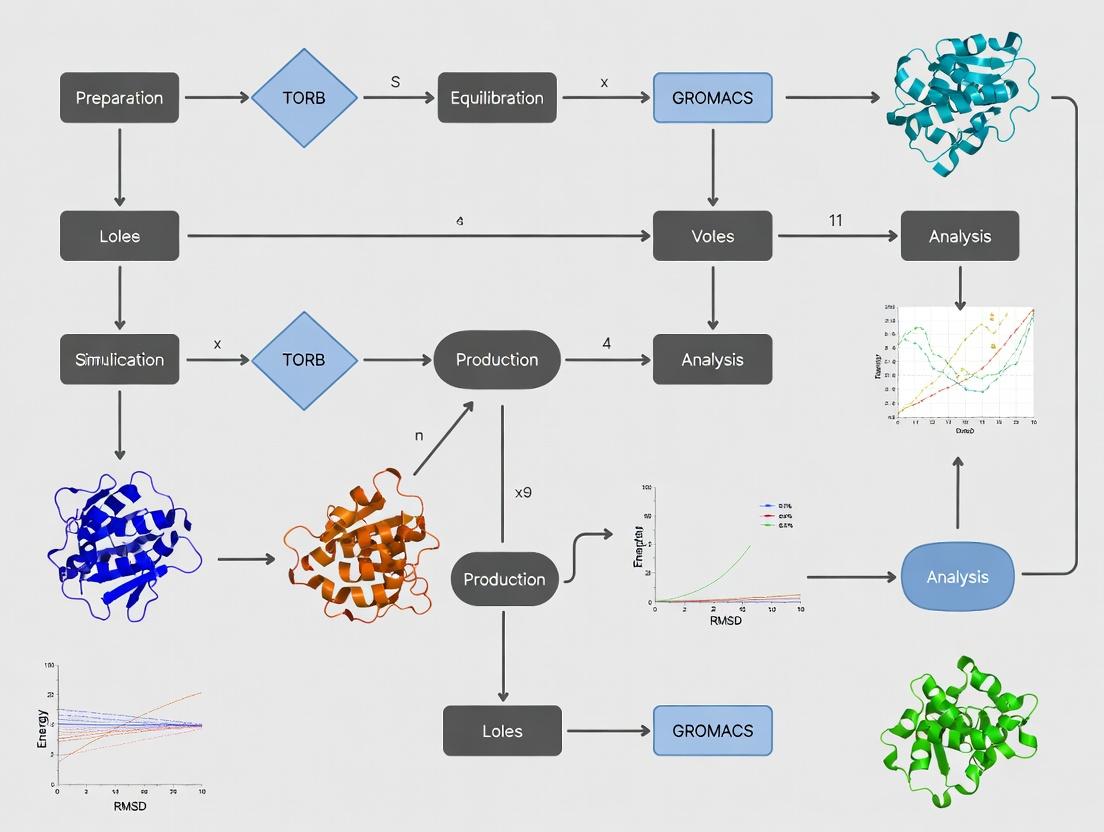
This article provides a comprehensive, step-by-step guide to performing rigorous molecular dynamics (MD) simulations of proteins using the GROMACS software.
From PDB to Trajectory: A Complete GROMACS Protein Simulation Protocol for Researchers & Drug Developers
Abstract
This article provides a comprehensive, step-by-step guide to performing rigorous molecular dynamics (MD) simulations of proteins using the GROMACS software. Tailored for researchers, scientists, and drug development professionals, the protocol covers essential foundations, a detailed methodological workflow, common troubleshooting and optimization strategies, and critical validation techniques. Readers will gain practical knowledge to simulate protein dynamics, assess stability, analyze interactions, and generate reliable data for structural biology and computational drug discovery applications.
Understanding the Core: Foundational Principles of GROMACS for Protein Systems
What is GROMACS? Overview and Relevance in Modern Computational Biology
GROMACS (GROningen MAchine for Chemical Simulations) is a highly versatile, open-source software package primarily designed for performing molecular dynamics (MD) simulations. It simulates the Newtonian equations of motion for systems ranging from several hundred to millions of particles, with a particular focus on biomolecular systems like proteins, lipids, and nucleic acids. Its exceptional speed, achieved through advanced algorithmic optimizations and efficient parallelization across CPUs and GPUs, has made it one of the most widely used MD engines in computational biology and chemistry. In the context of modern drug discovery and structural biology, GROMACS is indispensable for elucidating protein dynamics, understanding allosteric mechanisms, predicting ligand-binding poses, and calculating free energies—providing atomic-level insights that are often inaccessible to experimental techniques alone.
Key Performance Metrics and Applications
Table 1: Representative GROMACS Performance Benchmarks and Common Applications
| Metric / Area | Typical Range / Example | Relevance to Protein Research |
|---|---|---|
| System Size | 10,000 to 10+ million atoms | Enables simulation of large complexes (e.g., ribosomes, viral capsids) and membrane environments. |
| Simulation Timescale | Nanoseconds to microseconds (routine); milliseconds (with specialized hardware) | Allows observation of protein folding, domain motions, and ligand binding/unbinding events. |
| Performance | 100-1000 ns/day on a GPU node for a ~50,000 atom system | High throughput enables robust statistical sampling and parameter screening. |
| Key Applications | Protein folding & stability, Ligand-protein binding affinity (ΔG), Membrane protein dynamics, Allosteric communication pathways. | Directly informs rational drug design, understanding disease mutations, and engineering protein function. |
Protocol: Standard Protein-Ligand MD Simulation Workflow
This protocol outlines a standard workflow for setting up and running a simulation of a protein with a small-molecule ligand, a cornerstone experiment in structure-based drug design.
1. System Preparation & Topology Building
- Input: Protein PDB file (e.g., from crystallography), ligand 3D structure (e.g., SDF).
- Tools:
pdb2gmx,ligand parametrization tools(e.g., CGenFF, ACPYPE). - Method:
a. Protein Preparation: Use
pdb2gmxto process the protein PDB file:gmx pdb2gmx -f protein.pdb -o processed.gro -water spce. This selects a force field (e.g., CHARMM36, AMBER99SB-ILDN), adds missing hydrogens, and generates the protein topology. b. Ligand Parametrization: Generate topology and parameters for the non-standard ligand using a force field-specific tool. For example, with the CHARMM General Force Field (CGenFF), use the CGenFF web server or program to obtain ligand topology (ligand.itp) and parameter files. c. Complex Assembly: Combine the processed protein coordinates and ligand coordinates into a single.grofile. Merge the protein topology and ligand topology (ligand.itp) into the main system topology file (topol.top).
2. Solvation and Ionization
- Tool:
gmx editconf,gmx solvate,gmx genion. - Method:
a. Define Box: Place the complex in a simulation box (e.g., cubic, dodecahedron) with
editconf:gmx editconf -f complex.gro -o boxed.gro -c -d 1.0 -bt cubic. b. Add Solvent: Fill the box with water molecules usingsolvate:gmx solvate -cp boxed.gro -cs spc216.gro -o solvated.gro -p topol.top. c. Neutralize Charge: Add ions (e.g., Na⁺, Cl⁻) to neutralize the system's net charge and achieve physiological concentration (e.g., 0.15 M NaCl) usinggenion:gmx genion -s solvated.gro -o neutralized.gro -p topol.top -pname NA -nname CL -neutral -conc 0.15.
3. Energy Minimization and Equilibration
- Tool:
gmx grompp,gmx mdrun. - Method:
a. Minimization: Create a run input file (
em.mdp) defining steepest descent/conjugate gradient steps. Rungromppto prepare binaries andmdrunto perform energy minimization, relieving steric clashes. b. NVT & NPT Equilibration: Perform two short MD runs (50-100 ps each). First, under constant Number of particles, Volume, and Temperature (NVT ensemble,nvt.mdp) to stabilize temperature. Second, under constant Number of particles, Pressure, and Temperature (NPT ensemble,npt.mdp) to stabilize density/pressure of the system.
4. Production MD and Analysis
- Tool:
gmx mdrun, analysis tools (gmx rms,gmx hbond,gmx energy, etc.). - Method:
a. Production Run: Execute a long, unbiased simulation (e.g., 100 ns - 1 µs) using an
mdpfile with desired parameters. Run withmdrun, optimally using MPI/GPU acceleration. b. Trajectory Analysis: Analyze the output trajectory (.xtc/.trr) to compute properties like: * Root-mean-square deviation (RMSD) of protein/ligand. * Root-mean-square fluctuation (RMSF) of residues. * Protein-ligand hydrogen bonds and contact frequencies. * Binding free energy estimates (e.g., via MMPBSA/MMGBSA or alchemical methods).
Visualization: GROMACS Simulation Workflow
Diagram Title: Standard GROMACS Simulation Protocol for Protein-Ligand Systems
The Scientist's Toolkit: Essential Research Reagents & Materials
Table 2: Key Computational "Reagents" for GROMACS Protein Simulations
| Item / Solution | Function & Purpose | Example / Note |
|---|---|---|
| Molecular Force Field | Defines potential energy functions and parameters (masses, charges, bond strengths) for all atoms in the system. | CHARMM36, AMBER99SB-ILDN, OPLS-AA. Choice is critical for accuracy. |
| Solvation Model | Represents the aqueous environment surrounding the biomolecule. | Explicit water (e.g., SPC/E, TIP3P, TIP4P) or implicit solvent models for faster sampling. |
| Ion Parameters | Models physiological salt concentrations and neutralizes system charge. | Parameters for Na⁺, K⁺, Ca²⁺, Cl⁻ compatible with the chosen force field. |
| Ligand Topology & Parameters | Provides the force field description for non-standard small molecule inhibitors/drugs. | Generated via CGenFF (CHARMM), ACPYPE (AMBER), or PRODRG (GROMOS). |
| Simulation Box | Defines the periodic boundary conditions to avoid edge effects. | Common shapes: cubic, dodecahedral. Size must allow for solvent shell. |
| Neutralizing Ions | Added via ion exchange to achieve zero net charge before simulation. | Typically Na⁺ or Cl⁻ ions replace solvent molecules. |
| Computational Hardware | Provides the processing power to integrate equations of motion. | High-performance CPU clusters and GPUs (NVIDIA) dramatically accelerate calculations. |
Application Notes and Protocols for GROMACS Protein Simulations
This document details core concepts and protocols essential for executing and analyzing molecular dynamics (MD) simulations of protein systems within the GROMACS framework, a cornerstone of modern computational biophysics and drug discovery.
Force Fields: Parameterization for Biological Macromolecules
Force fields are mathematical models that calculate the potential energy of a system of particles. They are defined by functional forms and parameter sets describing bonded and non-bonded interactions.
Key Force Fields for Protein Simulation in GROMACS:
| Force Field | Primary Developer/Origin | Strengths | Common Use in Protein Research | Latest Common Version (2024) |
|---|---|---|---|---|
| CHARMM | Karplus et al., Harvard | Excellent for proteins, lipids, carbohydrates; includes polarizable variants. | Membrane proteins, complex biomolecular assemblies. | CHARMM36m (2021 update) |
| AMBER | Case et al., UCSP | Accurate for proteins & nucleic acids; widely used in drug design. | Protein-ligand binding, folding studies, nucleic acids. | FF19SB/OL4 (protein/RNA) |
| OPLS | Jorgensen et al., Yale | Optimized for liquid properties & protein-ligand interactions. | Ligand binding free energies, protein solvation. | OPLS-AA/M (2019) |
| GROMOS | SPC water model | Unified atom; computationally efficient. | Fast sampling, folding of small proteins. | 54A7 (2016) |
| Martini | Marrink et al., Groningen | Coarse-grained; enables longer timescales. | Large-scale membrane remodeling, protein aggregation. | Martini 3 (2021) |
Protocol 1.1: Selecting and Implementing a Force Field in GROMACS
- System Preparation: Obtain your protein's initial structure from PDB. Use
pdb2gmxto generate topology.
- Force Field Specification: The
-ffflag selects the force field. Ensure all system components (e.g., ligands, ions) have compatible parameters. - Ligand Parametrization: For non-standard residues, use external tools (e.g., CGenFF, ACPYPE for CHARMM/AMBER) to generate topology and coordinate files, then incorporate via
includestatements or manually.
Workflow for Force Field Implementation in GROMACS
Periodic Boundary Conditions (PBC)
PBC simulates an infinite system by replicating the simulation box in all spatial dimensions. Particles leaving the box re-enter from the opposite side, conserving particle number and density.
Protocol 2.1: Implementing and Managing PBC in a Protein Simulation
- Box Creation: After solvation, define the simulation box. For a globular protein, use a cubic or dodecahedral box.
Neutralization & Ion Addition: Add ions to neutralize the system's charge and achieve physiological concentration (e.g., 0.15 M NaCl).
Post-Processing Trajectory Correction: During analysis, remove periodicity artifacts by centering the protein and applying
-pbc molor-pbc whole.
Statistical Ensembles: NVT and NPT
Ensembles define the macroscopic thermodynamic state of the system. Constant Number of particles, Volume, and Temperature (NVT) and constant Number, Pressure, and Temperature (NPT) are standards for equilibration and production.
Common Thermostats and Barostats in GROMACS:
| Ensemble | GROMACS Thermostat | Key Parameter | GROMACS Barostat | Key Parameter |
|---|---|---|---|---|
| NVT | V-rescale (modified Berendsen) | tau_t (coupling time constant, ~0.1-1 ps) |
N/A | N/A |
| NPT | Nose-Hoover | tau_t (~1-2 ps) |
Parrinello-Rahman | tau_p (~5-10 ps), compressibility |
Protocol 3.1: System Equilibration in NVT and NPT Ensembles
- Energy Minimization: Remove steric clashes using steepest descent.
- NVT Equilibration (100-200 ps): Gently heat the system to target temperature (e.g., 310 K) while restraining protein heavy atoms.
- NPT Equilibration (200-500 ps): Release restraints and couple the system to a pressure bath (1 bar).
- Production MD: Run extended simulation (ns-µs) in NPT ensemble with no restraints.
GROMACS Simulation Workflow: Equilibration to Production
The Scientist's Toolkit: Key Research Reagent Solutions
| Reagent/Material | Function in Simulation Protocol | GROMACS Command/Tool Equivalent |
|---|---|---|
| Force Field Parameter Set | Defines atom types, bonds, angles, dihedrals, and non-bonded interactions. | charmm36-mar2019.ff/, amber99sb-ildn.ff/ |
| Water Model | Solvates the protein, providing dielectric environment & explicit solvent interactions. | spc216.gro (SPC/E), tip4p2005.gro |
| Ion Database | Neutralizes system charge and mimics physiological ionic strength. | ions.itp, genion |
| Position Restraint File | Holds protein coordinates during initial equilibration phases. | posre.itp (generated by pdb2gmx) |
| Simulation Input (MDP) File | Contains all control parameters for MD steps (integrator, ensembles, output). | nvt.mdp, npt.mdp, md.mdp |
| Topology (TOP) File | Describes the molecular system composition and connectivity. | topol.top |
| Run Input (TPR) File | Portable binary file containing all data needed for the simulation run. | md_0_1.tpr (generated by grompp) |
| Trajectory (XTC/TRR) File | Contains atomic coordinates/velocities over time; primary output for analysis. | traj_comp.xtc, md.trr |
Within the broader thesis on developing a robust, standardized GROMACS protocol for protein research, this document details the complete simulation pipeline. This pipeline serves as the foundational framework for generating reproducible, high-quality molecular dynamics (MD) data, crucial for applications in structural biology, biophysics, and computer-aided drug design.
The core protein simulation pipeline in GROMACS can be conceptualized as a sequential, cyclical process with distinct phases.
Diagram Title: Protein Simulation Workflow Cycle
Application Notes & Detailed Protocols
Phase 1: System Preparation (Input)
Application Note: This phase transforms an initial protein structure into a solvated, neutralized, and physically realistic simulation system. The choice of force field and water model is critical and must be documented precisely.
Protocol 1.1: Building a Solvated Protein System
- Input Structure Preparation: Obtain a PDB file (e.g.,
protein.pdb). Usepdb2gmxto generate topology using a selected force field (e.g., CHARMM36m) and water model (e.g., TIP3P).
Define Simulation Box: Place the protein in a cubic (or dodecahedral) box with a minimum 1.0 nm distance between the protein and box edge using
editconf.Solvation: Fill the box with water molecules using
solvate.Neutralization: Add ions to neutralize the system charge and achieve a desired physiological concentration (e.g., 0.15 M NaCl) using
genion.
Table 1: Common Force Field and Water Model Combinations
| Force Field | Water Model | Best Suited For | Typical Citation |
|---|---|---|---|
| CHARMM36m | TIP3P | Membrane proteins, IDPs | Huang et al. (2017) |
| AMBER ff19SB | OPC / TIP4P-Ew | Soluble proteins, accuracy | Tian et al. (2020) |
| GROMOS 54A7 | SPC | Biomolecular condensates, efficiency | Schmid et al. (2011) |
Phase 2: Energy Minimization and Equilibration
Application Note: This phase relaxes steric clashes and gradually introduces thermodynamic constraints (temperature, pressure) to prepare for production MD without system instability.
Protocol 2.1: Stepped Equilibration
- Energy Minimization: Run steepest descent minimization (5000 steps) to remove bad contacts.
- NVT Equilibration: Equilibrate at constant Number of particles, Volume, and Temperature (300 K) for 100 ps, using a velocity-rescaling thermostat. Restrain protein heavy atoms.
- NPT Equilibration: Equilibrate at constant Number of particles, Pressure (1 bar), and Temperature (300 K) for 100-200 ps, using a Parrinello-Rahman barostat. Restrain protein heavy atoms.
Table 2: Typical Equilibration Parameters
| Step | Ensemble | Thermostat | Barostat | Time (ps) | Position Restraints |
|---|---|---|---|---|---|
| Minimization | - | - | - | - | None |
| Equil. Phase I | NVT | v-rescale | - | 100 | Protein heavy atoms (1000 kJ/mol/nm²) |
| Equil. Phase II | NPT | v-rescale | Parrinello-Rahman | 100-200 | Protein heavy atoms (1000 -> 0 kJ/mol/nm²) |
Phase 3: Production MD and Analysis
Application Note: This is the data-generation phase. Simulation length must be justified by the biological process under study. Concurrent analysis during the run is recommended to monitor stability.
Protocol 3.1: Launching and Monitoring a Production Run
- Production MD: Run an unrestrained simulation for the desired duration (e.g., 100 ns - 1 µs).
- Stability Checks: During/after the run, calculate Root Mean Square Deviation (RMSD) and Radius of Gyration (Rg) to confirm structural stability.
Table 3: Key Analysis Metrics and Their Interpretation
| Metric | Tool (GROMACS) | What it Indicates | Acceptable Trend |
|---|---|---|---|
| RMSD (Backbone) | gmx rms |
Structural convergence & stability | Plateaus after equilibration |
| Radius of Gyration | gmx gyrate |
Protein compactness | Stable for folded proteins |
| RMSF | gmx rmsf |
Per-residue flexibility | Correlates with secondary structure |
| Secondary Structure | gmx do_dssp |
Structural element persistence | Consistent with experimental data |
The Scientist's Toolkit: Research Reagent Solutions
Table 4: Essential Software and Data Resources for Protein MD
| Item | Function / Purpose | Example / Source |
|---|---|---|
| GROMACS | Core MD engine for simulation execution. | https://www.gromacs.org |
| Force Field | Mathematical potential functions defining interatomic forces. | CHARMM36m, AMBER ff19SB |
| Visualization Software | For visual inspection of trajectories and structures. | VMD, PyMOL, UCSF ChimeraX |
| Protein Data Bank (PDB) | Primary repository for initial 3D structural input. | https://www.rcsb.org |
| Molecular Topology | Defines atom types, bonds, and parameters for the system. | Generated by pdb2gmx from force field. |
| Trajectory Analysis Suite | For calculating quantitative metrics from simulation data. | Built-in GROMACS tools, MDAnalysis, MDTraj |
| High-Performance Computing (HPC) | Cluster/GPU resources required for production-scale MD. | Local clusters, cloud (AWS, Azure), national grids |
Within the broader thesis on establishing a robust GROMACS molecular dynamics (MD) simulation protocol for protein research and drug development, the computational environment is foundational. This document details the essential hardware and software prerequisites, providing application notes and protocols for researchers and scientists to construct a reliable simulation workstation or cluster node.
Hardware Prerequisites
Performance in MD simulations scales directly with hardware capability. The primary computational loads are bonded and non-bonded force calculations, which are highly parallelizable across CPU cores and, increasingly, GPUs.
Quantitative Hardware Specifications
The following table summarizes minimum, recommended, and high-performance configurations for running GROMACS simulations of typical protein systems (20k-100k atoms).
Table 1: Hardware Configuration Tiers for Protein MD Simulations
| Component | Minimum Specification | Recommended Specification | High-Performance Specification |
|---|---|---|---|
| CPU | x86-64, 4 physical cores (e.g., Intel Core i5/i7, AMD Ryzen 5) | Modern x86-64, 8+ physical cores with AVX2/AVX-512 (e.g., Intel Xeon Scalable, AMD Ryzen 9/Threadripper, EPYC) | Dual-socket server CPU, 32+ cores per socket, high memory bandwidth, AVX-512 |
| GPU | Integrated graphics (CPU-only runs) | NVIDIA GPU with Compute Capability ≥ 5.2 (Pascal+), 8+ GB VRAM (e.g., RTX 3070, A2000) | NVIDIA A100/H100, or multiple RTX 4090/RTX 6000 Ada GPUs |
| System Memory (RAM) | 16 GB | 32 - 64 GB (≥ 1 GB per 10,000 atoms) | 128 GB - 1 TB+ (for large membrane systems or ensemble runs) |
| Storage | 500 GB SSD | 1 TB NVMe SSD (High I/O for checkpointing/trajectories) | 2+ TB NVMe SSD (RAID 0 for performance) |
| Network | Gigabit Ethernet | 10 Gigabit Ethernet or InfiniBand (for multi-node clusters) |
Hardware Selection Protocol
Protocol 1.1: Benchmarking Hardware for GROMACS Performance
- Objective: Quantify the performance of a candidate CPU/GPU combination using a standard benchmark system.
- Reagents/Materials: Pre-built GROMACS binary,
ion_channelbenchmark suite (available from the GROMACS website). - Methodology:
a. Install the GROMACS binary on the test system (see Software Protocol 2.1).
b. Download the benchmark TPR file (
benchMEM.tprfor membrane proteins, orbenchPEP.tprfor soluble proteins). c. Execute the benchmark:gmx mdrun -s benchMEM.tpr -nsteps 10000 -resetstep 5000 -noconfout. d. Record thens/day(nanoseconds simulated per day) value from the terminal output. e. Compare thens/dayresult against published benchmarks on the GROMACS performance webpage for cost-performance analysis. - Expected Outcome: A clear metric (
ns/day) to guide hardware procurement decisions and predict simulation throughput.
Software Prerequisites
A stable, performant, and reproducible software stack is critical.
Core Software Stack
Table 2: Essential Software Stack for GROMACS Protein Simulations
| Software | Version (Minimum) | Recommended Version | Purpose/Function |
|---|---|---|---|
| Operating System | Linux Kernel 4.18+ | Latest LTS (Ubuntu 22.04/24.04, Rocky Linux 9, RHEL 9) | Provides stability, security, and optimized libraries. Windows WSL2 is acceptable for development. |
| Compiler | GCC 8.0, LLVM/Clang 6.0 | GCC 11+, Intel oneAPI DPC++/C++ Compiler | Compiles GROMACS from source for optimized binaries. |
| MPI Library | OpenMPI 4.0, MPICH 3.3 | Latest stable (for multi-node parallelization) | Enables parallel execution across multiple CPUs/nodes. |
| GROMACS | 2021.5 | Latest stable release (e.g., 2024.x) | Core MD simulation engine. |
| CUDA Toolkit | 11.0 (for NVIDIA GPU) | 12.x (matches GPU driver) | Enables GPU acceleration for NVIDIA hardware. |
| FFTW | 3.3.8 | 3.3.10 | Library for Fast Fourier Transforms (required for PME). |
Software Installation Protocol
Protocol 2.1: Building GROMACS from Source with GPU Support
- Objective: Install a high-performance GROMACS binary optimized for the local hardware.
- Reagents/Materials: Base OS installation, internet connection, sudo privileges.
- Methodology:
a. Install Dependencies:
- Validation: Run
gmx --versionandgmx mdrun --device-statusto confirm installation and GPU detection.
Visualization: Computational Workflow & System Architecture
Diagram 1: MD Simulation Setup & Execution Workflow
The Scientist's Toolkit: Research Reagent Solutions
Table 3: Key Software & Data "Reagents" for Protein MD Setup
| Item | Function/Explanation |
|---|---|
| CHARMM36/AMBER ff19SB Force Field | Parameter sets defining bond, angle, dihedral, and non-bonded interactions for proteins, lipids, and nucleic acids. The "reagent" that encodes molecular physics. |
| TIP3P/TIP4P Water Model | Explicit solvent model parameters defining water molecule behavior in the simulation box. |
| PDB File (e.g., 1AKI) | Initial 3D atomic coordinates of the protein system obtained from the Protein Data Bank. The starting structural "reagent." |
| MDAnalysis/VMD | Analysis and visualization software "reagents" for processing trajectory data and generating insights. |
| Phenol, DMSO, or Water Topology | Pre-defined topology and parameter files for common solvent and ligand molecules, essential for simulating realistic conditions. |
Within the broader thesis establishing a robust, reproducible GROMACS molecular dynamics (MD) simulation protocol for protein research, the initial step of sourcing and preparing a protein structure is the most critical determinant of success. The choice of starting structure, its resolution, completeness, and the subsequent preprocessing steps directly influence the stability, biological relevance, and interpretability of multi-nanosecond simulation trajectories. This protocol details best practices for querying the Protein Data Bank (PDB), selecting optimal entries, and performing essential pre-MD preparations.
The PDB Search and Selection Protocol
A systematic approach to PDB entry selection mitigates the risk of propagating experimental artifacts into simulations.
Protocol 2.1: Structured PDB Query and Prioritization
- Identify Target: Define the protein of interest (UniProt ID, gene name) and its required state (e.g., human EGFR kinase domain in DFG-in conformation, bound to inhibitor erlotinib).
- Advanced Search: Use the RCSB PDB's advanced search interface (https://www.rcsb.org/search/advanced) to construct a precise query.
- Combine "Protein Name" (e.g., "Epidermal growth factor receptor") with "Organism" (e.g., "Homo sapiens").
- Filter by "Experimental Method": Prioritize entries solved by X-ray diffraction (resolution ≤ 2.0 Å preferred) or Cryo-EM (resolution ≤ 3.0 Å preferred). NMR structures require specialized handling.
- Filter by "Resolution" (numerical, lower is better).
- If relevant, use "Ligand Name" or "Has Polymer" to find specific complexes.
- Entry Prioritization: Download a candidate list and prioritize using the criteria in Table 1.
Table 1: Quantitative Criteria for PDB Entry Selection
| Criterion | Optimal Value/Range | Acceptable Compromise | Risk if Suboptimal |
|---|---|---|---|
| Resolution (X-ray) | ≤ 2.0 Å | 2.0 - 2.5 Å | Poor sidechain placement, unstable dynamics. |
| R-Value Free | < 0.25 | < 0.30 | Potential overfitting of atomic model to data. |
| R-Value Work | < 0.20 | < 0.25 | Model quality indicator. |
| Completeness | > 95% (for region of interest) | > 90% | Missing loops require modeling, introducing uncertainty. |
| Mutations | Wild-type sequence | Clinically relevant variant | Non-natural mutations may alter dynamics. |
| Ligand Presence | As required by hypothesis | Similar ligand or apo-form | Incorrect binding pocket state. |
Protocol 2.2: Pre-Download Structure Assessment
- Visual Inspection: Use the integrated 3D viewer (e.g., Mol*) on the PDB entry page to visually check for:
- Major gaps in the protein backbone within your region of interest.
- Correct ligand placement (electron density map, if available: 2mFo-DFc).
- Unphysical clashes or improbable rotamers.
- Validation Report: Access the "Validation" tab for the entry. Scrutinize:
- Ramachandran plot: >98% residues in favored/allowed regions.
- Clashscore: Percentile score > 10th percentile.
- Sidechain outliers: Minimize number.
Preprocessing Protocol for GROMACS
Once an optimal PDB file (protein.pdb) is downloaded, it must be processed into a simulation-ready system.
Protocol 3.1: Initial Cleaning and Structure Preparation
- Objective: Remove non-essential components, add missing atoms/residues, optimize hydrogen bonding.
- Tools: UCSF ChimeraX, PyMOL, or Swiss-PDB Viewer.
- Steps:
- Remove crystallographic water molecules (except any structurally critical waters).
- Remove non-relevant ions and buffer molecules.
- For asymmetric units with multiple chains, select only the biological assembly (available on the PDB "Structure" tab).
- Add missing heavy atoms to residues (e.g., alternate sidechain conformations) using the Dunbrack rotamer library.
- Add missing loops using homology modeling tools (e.g., MODELLER) if gaps are in functionally important regions. Document all modeled regions.
- Protonate the structure at physiological pH (7.4) using
pdb2gmxor H++ server, ensuring proper assignment of His, Asp, Glu, Lys, and Cys states.
Protocol 3.2: Generation of Topology and Initial System
- Objective: Create GROMACS-compatible topology and position restraint files.
- Tool: GROMACS
pdb2gmx. - Command Example & Logic:
- Outputs:
processed.gro(coordinates),topol.top(system topology),posre.itp(position restraint file for equilibration).
Workflow Diagram
Diagram Title: From PDB to Simulation-Ready System in GROMACS
The Scientist's Toolkit: Essential Research Reagents & Materials
Table 2: Key Digital Tools and Resources for Structure Sourcing and Prep
| Item / Resource | Category | Primary Function |
|---|---|---|
| RCSB PDB Database | Database | Primary repository for experimentally determined 3D structures of proteins and nucleic acids. |
| PDB Validation Report | Quality Metric | Provides standardized metrics (Ramachandran, clashscore) to assess structural reliability. |
| UCSF ChimeraX / PyMOL | Visualization & Editing Software | For 3D visualization, cleaning PDB files, removing ligands, and analyzing electron density. |
GROMACS (pdb2gmx) |
MD Simulation Suite | Converts a clean PDB file into a force-field specific topology, adding hydrogens and generating restraints. |
| CHARMM36 / AMBER ff19SB | Molecular Force Field | Parameter sets defining energy terms for bonded and non-bonded interactions in the simulation. |
| H++ Server / PROPKA | Computational Tool | Predicts pKa values of ionizable residues to determine protonation states at a given pH. |
| MODELLER | Homology Modeling | Used to add missing loops or domains not resolved in the experimental structure. |
Hands-On Tutorial: A Step-by-Step GROMACS Protein Simulation Workflow
Application Notes
In the context of a molecular dynamics (MD) simulation protocol for protein research using GROMACS, system building is the critical first step following protein preparation. This phase transforms a solitary protein structure into a solvated, electroneutral, and physiologically relevant system ready for energy minimization and simulation. The primary objectives are to: 1) embed the protein in a solvent environment mimicking experimental conditions (typically water), 2) define periodic boundary conditions to simulate a bulk system, and 3) add ions to both neutralize the system's net charge and achieve a desired salt concentration. The accuracy of this setup directly influences the stability and biological relevance of subsequent simulation steps.
Solvent Box Selection: The choice of solvent box (e.g., cubic, dodecahedral, octahedral) impacts computational efficiency and the avoidance of artificial periodicity artifacts. Dodecahedral boxes often provide the best compromise, minimizing solvent count while maintaining a sufficient distance between periodic images of the protein.
Neutralization and Ion Concentration: Proteins carry a net charge at most pH levels. Adding counterions (e.g., Na⁺ for negatively charged proteins, Cl⁻ for positively charged ones) is essential to avoid unrealistic electrostatic forces in periodic systems. Further ions are added to match experimental salt concentrations (e.g., 150 mM NaCl).
Key Quantitative Parameters:
| Parameter | Typical Value/Range | Purpose & Consideration |
|---|---|---|
| Box Type | Cubic, Dodecahedral, Octahedral | Dodecahedral is most water-efficient; cubic is simplest. |
| Box Edge Distance | 1.0 - 1.5 nm | Minimum distance from protein to box edge. Prevents periodic image interactions. |
| Solvent Model | SPC/E, TIP3P, TIP4P | Water model choice affects density, diffusion, and protein dynamics. |
| Neutralizing Ions | Na⁺, Cl⁻ | Added to achieve zero net system charge. |
| Salt Concentration | 0.15 M (150 mM) NaCl | Mimics physiological ionic strength. |
| Ion Force Field | e.g., CHARMM, AMBER, OPLS | Must be compatible with the protein and water force field. |
Experimental Protocols
Protocol 1: Defining the Solvent Box and Solvation
- Input Preparation: Ensure your protein structure (
protein.pdb) is pre-processed (cleaned, protonated at target pH usingpdb2gmxor similar). Define Box: Use
gmx editconfto place the protein in the center of a chosen box type.-c: Centers the protein in the box.-d 1.2: Sets a 1.2 nm distance between the protein and box edge.-bt: Defines box type (dodecahedron,cubic,octahedron).
Solvate the System: Use
gmx solvateto fill the box with water molecules.-cp: Input protein coordinate file.-cs: Solvent configuration (standard SPC water boxspc216.gro).-p: Topology file; updated with added solvent count.
Protocol 2: Adding Ions for Neutralization and Concentration
Generate Topology and Position Restraint File: Prepare for ion addition.
-f ions.mdp: A parameter file defining a short energy minimization for setup (can be minimal settings).
Calculate Ion Addition: Use
gmx genionto add ions.-s: Input run file.-pname/-nname: Names for positive and negative ions (must match force field).-neutral: Adds ions to neutralize the system's net charge.-conc 0.15: Adds additional salt to reach 0.15 mol/L concentration (specified in the topology).
Mandatory Visualization
Diagram 1 Title: GROMACS Solvation and Ionization Workflow
The Scientist's Toolkit
| Research Reagent / Software | Function in System Building |
|---|---|
GROMACS (gmx editconf) |
Defines the periodic boundary box geometry and centers the solute. |
GROMACS (gmx solvate) |
Fills the periodic box with solvent molecules (typically water). |
GROMACS (gmx grompp) |
Assembles the molecular topology, coordinates, and simulation parameters into a portable binary (.tpr) input file. |
GROMACS (gmx genion) |
Replaces solvent molecules with ions to neutralize system charge and achieve target salt concentration. |
Water Model (e.g., spc216.gro) |
A file containing coordinates of pre-equilibrated water molecules used as a solvent source. |
| Ion Parameters (in Force Field) | Defines the atomic mass, charge, and Lennard-Jones parameters for ions (Na⁺, Cl⁻, etc.). |
Topology File (topol.top) |
The master system definition file, updated at each step with atom counts for solvent and ions. |
Parameter File (ions.mdp) |
A minimal set of MD parameters processed by gmx grompp to generate input for genion. |
Within the comprehensive GROMACS molecular dynamics (MD) simulation protocol for protein research, energy minimization (EM) is a critical preparatory step following system construction and solvation. Its primary function is to remove steric clashes and unfavorable atomic contacts introduced during the prior setup stages, such as hydrogen addition, solvation, and ion placement. This step relieves internal stresses by adjusting atomic coordinates to find a local energy minimum on the potential energy surface, ensuring the system adheres to the physical laws described by the chosen force field. Performing EM is essential to prevent simulation instability, unrealistic forces, and potential crashes during subsequent equilibration phases.
Theoretical Foundation
Energy minimization algorithms iteratively adjust atomic coordinates to reduce the total potential energy of the system, described by the force field equation: U_total = U_bonded + U_non-bonded. Steric clashes result in extremely high values of the non-bonded van der Waals repulsion term (U_VDW). Minimization algorithms navigate the energy landscape to find a local minimum where the net force on each atom is zero.
Key Algorithms & Quantitative Performance
Two primary algorithms are used within GROMACS for energy minimization, each with distinct performance characteristics.
Table 1: Comparison of GROMACS Energy Minimization Algorithms
| Algorithm | Primary Use Case | Key Parameters | Typical Iterations for a Solvated Protein System | Relative Computational Cost |
|---|---|---|---|---|
| Steepest Descent | Robust removal of severe clashes (initial minimization) | emtol (force tolerance), emstep (max step size) |
500 - 5000 | Low |
| Conjugate Gradient | Fine minimization near the energy minimum (later stages) | emtol (force tolerance) |
100 - 1000 | Moderate |
Detailed Protocol: Energy Minimization in GROMACS
Materials & Reagent Solutions
Table 2: Research Reagent Solutions for Energy Minimization Setup
| Item | Function in Protocol |
|---|---|
| Solvated & Ionized Protein System (.gro) | The initial structural file containing potential steric clashes from prior setup steps. |
| Topology File (.top) | Contains all force field parameters, molecular definitions, and interaction lists. |
| Run Input File (.mdp) | Plain-text file specifying minimization parameters (algorithm, tolerance, steps). |
| GROMACS Simulation Software (e.g., 2024.x) | Executes the minimization using the provided files and parameters. |
| High-Performance Computing (HPC) Cluster | Provides the computational resources for minimization of large systems. |
Step-by-Step Methodology
Step 1: Preparation of the Minimization Parameter (.mdp) File
Create a file (e.g., minim.mdp) with the following content:
Step 2: Generation of the Binary Run Input File
Use the gmx grompp command to process parameters, topology, and coordinates:
This step checks for consistency and produces a portable binary file (em.tpr) containing all simulation data.
Step 3: Execution of Energy Minimization
Run the minimization using gmx mdrun:
The -deffnm flag sets the default filenames for output (em.gro, em.edr, em.log).
Step 4: Analysis of Results
- Check Completion: Examine the log file (
em.log) for the line "Steepest Descent converged to Fmax < ...". This confirms success. - Verify Energy Decrease: Plot the potential energy from the energy file (
em.edr):
- Evaluate Forces: Ensure the maximum force reported at convergence is below the target
emtol.
Workflow Diagram
Title: GROMACS Energy Minimization Workflow
Troubleshooting & Optimization
- Non-Convergence: If minimization does not converge within
nsteps, increasenstepsor use a two-step protocol: first Steepest Descent with a conservativeemstep(0.01) to remove severe clashes, followed by Conjugate Gradient for finer minimization. - Abnormal Energy Spike: Indicates a persistent severe clash. Verify initial structure, box size, and solvent placement. Ensure the
emstepis not too large. - Performance: For very large systems, consider using double precision (
-double) on the HPC cluster if single precision fails.
Energy minimization is a non-negotiable step in the MD protocol, ensuring the structural integrity of the initial model. A successfully minimized system, free of extreme steric clashes, provides a stable foundation for the subsequent steps of equilibration and production MD, which explore the protein's dynamics under near-physiological conditions. This step directly impacts the physical realism and numerical stability of the entire simulation campaign.
Application Notes
Equilibration is a crucial preparatory phase in Molecular Dynamics (MD) simulations where the system is gently guided from its initial, often non-physical, coordinates toward a stable, realistic ensemble that mimics experimental conditions. This step applies position restraints on the protein's heavy atoms while allowing the solvent and ions to relax around it. The process is conducted in two canonical ensembles: the NVT (constant Number of particles, Volume, and Temperature) ensemble, followed by the NPT (constant Number of particles, Pressure, and Temperature) ensemble. NVT equilibration stabilizes the system's temperature, while NPT equilibration adjusts the system's density and volume to the target pressure, typically 1 bar. Skipping or inadequately performing equilibration leads to unstable dynamics, unrealistic structural artifacts, and non-convergent results in subsequent production runs.
Quantitative Equilibration Parameters Table
| Parameter | NVT Phase (Thermostatting) | NPT Phase (Barostatting) | Rationale |
|---|---|---|---|
| Duration | 50-100 ps | 100-200 ps | Allows sufficient time for temperature/pressure coupling without excessive computational cost. |
| Time Step | 2 fs | 2 fs | Standard for all-atom force fields with bonds constrained to hydrogen atoms. |
| Temperature Coupling | V-rescale (Berendsen) | Nose-Hoover | V-rescale is robust for initial heating. Nose-Hoover provides correct canonical ensemble for production. |
| Reference Temperature | 300 K (or system-specific) | 300 K (or system-specific) | Standard physiological temperature. |
| Coupling Constant (τ_T) | 0.1 ps | 1.0 ps | Tight coupling for initial heating, looser for stable production. |
| Pressure Coupling | Not Applied | Parrinello-Rahman | Parrinello-Rahman is efficient for isotropic pressure coupling. |
| Reference Pressure | N/A | 1.0 bar | Standard atmospheric pressure. |
| Coupling Constant (τ_P) | N/A | 5.0 ps | Allows gradual, stable box size fluctuations. |
| Compressibility | N/A | 4.5e-5 bar⁻¹ | Isotropic compressibility of water. |
| Position Restraints | Applied on protein heavy atoms (force constant: 1000 kJ/mol/nm²) | Applied on protein heavy atoms (force constant: 1000 kJ/mol/nm²) | Prevents large structural drift while solvent equilibrates. |
Experimental Protocols
Protocol 1: NVT (Isothermal) Equilibration
- Input: The energy-minimized structure (em.gro) and topology.
- Parameter File (NVT .mdp):
- Define
integrator = md - Set
nsteps = 25000(for 50 ps with 2 fs timestep). - Set
dt = 0.002 - Configure temperature coupling:
tcoupl = v-rescalewithtau_t = 0.1andref_t = 300. - Set
pcoupl = no. - Define position restraints:
define = -DPOSRES.
- Define
- Execution:
- Validation: Monitor
nvt.logand plotnvt.edrusinggmx energyto confirm temperature has stabilized to the target value.
Protocol 2: NPT (Isobaric-Isothermal) Equilibration
- Input: The output of the NVT phase (
nvt.gro). - Parameter File (NPT .mdp):
- Use same
integrator,dt, andnsteps = 50000(for 100 ps). - Configure temperature coupling:
tcoupl = Nose-Hooverwithtau_t = 1.0andref_t = 300. - Configure pressure coupling:
pcoupl = Parrinello-Rahmanwithtau_p = 5.0,ref_p = 1.0, andcompressibility = 4.5e-5. - Maintain position restraints:
define = -DPOSRES.
- Use same
- Execution:
- Validation: Plot energy (
npt.edr) to confirm stable temperature, pressure, and density. Density should converge to ~1000 kg/m³ for aqueous systems.
Visualization
Diagram 1: GROMACS Equilibration Workflow
Diagram 2: System State Evolution During Equilibration
The Scientist's Toolkit: Essential Research Reagent Solutions for Equilibration
| Reagent/Material | Function in Equilibration Protocol |
|---|---|
| GROMACS Software Suite | The primary simulation engine used to execute the NVT and NPT parameter files and integrate equations of motion. |
| Protein Topology File (.top) | Contains all force field parameters, atom definitions, and position restraint directives (POSRES) for the protein. |
| NVT & NPT Parameter Files (.mdp) | Plain-text configuration files defining all simulation parameters for the equilibration steps (integrator, coupling, duration, etc.). |
| Position Restraint Definitions | Generated by pdb2gmx or manually, these files (posre.itp) apply harmonic restraints to protein heavy atoms, preventing unfolding. |
| Thermostat Algorithm (V-rescale, Nose-Hoover) | Computational methods that regulate system temperature by scaling velocities or extending the dynamical system. |
| Barostat Algorithm (Parrinello-Rahman) | Computational method that regulates system pressure by dynamically scaling the simulation box dimensions. |
| Visualization/Analysis Tools (VMD, PyMOL, Grace) | Used to visually inspect the equilibrating system and plot time-series data (temperature, pressure, density) to validate stability. |
| Checkpoint File (.cpt) | Binary file written during mdrun that contains the complete state of the simulation, allowing seamless continuation from the NVT to the NPT phase. |
Application Notes
This protocol details the execution of extended, production-phase molecular dynamics (MD) simulations within a comprehensive GROMACS workflow for protein research. After successful system equilibration, production MD generates the trajectory data used for thermodynamic and kinetic analysis. This phase prioritizes sampling and stability, with parameter choices directly impacting the statistical relevance of results for applications in structural biology, allostery, and drug discovery.
Key considerations include simulation length, integration timestep, and output frequency, which must balance computational cost with the biological timescales of the process under study (e.g., side-chain motion vs. large-scale conformational changes). The choice of ensemble (typically NPT) and barostat/thermostat algorithms is critical for maintaining physiological conditions.
Detailed Protocol
Pre-Production Check
- Objective: Verify equilibration completion.
Method:
Plot potential energy, temperature, density, and pressure from the equilibration trajectory (
equil.edr) using:Visually confirm that all properties have plateaued with minimal drift. Calculate root-mean-square deviation (RMSD) of the protein backbone to the minimized structure to ensure stability.
Production MD Execution
- Objective: Run an extended, unbiased simulation.
Method:
Prepare the TPR file from the final equilibrated structure and the production parameter file (
md.mdp):Launch the production simulation. For a single GPU node:
For very long simulations, implement a restart mechanism. If interrupted, restart using:
Parameter Choice Justification
- Objective: Define
md.mdpparameters for optimal sampling. - Method: Configure the following critical parameters in the
md.mdpfile, as justified in the table below.
Data Presentation: Production MD Parameter Table
| Parameter Group | Key Parameter | Typical Setting for Protein in Water | Rationale & Choice Guidance |
|---|---|---|---|
| Run Control | integrator |
md (leap-frog) |
Standard, efficient algorithm. md-vv may be used for exact NPT sampling. |
nsteps |
50,000,000+ | Defines length. 50M steps @ 2 fs = 100 ns. Choose based on desired biological event timescale. | |
dt |
0.002 (2 fs) | Standard with bonds to H constrained (LINCS). 4 fs may be used with hydrogen mass repartitioning. | |
| Output Control | nstxout |
0 | Do not write full precision .trr traj (large size). |
nstvout |
0 | Do not write velocities. | |
nstenergy |
5000 (10 ps) | Write energy to .edr frequently for monitoring. | |
nstlog |
5000 (10 ps) | Write to log file. | |
nstxout-compressed |
5000 (10 ps) | Write compressed (.xtc) trajectory. Balance storage vs. temporal resolution. | |
| Thermostat | tcoupl |
V-rescale (nose-hoover also valid) |
V-rescale is robust and efficient for production. |
tau_t |
0.5-1.0 ps | Coupling time constant. 1.0 ps is common for stable temperature control. | |
ref_t |
310 K (body temp) | Target physiological temperature. | |
| Barostat | pcoupl |
Parrinello-Rahman (or Berendsen for initial stability) |
Parrinello-Rahman gives a correct NPT ensemble. C-rescale is a modern alternative. |
pcoupltype |
isotropic (or semiisotropic for membranes) |
For a simple solvated protein system. | |
tau_p |
2.0-5.0 ps | Pressure relaxation time. 5.0 ps is a standard, stable choice. | |
ref_p |
1.0 bar | Atmospheric pressure. | |
compressibility |
4.5e-5 bar⁻¹ | For water. Use appropriate value for other solvents. | |
| Neighbor Search | cutoff-scheme |
Verlet |
Modern scheme, recommended. |
nstlist |
20 | Update neighbor list every 20 steps. With Verlet buffer, can be increased. | |
rcoulomb |
1.0-1.2 nm | Short-range electrostatics cutoff. 1.2 nm is common with PME. | |
rvdw |
1.0-1.2 nm | Short-range Van der Waals cutoff. Must be <= rcoulomb. |
|
| Electrostatics | coulombtype |
PME (Particle Mesh Ewald) |
Standard for handling long-range electrostatics in periodic systems. |
pme-order |
4 | Interpolation order. 4 offers good accuracy/speed balance. | |
fourierspacing |
0.12-0.16 | Grid spacing for FFT. 0.12 is more accurate, 0.16 is faster. | |
| Constraints | constraints |
h-bonds |
Constrains all bonds involving hydrogen, enabling 2 fs timestep. |
constraint-algorithm |
LINCS |
Standard, efficient algorithm. |
Mandatory Visualization
Diagram: Production MD Workflow and Data Flow
Title: GROMACS Production MD Execution and Output Workflow
Diagram: Parameter Selection Decision Logic
Title: Decision Logic for Key Production MD Simulation Parameters
The Scientist's Toolkit: Essential Research Reagents & Materials
| Item | Function/Description in Production MD |
|---|---|
| GROMACS Suite (v2024+) | Open-source MD simulation software used for all steps of production run execution, trajectory writing, and basic analysis. |
| High-Performance Computing (HPC) Cluster | Essential for running production simulations (typically >100 ns). Requires nodes with modern GPUs (NVIDIA V100/A100/H100) for optimal performance. |
| Molecular Topology/Force Field File (.top) | Contains all force field parameters for the protein, cofactors, water, and ions. Defines the physical model (e.g., CHARMM36, AMBER99SB-ILDN, OPLS-AA). |
| Production Parameter File (.mdp) | The master configuration file defining all parameters in the table above for the extended simulation. |
| Checkpoint File (.cpt) | Binary file from equilibration containing the complete state of the simulation (coordinates, velocities, box vectors, random seeds), ensuring continuity. |
| Portable Binary Run Input (.tpr) | Contains all information needed to run the simulation, generated by gmx grompp. The input for gmx mdrun. |
| Compressed Trajectory File (.xtc) | Lossily compressed trajectory file storing atomic coordinates over time. The primary data source for most analyses. Efficient for storage. |
| Energy File (.edr) | Contains all energy terms, temperature, pressure, density, etc., written at high frequency for simulation health monitoring. |
| Log File (.log) | Text file recording the step-by-step progress, performance metrics (ns/day), and any warnings from the production run. |
| Visualization Software (VMD/PyMOL) | Used to visually inspect the final structure and trajectories for qualitative assessment of stability and behavior. |
Quantitative Analysis of MD Trajectories
Molecular dynamics (MD) simulations generate vast amounts of trajectory data. The following key metrics are calculated to assess protein stability, flexibility, and intermolecular interactions over the simulation time course. The data below represents typical ranges observed for a well-folded, stable protein system (e.g., Lysozyme) in a 100 ns simulation.
| Metric | Full Name | Typical Range (Stable Protein) | Interpretation | Primary GROMACS Tool |
|---|---|---|---|---|
| RMSD | Root Mean Square Deviation | 0.1 - 0.3 nm (Backbone, after equilibration) | Measures structural drift from a reference (e.g., initial or crystal structure). Low, stable values indicate convergence. | gmx rms |
| RMSF | Root Mean Square Fluctuation | Loops: 0.15-0.5 nm; Helices/Strands: 0.05-0.15 nm (per residue) | Quantifies per-residue flexibility. Peaks indicate flexible or disordered regions. | gmx rmsf |
| Rg | Radius of Gyration | Varies by protein size (e.g., ~1.4 nm for Lysozyme) | Measures overall protein compactness. Stable or decreasing Rg suggests folding/stability. | gmx gyrate |
| H-Bonds | Hydrogen Bonds | 1-2 H-bonds per residue (intra-protein); Varies for ligand/complex | Counts specific donor-acceptor pairs within a cutoff distance and angle. Tracks interaction stability. | gmx hbond |
Table 2: Example Quantitative Output (Hypothetical 100 ns Simulation of T4 Lysozyme)
| Analysis | Average Value | Standard Deviation | Time to Plateau (ns) | Key Observation |
|---|---|---|---|---|
| Backbone RMSD (vs. t=0) | 0.22 nm | ±0.03 nm | ~20 | System equilibrated after 20 ns. |
| Rg | 1.42 nm | ±0.02 nm | ~15 | Compact structure maintained. |
| Total Intra-Protein H-Bonds | 165 | ±8 | - | Stable hydrogen bonding network. |
| Protein-Solvent H-Bonds | 320 | ±15 | - | Consistent solvation shell. |
Detailed Experimental Protocols
Protocol 2.1: RMSD, RMSF, and Radius of Gyration Analysis
Objective: To quantify the structural stability and residue-wise flexibility of the protein over the simulation trajectory.
Materials & Software:
- GROMACS (version 2023 or later)
- Processed MD trajectory file (
traj_comp.xtc) - Corresponding simulation system topology file (
topol.tpr) - Reference structure file (e.g.,
em.groor crystal structure) - Index file (
index.ndx) or ability to generate groups (e.g., "Backbone")
Procedure:
- Prepare the index group: Define the atom group for analysis (typically "Backbone" for RMSD/RMSF).
Calculate RMSD: Align each frame to the reference structure's backbone and compute deviation.
(Use
-nto select the "Backbone" group for fitting and calculation.)Calculate RMSF: Compute the average fluctuation of each residue (Cα atoms are typical).
(The
-resflag outputs per-residue averages.)Calculate Radius of Gyration: Determine the protein's overall compactness.
(Ensure the selected index group is the entire protein.)
Visualization: Plot the
.xvgfiles using tools likexmgrace,gnuplot, or Python (Matplotlib).
Protocol 2.2: Hydrogen Bond Analysis
Objective: To identify and quantify stable hydrogen bonds within the protein and between the protein and ligands/solvent.
Materials & Software: As in Protocol 2.1, with a clear definition of donor-acceptor groups.
Procedure:
- Define Hydrogen Bond Criteria: The default GROMACS criteria (and most commonly used) are a donor-acceptor distance ≤ 0.35 nm and a donor-hydrogen-acceptor angle ≥ 150°.
Run Analysis: Calculate the number of hydrogen bonds as a function of time.
(You will be prompted to select two groups for inter-molecular H-bonds, or one group for intra-molecular.)
Analyze Specific Interactions: To analyze H-bonds between a protein and a ligand, create index groups for each.
(Create group for protein, group for ligand.)
(Select protein as first group, ligand as second group.)
Generate H-Bond Map/Statistics: Create a matrix or summary of persistent H-bonds.
(The
.xpmfile can be converted to an image;.ndxlists atoms involved in each bond.)
Visualization of Analysis Workflow
Title: Workflow for Essential MD Trajectory Analysis in GROMACS
The Scientist's Toolkit: Research Reagent Solutions
| Item / Resource | Category | Function / Purpose | Example / Notes |
|---|---|---|---|
| GROMACS Suite | Software | Primary engine for running simulations and performing trajectory analysis. | Commands: gmx rms, gmx rmsf, gmx gyrate, gmx hbond. |
| Reference Structure (PDB ID) | Data | Crystal or NMR structure used for system setup and as a reference for RMSD/RMSF. | Source: RCSB Protein Data Bank (www.rcsb.org). |
| Visual Molecular Dynamics (VMD) | Visualization Software | For visualizing trajectories, inspecting structures, and preparing publication-quality images. | Used to animate simulations and verify analysis results. |
| PyMOL / UCSF ChimeraX | Visualization Software | Alternative to VMD for structural visualization and analysis. | Excellent for creating clear, high-impact figures. |
| MATLAB / Python (NumPy, SciPy, Matplotlib, MDAnalysis) | Analysis & Plotting | Scripting environments for advanced data analysis, custom calculations, and generating publication-quality plots. | Essential for batch processing and tailored analyses beyond standard tools. |
| Grace (xmgrace) / Gnuplot | Plotting Software | Lightweight tools for quickly plotting GROMACS .xvg output files. |
Useful for initial, rapid inspection of results. |
| High-Performance Computing (HPC) Cluster | Infrastructure | Provides the necessary CPU/GPU resources to run multi-nanosecond simulations in a reasonable time. | Typically uses SLURM or PBS job schedulers. |
| Force Field Parameters | Molecular Model | Defines the potential energy functions for all atoms in the system (protein, water, ions, ligands). | CHARMM36, AMBER ff19SB, OPLS-AA/M. Must be consistent. |
Solving Common Pitfalls: Troubleshooting and Optimizing Your GROMACS Simulations
Introduction Within the broader thesis on establishing a robust, high-throughput GROMACS molecular dynamics (MD) simulation protocol for protein-ligand interaction studies in drug development, simulation stability is paramount. Frequent crashes due to LINCS warnings, velocity divergence, and pressure instabilities represent critical bottlenecks. These application notes provide a systematic diagnostic and remediation framework for researchers and scientists.
1. LINCS Warnings and Bond Constraint Failures The LINCS algorithm constrains bond lengths to enable longer timesteps. Warnings indicate it is failing to satisfy constraints, often leading to catastrophic energy explosion.
1.1. Primary Causes & Quantitative Indicators
| Cause | Typical Warning/Error Message | Key Diagnostic Output |
|---|---|---|
| Incorrect Topology | Lincs warning: constraint deviation... |
High RMS relative constraint deviation in log file (>0.01). |
| Too Large Timestep | Lincs warning: 1 constraint ... |
Correlation with dt settings (e.g., 2fs vs 4fs). |
| Extreme Forces | Step X: Water molecule starting at atom Y... |
Preceding spikes in Potential Energy in .edr file. |
| Insufficient lincs_iter | Lincs warning: 1 constraint ... |
Default lincs_iter=1 for proteins; lincs_order=4. |
1.2. Protocol: Diagnosing and Resolving LINCS Failures
Protocol 1.1: Systematic Constraint Check
- Generate a clean topology: Run
gmx grompp -f min.mdp -c system.gro -p topol.top -o min.tpr -maxwarn 0. Any warning here indicates a topology issue. - Verify molecule processing: Check the
.tprcreation log for lines like"Number of degrees of freedom in T-Coupling...". Compare counts to expected atom numbers. - Run constrained energy minimization: Use steepest descent (
integrator = steep) with constraints (constraints = h-bonds). Analyze the log for final constraint deviation. - Adjust LINCS parameters: In the production
.mdpfile, incrementally increase:lincs_iter(from 1 to 2 or 4).lincs_order(from 4 to 6).
- Reduce timestep: If warnings persist, reduce
dtfrom 0.002 to 0.001 and re-test.
2. Velocity and Temperature Divergence Uncontrolled velocity increases manifest as temperature spikes, often preceding a crash.
2.1. Primary Causes & Quantitative Indicators
| Cause | Simulation Symptom | Diagnostic Data |
|---|---|---|
| Overlapping Atoms (Bad Starting Structure) | Immediate crash in first steps of minimization or MD. | High positive potential energy after gmx energy. |
| Insufficient Minimization/Equilibration | Temperature/pressure spikes early in production MD. | Density and Temperature in NPT equilibration not stable. |
| Incorrect Thermostat Coupling | Erratic temperature fluctuations. | Temperature profile shows large oscillations (>10K). |
| Hardware/Parallelization Issues | Rare, random crashes. | Check MPI/OpenMP compatibility and node performance. |
2.2. Protocol: Stepwise System Equilibration
Protocol 2.1: Robust Minimization and Equilibration
- Minimization I (Steepest Descent):
integrator = steepnsteps = 50000emtol = 1000.0(kJ/mol/nm)- Goal: Remove severe clashes.
- Minimization II (Conjugate Gradient):
integrator = cgnsteps = 50000emtol = 10.0- Goal: Polish the energy landscape.
- NVT Equilibration (100 ps):
integrator = mddt = 0.001Tcoupl = V-rescale(tau_t = 0.1,ref_t = 300)constraints = h-bonds- Goal: Stabilize temperature.
- NPT Equilibration (100-200 ps):
- Continue NVT settings.
Pcoupl = Parrinello-Rahman(tau_p = 2.0,ref_p = 1.0,compressibility = 4.5e-5)- Goal: Stabilize density (~system dependent).
- Verification: Use
gmx energyto plot temperature, pressure, density, and potential energy. Ensure all are stable before production.
3. Pressure and Barostat Instabilities Pressure runaway often couples with temperature spikes and LINCS failures.
3.1. Primary Causes & Quantitative Indicators
| Cause | Effect on Pressure | Corrective Action |
|---|---|---|
| Incompressible System (Missing ions) | Extreme oscillation, failure to converge. | Add sufficient ions to neutralize and reach ~150 mM salt. |
Incorrect compressibility |
Drift or instability. | Use 4.5e-5 for water, verify for other solvents. |
tau_p too small |
Unphysical high-frequency oscillations. | Increase tau_p from 2.0 to 5.0-10.0. |
| Coupled to Temperature Instability | Concurrent spike in T and P. | Follow Protocol 2.1. |
3.2. Protocol: Stabilizing Pressure Coupling
Protocol 3.1: Barostat Tuning and System Verification
- Check system neutrality: Ensure total charge is integer. Neutralize with ions, then add salt concentration.
- Verify box volume and solvent: Use
gmx energy -f npt.edr -s npt.tprto outputDensity. Compare to expected solvent density (e.g., ~997 kg/m³ for SPC/E water at 300K). - Tune barostat parameters: In the NPT equilibration
.mdp:- Set
Pcoupl = Parrinello-Rahman(more stable for typical protein/water systems than Berendsen). - Increase coupling constant:
tau_p = 5.0. - Ensure
ref_p = 1.0(bar) unless specified otherwise.
- Set
- Extend equilibration: If density does not stabilize, extend NPT simulation to 500 ps or 1 ns.
Visualization of Diagnostic Workflow
Diagnostic Decision Tree for MD Crashes
The Scientist's Toolkit: Essential Research Reagent Solutions
| Reagent / Tool | Primary Function in Crash Diagnosis |
|---|---|
GROMACS (gmx) suite |
Core simulation engine. Commands like gmx grompp, gmx mdrun, gmx energy are essential for preparation, running, and analysis. |
| Stable Force Field (e.g., CHARMM36, AMBER ff19SB) | Provides accurate parameters for bonds, angles, dihedrals, and non-bonded interactions, forming the physical basis of the simulation. Topology errors here cause LINCS failures. |
| Explicit Solvent Model (e.g., TIP3P, SPC/E water) | Mimics aqueous environment. Incorrect box size or solvent density leads to pressure instability. |
| Ions (e.g., Na+, Cl-) | Neutralize system charge and set physiological ionic strength. Omission causes extreme pressure oscillations. |
| Thermostat (e.g., V-rescale/Berendsen) | Regulates system temperature. Incorrect coupling groups or tau_t cause temperature divergence. |
| Barostat (e.g., Parrinello-Rahman) | Regulates system pressure. More robust for equilibration than Berendsen. |
| Visualization Software (e.g., VMD, PyMOL) | Inspect starting and intermediate structures for atomic clashes, solvation errors, and unfolding. |
Log File & .edr Analysis Scripts |
Critical for extracting quantitative data on energy, temperature, pressure, and constraint deviations to pinpoint crash origin. |
This document provides detailed application notes and protocols for optimizing GROMACS molecular dynamics (MD) simulations, a core component of a broader thesis on developing a robust simulation protocol for protein research in structural biology and drug development. Efficient utilization of high-performance computing (HPC) resources via MPI (Message Passing Interface) and GPU (Graphics Processing Unit) acceleration, coupled with judicious selection of run parameters, is critical for achieving biologically relevant timescales and maintaining scientific throughput.
Key Performance Concepts & Quantitative Benchmarks
Recent benchmarking data (2023-2024) highlights the performance gains achievable with modern hardware. The following table summarizes typical performance metrics for a standard benchmark system (e.g., DHFR in water) on current hardware.
Table 1: GROMACS Performance Benchmarks on Different Hardware Configurations (DHFR, PME, ~23,500 atoms)
| Hardware Configuration | Simulation Speed (ns/day) | Relative Speedup | Approx. Energy Efficiency (ns/kWh)* | Optimal Use Case |
|---|---|---|---|---|
| Single CPU core (AMD EPYC) | 0.5 - 2 | 1x (baseline) | Low | Protocol development, debugging |
| Multi-core CPU (32-core, MPI+OpenMP) | 40 - 100 | ~50x | Medium | Small/medium systems, no GPU access |
| Single GPU (NVIDIA V100) | 200 - 400 | ~200x | High | Single node, GPU-accelerated runs |
| Multiple GPUs (4x NVIDIA A100, MPI) | 800 - 1600+ | ~800x | Very High | Large systems (>500k atoms), fast sampling |
| CPU-GPU Hybrid (e.g., 2x CPU, 4x GPU) | 500 - 1200 | ~400x | High | Complex mixed-precision workloads |
Note: Energy efficiency estimates are approximate and highly system-dependent. GPU acceleration typically offers significantly better performance per watt.
Detailed Protocols for Accelerated Simulations
Protocol 3.1: Setting Up a Basic GPU-Accelerated Run
Objective: Execute a standard MD simulation leveraging a single GPU for bonded and short-range non-bonded force calculations.
Materials:
- A prepared simulation system (.tpr file) using
gmx grompp. - A compute node with a compatible NVIDIA GPU and CUDA drivers installed.
- GROMACS compiled with CUDA support.
Procedure:
- Environment Check: Verify GPU detection with
nvidia-smi. Ensure the GROMACS binary is GPU-enabled (gmx mdrun -hshould show GPU options). - Execution Command:
This assigns the simulation to GPU 0. The PME (Particle Mesh Ewald) long-range electrostatics will typically run on the CPU by default.
- Log File Verification: Check the
md_run.logfile. Look for lines like:
Protocol 3.2: Multi-Node, Multi-GPU Simulation with MPI
Objective: Distribute a large simulation across multiple nodes and GPUs using MPI for linear scaling.
Materials:
- A large simulation system (.tpr file, e.g., >1 million atoms).
- An HPC cluster with multiple nodes, each equipped with GPUs, and an MPI library.
- GROMACS compiled with CUDA and MPI support.
Procedure:
- Partitioning Decision: Use
-npme 1to separate Particle-Mesh Ewald (PME) tasks initially. For N total GPUs, start with N-1 for particle-particle (PP) work and 1 for PME. - MPI Execution Command (Slurm example):
This runs on 2 nodes, with 4 GPUs per node. The -gpu_id 001123 assigns MPI rank 0 to GPU 0, rank 1 to GPU 1, etc., across nodes. -ntomp controls OpenMP threads per MPI rank for CPU tasks.
- Optimization: Monitor performance and adjust
-npme(try 0 for GPU-driven PME, or increase for very large systems). Usegmx tune_pmefor automated parameter search.
Protocol 3.3: Optimizing Run Parameters for Throughput vs. Accuracy
Objective: Systematically adjust key .mdp parameters to balance simulation speed, stability, and physical accuracy.
Materials:
- Initial
.mdpparameter file. - Test system (e.g., a solvated protein).
Procedure:
- Integrator and Time Step:
- Use
integrator = md(leap-frog) for standard runs. - Increase
dtfrom 1 fs to 2 fs, only if bonds involving hydrogen are constrained usingLINCS(constraints = h-bonds). - For even higher
dt(4 fs), use hydrogen mass repartitioning (HMR) by scaling hydrogen masses by 3-4 and adjusting bonded force constants.
- Use
Non-Bonded Interactions:
- Set
cutoff-scheme = Verlet(default). - Use
rlist = 1.2(nm) andrvdw = 1.2(nm). The Coulomb cutoffrcoulombcan often be set to 1.2 nm, but 1.0-1.1 nm may be acceptable for speed. - For PME,
fourierspacing = 0.12is standard. Increasing to0.15or0.16can speed up PME computation at a slight cost in accuracy.
- Set
Neighbor Searching:
- Set
nstlist = 20(or higher, e.g., 40-80 for GPUs). This reduces the frequency of the costly neighbor list update. Must satisfynstlist * dt < (rlist - rvdw)for stability.
- Set
Table 2: Parameter Trade-offs for Performance vs. Accuracy
| Parameter | Fast Setting | Balanced Setting | Accurate Setting | Key Consideration |
|---|---|---|---|---|
Time step (dt) |
4 fs (with HMR) | 2 fs (with constraints) | 1-1.5 fs | Stability, energy drift. |
Coulomb cutoff (rcoulomb) |
0.9-1.0 nm | 1.1 nm | 1.2 nm | Artifacts in electrostatic interactions. |
Neighbor list update (nstlist) |
80-100 | 20-40 | 10 | Must maintain the buffer condition. |
PME grid spacing (fourierspacing) |
0.16 nm | 0.12 nm | 0.1 nm | Accuracy of long-range electrostatics. |
Temperature coupling (tau_t) |
0.5 ps | 1.0 ps | 2.0 ps | Weaker coupling is less perturbative. |
Output frequency (nstxout) |
100,000 | 50,000 | 10,000 | Storage space vs. trajectory resolution. |
Visualizations
Diagram 1: GROMACS Hybrid Parallelization Model
Title: GROMACS Parallelization Architecture for CPU/GPU
Diagram 2: Parameter Optimization Decision Workflow
Title: Decision Flow for Acceleration & Run Parameter Selection
The Scientist's Toolkit: Essential Research Reagents & Solutions
Table 3: Key Computational Reagents for Optimized GROMACS Simulations
| Item/Software | Category | Function & Relevance |
|---|---|---|
| GROMACS (2023/2024) | Simulation Engine | Core MD software with continuous optimizations for CPU/GPU, SIMD, and algorithms. |
| CUDA Toolkit (v12.x) | GPU Programming Platform | Enables GPU acceleration on NVIDIA hardware; required for compiling GPU-enabled GROMACS. |
| OpenMPI / Intel MPI | Communication Library | Implements MPI standard for parallel communication across CPU cores and nodes. |
| Slurm / PBS Pro | Workload Manager | Manages job scheduling and resource allocation on HPC clusters. |
| AMBER/CHARMM Force Fields | Molecular Model | Parameter sets defining bonded/non-bonded interactions for proteins, lipids, nucleic acids. |
| VMD / PyMOL / ChimeraX | Visualization & Analysis | Tools for preparing structures, visualizing trajectories, and analyzing results. |
| Packed Simulation Systems | Benchmarking Reagent | Pre-equilibrated systems (e.g., DHFR, STMV, membrane proteins) for performance testing. |
gmx tune_pme |
Optimization Tool | Built-in GROMACS utility for automatically balancing PP and PME task distribution. |
| HMR Scripts | Parameter Modifier | Scripts to implement hydrogen mass repartitioning, enabling larger integration time steps. |
Within the broader thesis on developing a robust, standardized GROMACS molecular dynamics (MD) simulation protocol for protein research, the management of system artifacts is paramount. Artifacts such as spurious protein unfolding, unrealistic center-of-mass drift, and unphysical solvent behavior can invalidate simulation results, leading to erroneous conclusions in structural biology and drug discovery. These artifacts often stem from improper system setup, force field selection, parameterization, or simulation control. This application note provides detailed protocols and strategies to identify, mitigate, and avoid these critical pitfalls, ensuring the production of thermodynamically relevant and reliable simulation data.
Avoiding Spurious Protein Folding/Unfolding
Artifactual unfolding or refolding during simulation typically indicates issues with force field stability, system equilibration, or initial structure.
Protocol 1.1: Pre-Simulation Stability Check with Short, Restrained MD
- Objective: To assess if the native structure is stable under the chosen force field/water model without experiencing immediate, unrealistic deformation.
- Methodology:
- Prepare your protein system (solvation, ionization) as per standard protocol.
- Generate a position restraint file (e.g.,
posre.itp) for all protein heavy atoms with a strong force constant (e.g., 1000 kJ mol⁻¹ nm⁻²). - Run a short (1-5 ns) NPT simulation with these heavy-atom restraints fully active.
- Analyze the backbone root-mean-square deviation (RMSD) of the restrained protein. A stable, low RMSD (<0.2 nm) indicates the solvent environment and force field are not inherently destabilizing. A large drift suggests problems with solvent model compatibility or initial steric clashes.
- Gradually reduce restraint forces during a multi-stage equilibration before production run.
Key Research Reagent Solutions:
| Item | Function & Rationale |
|---|---|
| CHARMM36m / Amber ff19SB | Modern, all-atom force fields optimized for protein stability, correcting earlier biases in secondary structure propensities. |
| TIP3P-FB / OPC | Advanced water models parameterized for better compatibility with specific protein force fields, improving solvation free energies. |
GROMACS pdb2gmx |
Tool for processing PDB files, assigning force field parameters, and generating topology and position restraint files. |
Position Restraints (posre.itp) |
Harmonic potentials applied to atom positions during equilibration to allow solvent to relax around a fixed protein scaffold. |
Table 1: Force Field Performance on Protein Stability Benchmarks (Representative Data)
| Force Field | Water Model | Avg. RMSD from Native (α-helix) [nm] | Avg. RMSD from Native (β-sheet) [nm] | Common Artifact |
|---|---|---|---|---|
| CHARMM36m | TIP3P-FB | 0.12 - 0.18 | 0.14 - 0.20 | Minimal |
| Amber ff19SB | OPC | 0.11 - 0.17 | 0.15 - 0.22 | Minimal |
| GROMOS 54A7 | SPC | 0.15 - 0.25 | 0.20 - 0.35 | Over-stabilization of α-helix |
Mitigating Unwanted System Drift
Center-of-mass (COM) translation or rotation of the entire system is an unphysical artifact that wastes computational energy and can impact pressure coupling.
Protocol 2.1: Implementing COM Motion Removal
- Objective: To periodically remove global translation and rotation during the simulation.
- GROMACS Methodology: This is controlled in the
.mdp(parameter) file.
Diagram 1: Periodic COM Motion Removal Workflow (nstcomm=1).
Controlling Solvent-Related Artifacts
Solvent artifacts include unrealistic ion placement, evaporation, and periodic boundary condition (PBC) induced forces.
Protocol 3.1: Robust Ion Placement and Concentration Matching
- Objective: To neutralize system charge and achieve physiological ion concentration without creating localized ion "clumps."
- Methodology:
- After solvation, calculate system net charge using
gmx pdb2gmxor topology output. - Use
gmx genionto replace water molecules with ions.
- After solvation, calculate system net charge using
Protocol 3.2: Preventing "Evaporation" and PBC Artifacts
- Objective: Maintain proper solvent density and avoid artificial interactions across PBC.
- Methodology:
- Long-Range Electrostatics: Always use Particle Mesh Ewald (PME).
- Long-Range Electrostatics: Always use Particle Mesh Ewald (PME).
Table 2: Common Solvent Artifacts and Corrective Actions
| Artifact | Symptom | Corrective Action |
|---|---|---|
| Ion "Clumping" | High local ion density near protein surface. | Use -conc flag with larger volume for placement; extend equilibration; consider ion force field (e.g., Madrid). |
| Solvent Evaporation | Decreasing box size, rising density. | Ensure proper pressure coupling; verify cut-offs < half the shortest box vector; check for large unpaired charges. |
| PBC "Jumping" | Molecule images appear broken across box edges. | Always use trjconv -pbc mol -center for trajectory analysis and visualization. |
Diagram 2: Protocol for Ion Placement to Avoid Artifacts.
Application Notes for GROMACS in Complex System Simulation
Simulating large and complex biomolecular systems presents unique challenges in force field accuracy, computational cost, and system preparation. Within the broader thesis on a universal GROMACS protocol for protein research, these systems require specific considerations to ensure stability and meaningful sampling.
Membrane Protein Systems
The accurate simulation of membrane proteins requires a stable, pre-equilibrated lipid bilayer. The choice of lipid force field (e.g., CHARMM36, Lipid21, Slipids) must be compatible with the protein force field. Key metrics for successful equilibration include stable area per lipid, bilayer thickness, and lipid order parameters. Recent benchmarks (2023-2024) indicate that the CHARMM36m force field combined with the TIP3P water model provides robust performance for many membrane protein systems, though the OPLS-AA/M and Berger lipids combination remains prevalent for certain setups.
Protein-Ligand Complexes
Parameterization of non-standard ligands is a critical step. Current best practice involves using tools like CGenFF (for CHARMM) or ACPYPE (for AMBER/GAFF) to generate topology parameters, followed by restrained electrostatic potential (RESP) fitting for partial charges. Automated workflows like grade2.0 (GROningen Molecular Dynamics Extended) are increasingly integrated into GROMACS preprocessing. The stability of the ligand in the binding pocket is monitored via root-mean-square deviation (RMSD) and key interaction distances (e.g., hydrogen bonds, salt bridges).
Multimeric Protein Assemblies
Simulating large multimers (e.g., viral capsids, oligomeric channels) demands significant computational resources and careful handling of symmetry. Truncated octahedron or dodecahedron boxes are preferred to minimize solvent molecules. Essential dynamics (or principal component analysis) of simulation trajectories is crucial to identify collective motions. Recent studies emphasize the need for microsecond-scale simulations to capture large-scale conformational changes in such assemblies.
Performance and Scalability Data
The following table summarizes quantitative benchmarks for simulating different complex systems on modern GPU hardware (NVIDIA A100/V100).
Table 1: GROMACS Performance Benchmarks for Complex Systems (2023-2024 Data)
| System Type | Approx. System Size (Atoms) | Typical Simulation Time/day (A100, 4 GPUs) | Recommended Min. Simulation Length | Key Stability Metric (Target Value) |
|---|---|---|---|---|
| GPCR in Lipid Bilayer | 80,000 - 120,000 | 100 - 200 ns | 1 µs | Lipid APL (±0.5 Ų of exp.) |
| Kinase with ATP Inhibitor | 70,000 - 90,000 | 150 - 250 ns | 500 ns | Ligand RMSD (< 2.0 Å) |
| Trimeric Ion Channel | 150,000 - 250,000 | 50 - 100 ns | 2 µs | Inter-subunit RMSD (< 3.0 Å) |
| Viral Capsid Fragment | 500,000 - 1,000,000+ | 20 - 50 ns | 100 ns* | Subunit COM Distance (stable) |
*For very large systems, achieving 100ns of stable simulation is often the primary goal for functional analysis.
Detailed Protocols
Protocol 2.1: Building and Simulating a Membrane Protein System
Objective: To construct a simulation system for a G Protein-Coupled Receptor (GPCR) embedded in a POPC bilayer.
Materials & Software:
- Protein Structure (e.g., from PDB: 6GDG).
- GROMACS 2023 or later.
- CHARMM36m force field files.
Membrane Buildertool (e.g., CHARMM-GUI, MemProtMD, orgmx insert-membrane).- Pre-equilibrated POPC lipid coordinates.
Methodology:
- Protein Preparation:
- Use
pdb2gmxto generate protein topology:gmx pdb2gmx -f 6gdg_clean.pdb -o protein.gro -ignh -ter -ff charmm36m. - Orient the protein along the z-axis using
editconf:gmx editconf -f protein.gro -o protein_z.gro -rotate 0 0 0 -princ -center 0 0 0.
- Use
Membrane Embedding (using CHARMM-GUI workflow as reference):
- Input the oriented protein into the Membrane Builder module.
- Select lipid type (POPC), bilayer composition, and system size (e.g., 10Å padding).
- Solvate with TIP3P water and add 0.15 M NaCl.
- Download the final assembled system (
.gro) and GROMACS input files (*.mdp).
System Equilibration (6-step relaxation from CHARMM-GUI):
- Step 1-2: Minimization with heavy restraints on protein and lipids.
- Step 3-4: NVT and NPT equilibration with semi-isotropic pressure coupling, gradually releasing restraints.
- Step 5-6: Extended NPT equilibration (100-200 ps each) with no restraints. Monitor potential energy, pressure, density, and area per lipid.
Production MD:
- Run a multi-microsecond simulation using a 2-fs timestep, LINCS constraints, PME for electrostatics, and Parrinello-Rahman barostat.
- Analysis: Calculate Area Per Lipid (APL), bilayer thickness, lipid order parameters (SCD), and protein RMSD.
Protocol 2.2: Setting up a Protein-Ligand Complex Simulation
Objective: To simulate a kinase (e.g., BRAF V600E) in complex with a small-molecule inhibitor (e.g., Vemurafenib).
Materials & Software:
- Protein-ligand structure (PDB: 6VJJ).
- GROMACS, CGenFF program, antechamber (if using GAFF).
- SwissParam or the grade2.0 webserver.
Methodology:
- Ligand Parameterization (Using CGenFF/CHARMM):
- Separate ligand coordinates into a new
.mol2or.pdbfile. - Submit the ligand 2D structure (SMILES) or 3D coordinates to the CGenFF server to obtain topology and stream files.
- Alternatively, use the
grade2.0webserver for automated GROMACS-compatible topology generation.
- Separate ligand coordinates into a new
System Assembly:
- Process the protein with
pdb2gmx, omitting the ligand. - Combine the protein
.groand ligand.grofiles. Edit the topol.top file to include the ligand#includestatement for the generated.itpfile.
- Process the protein with
Solvation and Ionization:
- Use
gmx editconfto place the complex in a cubic box with 1.2 nm padding. - Solvate with
gmx solvate. - Add ions with
gmx genionto neutralize and reach 0.15 M NaCl.
- Use
Restrained Equilibration:
- Perform energy minimization.
- Run restrained NVT and NPT simulations (100 ps each) with position restraints applied to protein and ligand heavy atoms (1000 kJ/mol/nm²).
Production MD & Analysis:
- Run production simulation. Key analysis includes:
gmx distancefor specific protein-ligand atom pairs.gmx hbondfor hydrogen bond occupancy.gmx rmsfor ligand RMSD relative to the binding site.
- Run production simulation. Key analysis includes:
Visualization of Workflows and Pathways
Membrane Protein Simulation Workflow
Protein-Ligand Simulation Setup Protocol
The Scientist's Toolkit: Research Reagent Solutions
Table 2: Essential Tools & Resources for GROMACS Simulation of Complex Systems
| Item | Category | Function / Purpose |
|---|---|---|
| CHARMM-GUI | Web Server | Facilitates the building of complex simulation systems, especially membrane-protein systems, with ready-to-run input files for multiple MD engines including GROMACS. |
| grade2.0 | Web Server | Automated generation of topologies and parameters for drug-like molecules compatible with GROMACS, integrating multiple force field sources. |
| CGenFF Program | Software | Generates force field parameters (topology, charges) for ligands within the CHARMM force field family, crucial for protein-ligand simulations. |
| MDAnalysis | Python Library | Versatile trajectory analysis toolkit for in-depth analysis of interactions, distances, and dynamics in large biomolecular systems. |
| VMD | Visualization Software | High-performance visualization of trajectories, essential for debugging system setup and analyzing conformational changes in multimers. |
| PyMol | Visualization Software | Useful for initial structure preparation, alignment, and creating publication-quality images of protein-ligand and multimeric interfaces. |
| PME (Particle Mesh Ewald) | Algorithm | Handles long-range electrostatic interactions in periodic systems, essential for accuracy in charged systems like proteins/DNA/ligands. |
| LINCS | Algorithm | Constrains bond lengths to hydrogen atoms, allowing for a longer integration timestep (2 fs), drastically improving simulation efficiency. |
| Parrinello-Rahman Barostat | Algorithm | Pressure coupling scheme that allows for flexible simulation box shape, critical for accurate equilibration of lipid bilayers and large complexes. |
Within a broader thesis on developing a robust GROMACS molecular dynamics (MD) simulation protocol for protein-ligand and protein-protein interaction studies, efficient management of trajectory data is a critical, non-trivial challenge. A single production run can generate terabytes of data. This document provides detailed application notes and protocols for storing, processing, analyzing, and archiving these large trajectory files, ensuring scientific reproducibility and enabling high-throughput analysis in drug development pipelines.
The following table summarizes the typical data volume generated from standard MD simulations of protein systems using GROMACS.
Table 1: Estimated Trajectory File Sizes and Management Implications
| System Size (Atoms) | Simulation Length (ns) | Approx. Trajectory Size (Uncompressed .xtc) | Approx. Log/Energy File Size (.edr) | Key Management Consideration |
|---|---|---|---|---|
| 50,000 (e.g., single protein) | 100 ns | 2 - 4 GB | 10 - 20 MB | Suitable for local SSD storage; full analysis feasible on workstations. |
| 100,000 (e.g., protein in membrane) | 500 ns | 20 - 40 GB | 50 - 100 MB | Requires dedicated storage servers; prompts use of trajectory compression. |
| 250,000 (e.g., protein complex in solvent) | 1 µs | 200 - 400 GB | 100 - 200 MB | Demands high-performance storage (Lustre/GPFS); necessitates strategic down-sampling for initial analysis. |
| >500,000 (e.g., large multi-component system) | 1 µs+ | 0.5 - 2 TB+ | 0.5 - 1 GB+ | Requires data lifecycle policy; immediate post-processing and compression are mandatory. |
Core Data Management Protocols
Protocol 2.1: Optimal Trajectory Output Configuration in GROMACS
This protocol minimizes initial file size without sacrificing essential data for protein dynamics analysis.
- Coordinate Trajectory (.xtc): Use the GROMACS
-fflag withxtcformat for all production runs. Set output frequency (-nstepsand-dt) to capture dynamics relevant to your thesis question (e.g., 10 ps intervals for folding, 100 ps for diffusional motion).gmx mdrun -s topol.tpr -deffnm md -x compressed.xtc
- Full-Precision Restarts (.cpt): Write checkpoint files (
-cpi) frequently (every 15-30 minutes of wall time) to allow simulation restart. - Energy/Log Files (.edr): Output at high frequency (every 10-100 steps) for precise thermodynamics.
- Log File (.log): Always use the
-deffnmflag to ensure consistent naming.
Protocol 2.2: Post-Simulation Compression and Indexing
A mandatory step for long simulations to reduce storage footprint and enable rapid access.
- Lossy Compression: Use
trjconvto create a stripped trajectory (protein/ligand only) and/or reduce output frequency.gmx trjconv -f md.xtc -s md.tpr -o md_fit.xtc -pbc nojump -fit rot+trans -dt 1000
- Create an Index File (.ndx): Generate a custom index group for your protein domains, active site, or ligand.
gmx make_ndx -f md.tpr -o analysis.ndx
- Generate a Portable Binary File (.tpr): Keep the system topology file for all future analyses.
Protocol 2.3: Automated Analysis Workflow for High-Throughput Screening
This protocol enables batch analysis of multiple trajectories, common in drug development for comparing ligand effects.
- Scripted Workflow: Create a Bash or Python script to loop over simulation directories.
- Core Analyses: For each trajectory, run in sequence:
- RMSD:
gmx rms -s ref.tpr -f traj.xtc -o rmsd.xvg - RMSF:
gmx rmsf -s ref.tpr -f traj.xtc -o rmsf.xvg -res - H-Bonds:
gmx hbond -s topol.tpr -f traj.xtc -num hbonds.xvg - Distance/Dihedral:
gmx distanceorgmx angle
- RMSD:
- Data Aggregation: Use tools like
xmgrace,gnuplot, or Pythonpandas/matplotlibto compile results from all runs into summary tables and figures.
Visualizing the Data Management & Analysis Workflow
Diagram Title: MD Trajectory Data Management Pipeline
The Scientist's Toolkit: Research Reagent Solutions
Table 2: Essential Software & Hardware for Trajectory Management
| Tool/Resource | Category | Function in Trajectory Management |
|---|---|---|
| GROMACS Suite | Software | Core engine for running simulations (mdrun), trajectory compression/processing (trjconv, trjcat), and basic analysis (rms, rmsf, hbond). |
| High-Performance Computing (HPC) Cluster | Hardware | Provides the necessary CPU/GPU power for simulation generation and parallel analysis tasks. |
| Lustre / GPFS Parallel Filesystem | Hardware/Infrastructure | Enables high-speed read/write operations for terabyte-scale trajectory data during simulation and analysis. |
| Python (MDAnalysis, BioPython) | Software | Enables complex, custom analysis scripts, batch processing of multiple trajectories, and data visualization. |
| VMD / PyMOL | Software | For visual inspection and rendering of trajectory frames to generate publication-quality figures and videos. |
| Plotting Tools (Grace, Matplotlib) | Software | Critical for turning numerical analysis output (.xvg) into clear, informative graphs for publications and reports. |
| Data Archival System (Tape, Cold Storage) | Infrastructure | Provides cost-effective, long-term storage for raw and processed trajectory data to meet funding body reproducibility requirements. |
Ensuring Scientific Rigor: Validation, Benchmarking, and Comparative Analysis
1. Introduction Within a GROMACS-based thesis on protein dynamics, validating simulation stability is paramount. Unstable or non-converged simulations yield unreliable data, compromising conclusions on protein function, ligand binding, or allostery. This document provides application notes and protocols for assessing equilibration, convergence, and ensemble quality in molecular dynamics (MD) simulations.
2. Core Stability Metrics & Quantitative Thresholds Key metrics and their indicative thresholds for a well-equilibrated, converged protein system simulation are summarized below.
Table 1: Quantitative Metrics for Simulation Stability and Convergence
| Metric Category | Specific Metric | Target/Threshold Indicator | GROMACS Analysis Tool |
|---|---|---|---|
| Energetic Equilibration | Potential Energy | Stable plateau (no drift) | gmx energy |
| Total Energy | Stable plateau (no drift) | gmx energy |
|
| Structural Equilibration | Protein Backbone RMSD | Stable plateau around mean | gmx rms |
| Radius of Gyration (Rg) | Stable plateau, matches expected fold compactness | gmx gyrate |
|
| System Stability | Temperature (NVT/V-rescale) | Average at target (±1-2 K) | gmx energy |
| Pressure (NPT/Parrinello-Rahman) | Average at target (± several bar) | gmx energy |
|
| Density (NPT) | Stable at experimental value (~997 kg/m³ for water) | gmx energy |
|
| Ensemble Convergence | Root Mean Square Fluctuation (RMSF) | Per-residue profile stable between simulation halves | gmx rmsf |
| Block Averaging of Property X | Property mean & error stable with increasing block size | Custom scripting | |
| Principal Component (PC) Analysis | Overlap of essential subspace between halves (≥0.8) | gmx covar, gmx anaeig |
3. Detailed Experimental Protocols
Protocol 3.1: Assessing Equilibration and Identifying Production Start
- Energy Time Series: Extract potential, total, temperature, and pressure using
gmx energy -f npt.edr -o properties.xvg. Visually identify the point where all properties lose their initial drift and fluctuate around a stable mean. - Structural Drift: Calculate backbone RMSD relative to the energy-minimized or initial simulation structure:
gmx rms -s npt.tpr -f npt.xtc -o rmsd.xvg -tu ns. Use-tu nsfor time in nanoseconds. A plateau indicates loss of memory of the starting coordinates. - Production Start: The production phase begins after the latest point where all energetic and structural metrics have plateaued. Discard all data prior to this point as equilibration.
Protocol 3.2: Conducting Convergence Analysis via Block Averaging
- Property Calculation: From the production trajectory, calculate a key property (e.g., radius of gyration, SASA) at each time step or frame.
- Block Data Generation: Divide the total series of N observations into blocks of increasing size (n). For each block size, calculate the mean of the property for each block.
- Standard Error Calculation: Compute the standard deviation of these block means, then the standard error as: SE = σblockmeans / √(N/n). This estimates the statistical error.
- Convergence Check: Plot the standard error against block size. Convergence is indicated when the standard error reaches a stable plateau; a continued rise suggests more sampling is required.
Protocol 3.3: Essential Dynamics Convergence (PCA Overlap)
- Split Trajectory: Divide the production trajectory into two non-overlapping halves (A and B).
- Covariance & PCs: For each half, generate a covariance matrix of atomic positions (backbone Cα):
gmx covar -s prod.tpr -f prod.xtc. Extract the first n eigenvectors (e.g., n=10) defining the essential subspace:gmx anaeig. - Calculate Overlap: Project trajectory half A onto the eigenvectors of half B and vice-versa. The cumulative squared overlap of the first n PCs between the two halves should be high (≥0.7-0.8) for a converged essential subspace.
4. Visualization of Workflows
Title: Simulation Validation Workflow Decision Tree
Title: PCA Overlap Convergence Test Protocol
5. The Scientist's Toolkit: Research Reagent Solutions
Table 2: Essential Software & Analysis Tools for Validation
| Tool/Resource | Category | Primary Function in Validation |
|---|---|---|
| GROMACS Suite | Simulation/Analysis Engine | Core tool for running simulations (gmx mdrun) and most trajectory analyses (gmx rms, energy, covar, etc.). |
| Xmgrace / Grace | Plotting Software | Standard for plotting .xvg output files from GROMACS to visualize time series and identify plateaus. |
| Python (MDAnalysis, MDTraj, NumPy, Matplotlib) | Scripting & Analysis | Custom analysis (block averaging), advanced plotting, and automating validation workflows. |
| VMD / PyMOL | Molecular Visualization | Visual inspection of trajectories for gross instability, artifacts, or incorrect system setup. |
| Linux/Unix High-Performance Computing (HPC) Cluster | Computational Infrastructure | Essential for running long, replicable simulations required for convergence. |
| GROMACS Utility Scripts | Community Scripts | Scripts like gmx_MMPBSA, gmx cluster, or gmx lyso for specialized analyses complementing core tools. |
| Statistical Packages (R, SciPy) | Statistical Analysis | For rigorous statistical testing of differences between simulation halves or replicates. |
Application Notes
Comparative analysis of molecular dynamics (MD) simulations, such as those generated with GROMACS, is a cornerstone of modern computational protein research. Within a thesis focused on establishing a robust GROMACS protocol, this comparative framework is essential for validating the protocol's sensitivity and for extracting biologically meaningful insights from ensembles of simulations, whether of wild-type vs. mutant proteins or different ligand-bound states. Effective comparison moves beyond visual inspection of trajectories to quantitative, statistically grounded multi-parametric assessment.
Key comparison dimensions include:
- Structural Stability & Dynamics: Root-mean-square deviation (RMSD), root-mean-square fluctuation (RMSF), and radius of gyration (Rg).
- Conformational Sampling: Principal Component Analysis (PCA) to identify essential dynamics and collective motions.
- Energetics & Interactions: Analysis of hydrogen bonds, salt bridges, solvation energy, and binding free energies (e.g., via MM-PBSA/GBSA).
- Correlated Motions: Dynamic cross-correlation matrices (DCCM) to identify residue pairs moving in concert.
- State Populations: For mutants affecting conformational equilibria, quantify the population of key states (e.g., "open" vs. "closed").
The protocol's reproducibility is tested by comparing multiple replicates of the same system, while its discriminatory power is validated by its ability to consistently differentiate distinct biological states (e.g., pathogenic mutant from wild-type).
Table 1: Core Structural and Energetic Metrics for Wild-Type vs. Mutant Protein Simulations
| Metric | System A (Wild-Type) Mean ± SD | System B (Mutant M1) Mean ± SD | System C (Mutant M2) Mean ± SD | Statistical Significance (p-value, A vs. B) | Biological Interpretation |
|---|---|---|---|---|---|
| Backbone RMSD (nm) | 0.15 ± 0.02 | 0.22 ± 0.03 | 0.18 ± 0.02 | < 0.01 | Mutant M1 destabilizes the fold. |
| Rg (nm) | 1.82 ± 0.01 | 1.88 ± 0.02 | 1.83 ± 0.01 | < 0.001 | M1 leads to a more expanded structure. |
| Total H-bonds | 125 ± 4 | 118 ± 5 | 126 ± 4 | < 0.05 | M1 disrupts hydrogen bonding network. |
| MM-PBSA ΔG (kJ/mol) | -150.2 ± 12.5 | -122.8 ± 15.7 | -145.3 ± 13.1 | < 0.001 | M1 weakens ligand binding affinity. |
| Salt Bridge Lifetime (%) | 85.2 | 45.6 | 82.1 | < 0.001 | M1 specifically disrupts a key ionic interaction. |
Table 2: Principal Component Analysis – Variance Explained
| System | PC1 (% Variance) | PC2 (% Variance) | PC3 (% Variance) | Collective Motion Description (PC1) |
|---|---|---|---|---|
| Wild-Type (n=5) | 42.3 ± 3.1 | 18.5 ± 2.4 | 9.8 ± 1.5 | Hinge-bending for substrate access. |
| Mutant M1 (n=5) | 38.7 ± 4.0 | 25.1 ± 3.2 | 8.9 ± 1.8 | Altered hinge motion with twisting. |
| Mutant M2 (n=5) | 41.8 ± 2.8 | 19.1 ± 2.1 | 10.1 ± 1.6 | Similar to wild-type. |
Experimental Protocols
Protocol 1: Ensemble Comparison Workflow for Multiple Simulation Replicates
Objective: To systematically compare an ensemble of GROMACS simulation trajectories (e.g., wild-type vs. mutant replicates) using standardized analysis modules.
Materials: GROMACS installation (v2023+), Python/NumPy/MDAnalysis or R environment, PyMOL/VMD for visualization.
Procedure:
- Trajectory Preparation:
- Align all trajectories to a reference structure (e.g., initial protein backbone) using
gmx trjconv -fit rot+trans. - Ensure consistent sampling by stripping solvents and ions if focusing on protein dynamics, using
gmx trjconv -pbc nojump.
- Align all trajectories to a reference structure (e.g., initial protein backbone) using
Primary Metric Extraction:
- RMSD/RMSF/Rg: Calculate per trajectory using
gmx rms,gmx rmsf, andgmx gyrate. Pool data by system (e.g., all wild-type replicates). - H-bonds/Salt Bridges: Use
gmx hbondandgmx saltbr. Compute persistence/lifetime.
- RMSD/RMSF/Rg: Calculate per trajectory using
Essential Dynamics Analysis:
- Build a combined covariance matrix from all aligned trajectories using
gmx covar. - Diagonalize to get eigenvectors (PCs). Project each trajectory onto the collective PC space using
gmx anaeig. - Generate 2D/3D scatter plots of projections to visualize conformational clustering/separation.
- Build a combined covariance matrix from all aligned trajectories using
Free Energy Analysis (MM-PBSA/GBSA):
- Extract equally spaced frames (e.g., every 100 ps) from production trajectories.
- Use
gmx mmgbsaor external tools likegmx_MMPBSA. Calculate per-frame binding/interaction energies. - Average over replicates for each system. Perform statistical testing (e.g., t-test, bootstrapping).
Statistical Comparison & Visualization:
- Use statistical tests (ANOVA, t-test) on pooled metric data across system groups.
- Visualize with box plots (RMSD, Rg), line plots (RMSF per residue), and scatter plots (PCA).
Protocol 2: Comparative Analysis of Residue-Specific Interaction Networks
Objective: To identify and quantify differences in key residue-residue interaction networks between mutant and wild-type simulations.
Procedure:
- Contact Map Analysis:
- Calculate minimum heavy-atom distances between all residue pairs for each trajectory frame using
gmx mindistor MDAnalysis. - Define a contact if distance < 0.5 nm. Compute contact frequency matrices for each system.
- Calculate minimum heavy-atom distances between all residue pairs for each trajectory frame using
Dynamic Cross-Correlation:
- Calculate the DCCM for Cα atoms using
gmx covarandgmx analyzeor a custom script. Use the matrix of cross-correlations of atomic displacements.
- Calculate the DCCM for Cα atoms using
Difference Analysis:
- Subtract the wild-type contact frequency matrix from the mutant matrix. Highlight residues with frequency changes > 30%.
- Compare DCCM plots visually and identify regions of increased/decreased correlated motion.
Network Representation:
- Represent significant, persistent interactions (frequency > 70%) as nodes (residues) and edges (interactions) using network analysis tools (Cytoscape, NetworkX) for visualization.
Mandatory Visualization
Comparative MD Analysis Workflow
Comparative Analysis Logic & Data Integration
The Scientist's Toolkit: Research Reagent Solutions
Table 3: Essential Computational Tools & Resources for Comparative MD Analysis
| Item | Function in Comparative Analysis | Example/Note |
|---|---|---|
| GROMACS Suite | Core engine for running simulations and performing basic trajectory analysis (RMSD, RMSF, Rg, H-bonds, PCA). | Versions 2022-2024 recommended for GPU acceleration. gmx command-line tool. |
| MDAnalysis / MDTraj | Python libraries for flexible, programmatic trajectory manipulation and custom metric calculation. | Essential for batch processing multiple simulations and building complex analysis pipelines. |
| VMD / PyMOL / NGLview | Molecular visualization software for inspecting trajectories, rendering structures, and creating publication-quality figures. | Critical for visual validation of analysis results (e.g., visualizing conformations from PCA extremes). |
| gmx_MMPBSA / alchemical | Tools for calculating binding free energies from equilibrium MD trajectories, comparing ligand affinity across systems. | MM-PBSA/GBSA provides efficient, albeit approximate, comparative binding energy rankings. |
| Bio3D (R) | R package specifically designed for the comparative analysis of protein structure and sequence data, including ensemble MD. | Excellent for statistical comparison, clustering, and plotting of results from multiple trajectories. |
| Jupyter Notebook / RMarkdown | Interactive computing environments for documenting the entire analysis workflow, ensuring reproducibility and reporting. | Combines code, results, tables, and figures in a single, executable document. |
| High-Performance Computing (HPC) Cluster | Necessary computational resource to generate multiple, statistically independent, long-timescale simulation replicates. | Enables rigorous sampling for reliable comparison. Cloud-based options (AWS, GCP) are viable. |
Application Notes
In the context of developing and validating a GROMACS molecular dynamics (MD) simulation protocol for proteins, benchmarking against consolidated experimental structural data is paramount. Integrating complementary techniques—Cryo-Electron Microscopy (Cryo-EM), Nuclear Magnetic Resonance (NMR) spectroscopy, and X-ray Crystallography—provides a multi-faceted "ground truth" against which simulation ensembles can be rigorously assessed. This integration mitigates the inherent limitations of each individual method and allows for the validation of dynamic properties, rare conformational states, and solvent interactions that are critical for drug development.
Key Integration Points for MD Validation:
- Static vs. Dynamic Comparison: X-ray and Cryo-EM structures (typically static snapshots) validate the simulated average conformation and overall fold. NMR provides residual dipolar couplings (RDCs) and relaxation data that directly benchmark protein dynamics on timescales from picoseconds to nanoseconds.
- Ensemble Validation: NMR chemical shifts and Cryo-EM heterogeneity analysis can inform on conformational ensembles, allowing comparison to simulation replica exchanges or clustering analyses.
- Solvent & Ion Interactions: High-resolution X-ray data and NMR solvent paramagnetic relaxation enhancement (PRE) experiments provide precise locations of water molecules and ions, critical for validating forcefield water models and ion-protein interactions in simulations.
- Membrane Protein Systems: Cryo-EM is revolutionizing this field. Simulated membrane protein stability, lipid interaction sites, and conformational changes can be benchmarked against Cryo-EM maps and NMR data for lipids.
Protocols
Protocol 1: Benchmarking an MD Simulation Ensemble Against an Integrated Experimental Dataset
Objective: To validate a 500ns GROMACS MD simulation of a soluble enzyme against a consensus model derived from PDB crystallographic structures, NMR chemical shifts, and Cryo-EM volume (if applicable).
Materials & Software:
- GROMACS simulation trajectory files (.xtc, .trr)
- Experimental PDB file(s) (e.g., 7XYZ, 8ABC)
- NMR chemical shift report (BMRB entry xxxx)
- Cryo-EM map file (.mrc) and fitted model (if available)
- Software: VMD, PyMOL, MDAnalysis, CS-Rosetta, Phenix, GROMACS
gmxtools.
Procedure:
- Trajectory Preparation:
- Align all trajectory frames to a reference experimental structure using
gmx trjconv -fit rot+trans. - Create a representative simulation average structure using
gmx clustsizeandgmx trjconv.
- Align all trajectory frames to a reference experimental structure using
Root-Mean-Square Deviation (RMSD) Analysis:
- Calculate backbone RMSD of the simulation relative to the crystal structure:
gmx rms. - Segment analysis: Calculate RMSD for specific functional domains or secondary structure elements independently.
- Calculate backbone RMSD of the simulation relative to the crystal structure:
Radius of Gyration (Rg) and Solvent Accessible Surface Area (SASA):
- Compute Rg (
gmx gyrate) and SASA (gmx sasa) over time. - Compare average values to those calculated from the experimental structure ensemble and to solution measurements from NMR or SAXS.
- Compute Rg (
NMR Chemical Shift Validation:
- Extract backbone atom coordinates (N, Cα, C, Hα) from the MD trajectory.
- Use tools like SHIFTX2 or SPARTA+ to predict chemical shifts from the MD ensemble.
- Calculate the correlation coefficient (R) and root-mean-square error (RMSE) between MD-predicted and experimentally measured (BMRB) chemical shifts.
Cryo-EM Density Fitting (for large complexes):
- Fit multiple representative MD snapshots (e.g., cluster centroids) into the Cryo-EM density map using
UCSF ChimeraorPHENIX. - Calculate the cross-correlation coefficient between the simulated atomic model and the experimental map.
- Assess if flexible regions sampled in the MD simulation are consistent with variance in the Cryo-EM map.
- Fit multiple representative MD snapshots (e.g., cluster centroids) into the Cryo-EM density map using
Protocol 2: Using Experimental Restraints to Guide and Validate MD Simulations
Objective: To perform a restrained MD simulation incorporating experimental distance restraints from NMR and shape restraints from Cryo-EM, followed by free simulation validation.
Materials & Software:
- NMR-derived distance restraints file (.tbl)
- Cryo-EM density map (.mrc)
- GROMACS topology and parameter files.
- Software: GROMACS with PLUMED plugin.
Procedure:
- Restraint Potential Preparation:
- Convert NMR NOE-derived distances into flat-bottomed harmonic restraint potentials for use in PLUMED.
- Define a Cryo-EM density fitting potential (e.g.,
MOLPDForEMDensityscore) as a bias in PLUMED.
Restrained Simulation:
- Run a 100-200ns GROMACS simulation with PLUMED enabled, applying the experimental restraints.
- Monitor the satisfaction of NMR distances (
gmx distance) and improvement in map correlation.
Validation in Unrestrained Production Run:
- Release all restraints and continue with an unbiased production simulation.
- Analyze whether the conformation stabilized by the experimental restraints remains metastable in the free simulation, indicating consistency between the model and the underlying forcefield.
Data Presentation
Table 1: Benchmarking Metrics for MD Simulations Against Integrated Structural Data
| Metric | Experimental Source | Tool/Calculation | Target Value (Typical) | Interpretation |
|---|---|---|---|---|
| Backbone RMSD | X-ray / Cryo-EM Model | gmx rms |
1.0 - 3.0 Å | Measures average structural deviation. <2.0 Å often indicates good agreement. |
| RMSF per Residue | NMR S² Order Parameters | gmx rmsf |
Correlation R > 0.6 | Validates local flexibility patterns. |
| Chemical Shift Δδ | NMR (BMRB) | SHIFTX2 / RMSE | ≤ 0.3 ppm (¹H), ≤ 1.0 ppm (¹³C) | Assesses local electronic environment accuracy. |
| Map Correlation (CC) | Cryo-EM Density | Phenix model_vs_map |
CC > 0.7 | Quantifies fit of MD snapshots to experimental density. |
| Distance Restraint Violations | NMR NOEs | gmx distance |
≤ 0.5 Å (serious) | Checks consistency with experimental proximity data. |
| Radius of Gyration (Rg) | SAXS / Analytical Ultracentrifugation | gmx gyrate |
Within 5% of exp. value | Validates global compactness. |
Diagrams
Title: Workflow for MD Protocol Benchmarking
Title: Data-Metric Relationship Map
The Scientist's Toolkit: Research Reagent Solutions
Table 2: Essential Materials for Integrative Structural Validation
| Item / Reagent | Function / Application |
|---|---|
| GROMACS | Open-source MD simulation software suite for performing production simulations, energy minimization, and trajectory analysis. |
| PLUMED Plugin | Enhances GROMACS for free-energy calculations and applying experimental restraints (NMR, Cryo-EM) as biases. |
| AMBER/CHARMM Force Fields | Parameter sets defining atomic interactions. Choice (e.g., CHARMM36, AMBER ff19SB) is critical for accurate benchmarking. |
| PyMOL / VMD / UCSF Chimera | Visualization software for comparing MD trajectories with PDB structures and Cryo-EM density maps. |
| CS-Rosetta / SHIFTX2 | Software for predicting NMR chemical shifts from atomic coordinates, enabling direct MD-NMR comparison. |
| Phenix / REFMAC5 (CCP4) | Software for refining atomic models against Cryo-EM maps and calculating map-model correlation metrics. |
| Isotopically Labeled Proteins (¹⁵N, ¹³C) | Essential for multi-dimensional NMR experiments to obtain assignments, distance restraints, and relaxation data. |
| Grids for Cryo-EM (e.g., Quantifoil) | Supports the thin, vitrified ice layer required for high-resolution single-particle Cryo-EM data collection. |
| Crystallization Screening Kits | Commercial sparse-matrix kits (e.g., from Hampton Research) to identify initial crystallization conditions for X-ray studies. |
Within the broader thesis on establishing a robust, reproducible GROMACS molecular dynamics (MD) simulation protocol for protein research, the selection of force field and water model constitutes a foundational decision. This choice directly governs the accuracy of simulated protein dynamics, folding, ligand binding, and free energy calculations, impacting conclusions relevant to basic research and structure-based drug design.
Current Force Fields for Protein Simulations: Quantitative Comparison
Table 1: Popular Biomolecular Force Fields in GROMACS (2024)
| Force Field | Year | Key Characteristics | Best Suited For | Common Water Model Pairing |
|---|---|---|---|---|
| CHARMM36m | 2016/2021 | Optimized for proteins, membrane proteins, IDPs. Balanced backbone dihedrals. | Membrane systems, intrinsically disordered proteins (IDPs), folded proteins. | CHARMM-modified TIP3P (TIP3P-CHARM), TIP4P-CHARMM |
| AMBER ff19SB | 2019 | Backbone (ff19SB) and side-chain (OL3) optimizations from NMR data. | High-resolution protein dynamics, NMR-refinement simulations. | OPC, TIP4P-Ew, SPC/E |
| AMBER ff15ipq | 2020 | "In-line" charge correction for improved electrostatic properties. | Protein-ion interactions, nucleic acids. | OPC, TIP4P-D |
| OPLS-AA/M | 2021 (v1.5.0) | Updated torsions and non-bonded parameters; "Middleware" for compatibility. | Drug-like small molecules in protein-ligand systems. | TIP3P, TIP4P variants |
| GROMOS 54A7 | 2011 (still used) | United-atom, fast, parameterized against thermodynamic data. | Folding, membrane proteins (with Berger lipids), efficient sampling. | SPC, SPC/E |
| a99SB-disp | 2020 | All-atom, uses "dispersion" water model foundation. | Disordered proteins and folded states without explicit water model switch. | a99SB-disp is a combined force field & water model |
Water Models: Physical Properties and Impact
Table 2: Common Water Models and Their Key Physical Properties
| Water Model | Description (Site Count) | Dielectric Constant (ε) | Diffusion Coefficient (10⁻⁵ cm²/s) | Density (g/mL) | Best Paired With |
|---|---|---|---|---|---|
| SPC | Simple Point Charge (3-site) | ~65 | ~4.3 | ~0.97 | GROMOS |
| SPC/E | Extended SPC (3-site) | ~71 | ~2.5 | ~1.00 | GROMOS, AMBER |
| TIP3P | Transferable Intermolecular Potential (3-site) | ~82-100 | ~5.1 | ~0.98 | CHARMM, OPLS |
| TIP4P-Ew | 4-site, Ewald optimized | ~62 | ~2.4 | ~1.00 | AMBER ff19SB, ff14SB |
| TIP4P-2005 | 4-site, accurate temp. dependence | ~58 | ~2.1 | ~0.997 | AMBER (for phase behavior) |
| OPC | Optimized Point Charge (4-site) | ~78 | ~2.1 | ~0.995 | AMBER ff19SB, ff15ipq |
| TIP4P-D | 4-site, includes dispersion corrections | ~78 | ~2.2 | ~0.995 | AMBER ff15ipq, ff14SB |
Experimental Protocols for Validation
Protocol 4.1: Benchmarking Force Field/Water Model on a Folded Protein
Objective: Validate a chosen combination by simulating a well-characterized protein (e.g., Ubiquitin, BPTI) and comparing simulation-derived metrics with experimental data. Materials: High-resolution crystal/NMR structure (from PDB), GROMACS installation, chosen force field/water model files. Procedure:
- System Preparation: Use
pdb2gmxto generate topology for the protein using the target force field. Select the corresponding water model during this step if integrated. - Solvation: Place the protein in a cubic dodecahedron box with 1.2 nm minimum distance to the edge using
gmx editconfandgmx solvate. Add specified water model. - Neutralization: Add ions (e.g., Na⁺/Cl⁻) to neutralize the system and achieve desired ionic strength (e.g., 150 mM) using
gmx genion. - Energy Minimization: Run steepest descent minimization (max 5000 steps) until maximum force < 1000 kJ/mol/nm using
gmx gromppandgmx mdrun. - Equilibration: a. NVT: Equilibrate for 100 ps at 300 K using V-rescale thermostat. b. NPT: Equilibrate for 100-200 ps at 1 bar using Parrinello-Rahman barostat.
- Production MD: Run 100 ns-1 µs simulation in NPT ensemble. Save frames every 10 ps.
- Analysis:
- Root Mean Square Deviation (RMSD):
gmx rmsto assess structural stability. - Radius of Gyration (Rg):
gmx gyratefor compactness. - Experimental Comparison: Calculate NMR order parameters (S²) via
gmx rotacgand compare to experimental NMR data. Calculate scalar couplings (³J-couplings) if possible. - Solvent Accessible Surface Area (SASA):
gmx sasa.
- Root Mean Square Deviation (RMSD):
Protocol 4.2: Assessing Water Model Accuracy for Biomolecular Solvation
Objective: Evaluate the performance of a water model in reproducing correct water density and diffusion. Materials: Pre-equilibrated box of the target water model (available in GROMACS share/top directory). Procedure:
- Pure Water Simulation: Simulate a box of > 1000 water molecules for 10 ns in NPT ensemble at 298 K and 1 bar.
- Analysis:
a. Density: Use
gmx energyto extract density from the.edrfile. Compare to Table 2. b. Diffusion Coefficient: Calculate Mean Squared Displacement (MSD) usinggmx msd. Use Einstein relation: D = (1/6) * slope(MSD vs time). Compare to Table 2. - Hydration Free Energy: Use alchemical free energy perturbation (FEP) or thermodynamic integration (TI) protocols with a standardized small molecule (e.g., methane, ethanol) to test solvation thermodynamics.
Decision Workflow and Best Practices Diagram
Title: Force Field and Water Model Selection Workflow
The Scientist's Toolkit: Key Research Reagent Solutions
Table 3: Essential Software and Data Resources for Force Field Selection
| Item | Function/Description | Source (Example) |
|---|---|---|
| GROMACS | Open-source MD simulation package for performing all steps of the protocol. | www.gromacs.org |
| CHARMM-GUI | Web-based interface for building complex systems (membranes, solutions) with CHARMM force fields. | www.charmm-gui.org |
| AmberTools | Suite of programs for preparing systems and analyzing simulations with AMBER force fields. | ambermd.org |
| MCPROB | Database of experimentally measured protein dynamics for benchmarking (NMR S², etc.). | mcprob.niewa.org |
| H++ Server | Predicts protonation states of amino acids at given pH for proper system preparation. | biophysics.cs.vt.edu |
| PyMOL / VMD | Molecular visualization software for inspecting structures, trajectories, and analysis results. | pymol.org / www.ks.uiuc.edu |
| MDAnalysis | Python library for advanced trajectory analysis and data mining. | www.mdanalysis.org |
| LiveBench | Continuous benchmarking project comparing force field performance on various targets. | Available on GitHub repositories (e.g., DEER-Benchmark) |
| SwissParam | Provides topologies and parameters for drug-like small molecules for CHARMM/OPLS force fields. | www.swissparam.ch |
Within the broader thesis on developing robust GROMACS molecular dynamics (MD) protocols for protein research, the reproducibility and transparency of simulations are paramount. As computational experiments, MD simulations require reporting standards that match the rigor of wet-lab science to enable validation, comparison, and reuse. This document outlines application notes and protocols for achieving this goal.
Essential Metadata Reporting Framework
Comprehensive reporting requires documenting the simulation system, parameters, and computational environment. The following table summarizes the minimal quantitative data required.
Table 1: Minimum Required Simulation Metadata for Reporting
| Category | Specific Parameter | Example/Format | Importance |
|---|---|---|---|
| Initial Structure | PDB ID, modifications, protonation states | 1AKI, His148 HSD, N-terminus acetylated | Defines starting coordinates. |
| Force Field | Name, version, water model | CHARMM36m (2021), TIP3P | Governs interatomic potentials. |
| System Setup | Box type, dimensions, ionic concentration | dodecahedron, ~1.0 nm padding, 0.15 M NaCl | Defines simulation environment. |
| Energy Minimization | Algorithm, tolerance, steps | Steepest descent, Fmax < 1000 kJ/mol/nm, 5000 steps | Ensures stable starting configuration. |
| Equilibration | Ensembles, time, temperature & pressure coupling | NVT (100 ps), NPT (100 ps), V-rescale, Berendsen | Brings system to target state. |
| Production MD | Ensemble, duration, integration step | NPT, 100 ns, 2 fs | Generates data for analysis. |
| Computational | GROMACS version, hardware, GPU usage | 2024.2, 2x NVIDIA A100, ~24 hr/10 ns | Determines performance & accuracy. |
| Analysis | Tools & scripts used, versions | GROMACS 2024.2, MDAnalysis 2.4.0, VMD 1.9.3 | Ensures analysis reproducibility. |
Experimental Protocols for System Preparation and Simulation
Protocol 1: Complete System Building and Equilibration for a Solvated Protein
- Preparation: Acquire protein structure (e.g., from PDB). Use
pdb2gmxto generate topology with chosen force field (e.g.,-ff charmm36m). Specify water model and assign protonation states interactively. - Solvation: Define unit cell using
editconf(e.g.,-bt dodecahedron -d 1.0). Solvate withsolvate(e.g., using-cs tip3p). Add ions usinggromppandgenionto neutralize charge and achieve target concentration (e.g.,-conc 0.15). - Energy Minimization: Create
.mdpfile with steepest descent or conjugate gradient algorithm. Rungromppto prepare binary input. Executemdrun(e.g.,mdrun -v -deffnm em). Validate by confirming potential energy (potential) and maximum force (Fmax) plateau. - NVT Equilibration: Create
.mdpfile for NVT ensemble (e.g.,-pcoupl = no). Use temperature coupling (e.g.,V-rescale,-tc-grps = Protein Non-Protein). Run for 50-100 ps. Monitor temperature stability via log file. - NPT Equilibration: Create
.mdpfile for NPT ensemble (e.g.,-pcoupl = Parrinello-Rahman). Use same temperature coupling. Run for 100-200 ps. Monitor density (Density) and box dimensions (Box-X,Box-Y,Box-Z) for stabilization. - Production Run: Prepare final
.mdpfile with desired length (e.g.,nsteps = 50000000for 100 ns at 2 fs). Use leap-frog integrator. Runmdrunwith performance flags (e.g.,-gpu_id 0). Save trajectory at appropriate frequency (e.g., every 10 ps).
Protocol 2: Execution of a Standard Production Simulation
- Input Check: Ensure all files are present: topology (
topol.top), structure (conf.gro), parameters (npt.mdp), binary input (npt.cpt). - Generate TPR: Run
grompp -f md.mdp -c npt.gro -t npt.cpt -p topol.top -o md_0.tpr. Check for warnings about potential issues. - Launch Simulation: Execute
mdrun -deffnm md_0 -cpi md_0.cpt -noappend. For restarting, usemdrun -deffnm md_0 -cpi md_0.cpt. Implement checkpointing (default). - Real-time Monitoring: Use
gmx energy -f md_0.edrto plot energy, temperature, pressure, and density during the run. Usegmx distancefor specific interactions.
Visualization of Workflows and Data Relationships
Standard GROMACS Simulation and Reporting Workflow
Relationship Between Simulation Components and FAIR Data
The Scientist's Toolkit: Essential Research Reagents & Materials
Table 2: Key Computational Reagents for Reproducible GROMACS Simulations
| Item | Function/Description | Example/Note |
|---|---|---|
| Protein Data Bank (PDB) | Repository for initial 3D atomic coordinates of biomolecular structures. Source of the primary "sample." | https://www.rcsb.org/ |
| Molecular Force Field | Mathematical model defining potential energy and forces between atoms. The "physical law" of the simulation. | CHARMM36m, AMBER ff19SB, OPLS-AA/M. |
| Solvent Model | Defines water and ion parameters within the force field. Represents the biochemical environment. | TIP3P, TIP4P/2005, SPC/E. |
| GROMACS Software | The primary simulation engine. Executes energy minimization, equilibration, and production MD. | Version 2024.x recommended for current hardware. |
| Parameter File (.mdp) | Plain-text configuration file specifying all simulation parameters and algorithms. The "experimental protocol." | Must be published verbatim. |
| Topology File (.top) | Defines molecule types, atomtypes, bonds, and non-bonded parameters for the system. The molecular "recipe." | Contains force field and molecule-specific data. |
| Checkpoint File (.cpt) | Binary file allowing a simulation to be stopped and restarted exactly, ensuring continuity. | Critical for long runs on shared compute resources. |
| Analysis Suite | Software for processing trajectory data to extract scientific insights. | GROMACS tools, MDAnalysis, VMD, PyMol, matplotlib. |
| Compute Hardware | CPUs and GPUs that perform the calculations. Determines feasibility and timescale of simulations. | NVIDIA GPUs (A100, V100, H100) for optimal performance. |
Conclusion
Mastering a complete GROMACS protocol empowers researchers to move confidently from a static protein structure to dynamic, mechanistic insights. By solidifying foundational knowledge, meticulously following the methodological steps, proactively troubleshooting, and rigorously validating results, simulations transition from technical exercises to robust computational experiments. This holistic approach is fundamental for advancing research in protein function, allostery, and drug discovery, where atomic-level dynamics inform hypothesis generation and experimental design. Future directions include the integration of AI/ML for enhanced sampling and force field development, pushing MD simulations closer to predicting in vivo timescales and directly impacting rational drug design and personalized medicine.