Integrating Multi-omics Data for Precision Oncology: A Comprehensive Guide to Cancer Subtype Classification
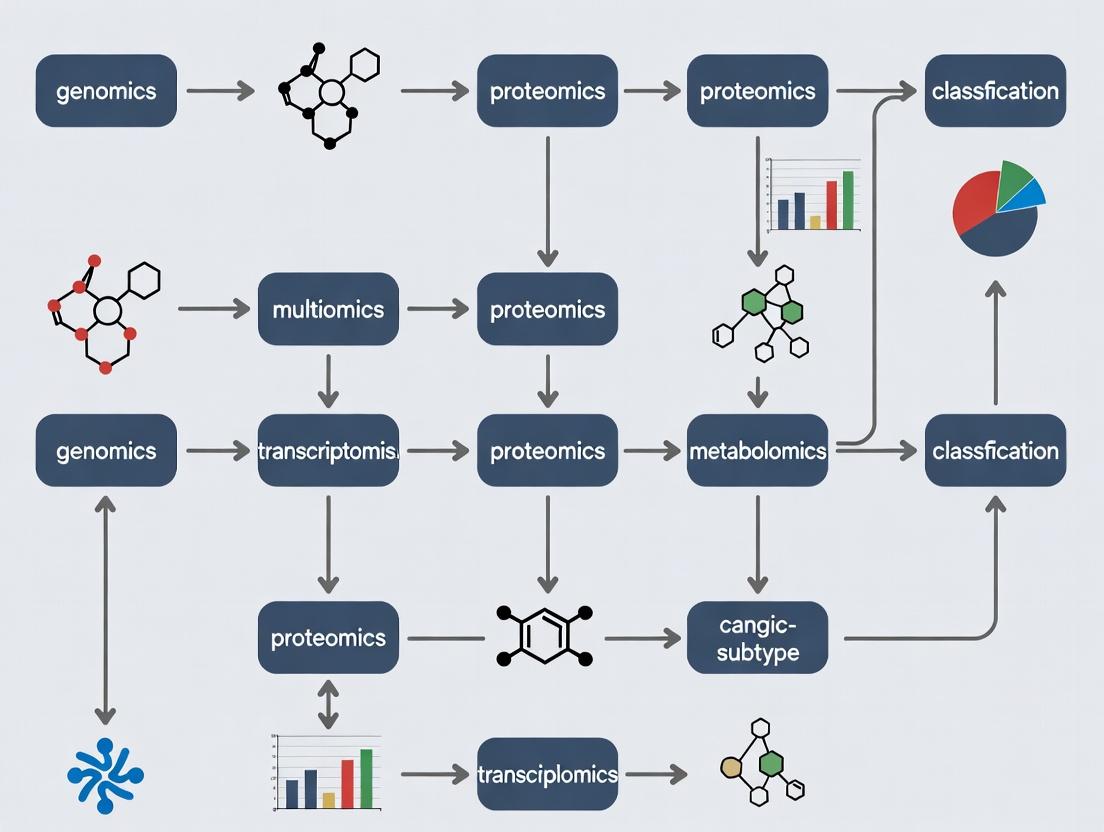
This comprehensive article addresses the critical challenge of classifying cancer subtypes through multi-omics data integration.
Integrating Multi-omics Data for Precision Oncology: A Comprehensive Guide to Cancer Subtype Classification
Abstract
This comprehensive article addresses the critical challenge of classifying cancer subtypes through multi-omics data integration. It first explores the foundational need for moving beyond single-omics approaches and surveys the diverse data types involved (genomics, transcriptomics, proteomics, epigenomics). The core methodological section dissects cutting-edge integration techniques, computational tools, and practical workflow applications. We then address common pitfalls in data harmonization, batch effects, and dimensionality reduction, offering optimization strategies. The analysis culminates in a comparative evaluation of integration methods, their validation using benchmark datasets, and discussion of clinical translatability. Designed for researchers, scientists, and drug development professionals, this guide synthesizes current best practices and future directions for leveraging multi-omics integration to refine cancer taxonomy, prognostication, and therapeutic targeting.
Why Multi-Omics? Unraveling Cancer Complexity Beyond Single-Data Type Analysis
This Application Note, framed within a thesis on Multi-omics data integration for cancer subtype classification, details the fundamental shortcomings of single-omic analyses. While genomics, transcriptomics, proteomics, and metabolomics each provide valuable insights, they offer inherently fragmented views of complex, dynamic tumor biology. Reliance on a single data layer risks misclassifying subtypes, overlooking key drivers, and failing to capture post-transcriptional and metabolic adaptations that define tumor behavior and therapeutic response.
Table 1: Comparative Limitations of Single-Omics Modalities in Cancer Research
| Omic Layer | Primary Measurement | Key Limitation in Tumor Biology | Exemplary Impact on Subtype Classification |
|---|---|---|---|
| Genomics (DNA) | Mutations, Copy Number Variations (CNVs), Structural Variants | Static; does not reflect functional state or regulation. Cannot detect transcript/protein abundance or activity. | Identifies drivers but cannot assess if they are expressed or functionally active, leading to potential misclassification of oncogenic potential. |
| Transcriptomics (RNA) | RNA expression levels (mRNA, non-coding RNA) | Poor correlation with protein abundance (r ~0.4-0.6). Misses post-translational modifications (PTMs) critical for signaling. | Tumors with similar mRNA profiles may have divergent proteomes and phenotypes, confounding subtype stratification. |
| Proteomics (Proteins) | Protein identity, abundance, localization | Technically challenging; dynamic range >10^6. Often misses low-abundance signaling proteins. Does not directly measure metabolite fluxes. | Captures effector function but provides limited insight into upstream genomic alterations or downstream metabolic reprogramming. |
| Metabolomics (Metabolites) | Small-molecule metabolites, pathway fluxes | Highly dynamic and sensitive to environment. Difficult to infer upstream regulatory mechanisms from snapshot data. | Reveals metabolic phenotype but cannot delineate whether it is driven by genomic, transcriptomic, or proteomic alterations. |
Experimental Protocols Highlighting Single-Omic Shortcomings
Protocol 1: Discrepancy Analysis Between RNA-Seq and Proteomics in Breast Cancer Subtyping
Objective: To demonstrate that transcriptomic classification does not fully recapitulate functional proteomic subtypes. Materials: Frozen breast tumor tissue sections, paired normal adjacent tissue. Reagents: RNeasy Kit, TRIzol, mass spectrometry grade trypsin, TMTpro 16plex reagents, LC-MS/MS buffers.
Procedure:
- Sample Preparation: Divide each tissue sample into two aliquots for parallel RNA and protein extraction.
- Transcriptomics (RNA-Seq): a. Extract total RNA, assess integrity (RIN > 7). b. Prepare stranded cDNA libraries (Illumina TruSeq). c. Perform 150bp paired-end sequencing on NovaSeq 6000 (40M reads/sample). d. Map reads to GRCh38, quantify gene expression (STAR/RSEM). e. Apply PAM50 classifier to assign intrinsic subtypes (Luminal A, Luminal B, HER2-enriched, Basal-like, Normal-like).
- Proteomics (LC-MS/MS): a. Homogenize tissue in RIPA buffer with protease inhibitors. b. Digest proteins with trypsin, label peptides with TMTpro 16plex tags. c. Fractionate using high-pH reversed-phase chromatography. d. Analyze by LC-MS/MS on an Orbitrap Eclipse Tribrid mass spectrometer. e. Identify and quantify proteins (Search engine: Sequest HT, FDR < 1%). f. Perform unsupervised clustering (k-means) on the top 3000 most variable proteins.
- Integrative Discrepancy Analysis: a. Compare subtype calls from PAM50 (RNA) and proteomic clustering. b. Calculate Spearman correlation between mRNA and protein levels for key subtype markers (e.g., ESR1, PGR, ERBB2, MKI67). c. Perform pathway enrichment (GSEA) on genes/proteins with discordant abundance.
Protocol 2: Validating Genomic Alterations at the Functional Phosphoproteomic Level
Objective: To show that identified genomic variants may not be functionally active, necessitating phosphoproteomic validation. Materials: NSCLC cell lines (e.g., with documented EGFR mutations), phosphoprotein enrichment kits. Reagents: Cell lysis buffer (8M Urea, phosphatase/protease inhibitors), Fe-IMAC magnetic beads, TiO2 beads, LC-MS/MS solvents.
Procedure:
- Genomic Characterization: a. Extract genomic DNA, perform targeted NGS using a pan-cancer panel (e.g., Illumina TruSight Oncology 500). b. Confirm activating EGFR mutation (e.g., L858R, exon 19 del).
- Functional Phosphoproteomic Profiling: a. Culture cell lines under standard conditions. Stimulate with EGF (100 ng/mL, 5 min) or vehicle. b. Lyse cells in urea buffer, reduce, alkylate, and digest proteins. c. Enrich phosphorylated peptides using a sequential Fe-IMAC and TiO2 protocol. d. Analyze by LC-MS/MS on a timsTOF Pro (DDA-PASEF mode). e. Identify phosphosites using MaxQuant (against UniProt human database).
- Data Integration & Analysis: a. Map identified phosphosites to signaling pathways (KEGG, Reactome). b. Compare phosphorylation status of key EGFR downstream nodes (MAPK1, AKT1, STAT5) between mutant and wild-type cells. c. Overlay genomic mutation data with phosphoproteomic activity maps to assess functional impact.
Visualizing the Gap: From Single-Omic Measurement to Integrated Understanding
Diagram Title: Single-Omics Provides Fragmented Biological Insight
The Scientist's Toolkit: Essential Research Reagent Solutions
Table 2: Key Reagents for Single-Omic and Multi-omics Profiling Experiments
| Reagent / Kit | Supplier Examples | Function in Experimental Workflow |
|---|---|---|
| AllPrep DNA/RNA/Protein Mini Kit | Qiagen | Simultaneous co-extraction of genomic DNA, total RNA, and protein from a single tissue sample, minimizing sample-to-sample variation for multi-omics. |
| TMTpro 16plex Label Reagent Set | Thermo Fisher Scientific | Isobaric chemical tags for multiplexed quantitative proteomics, allowing comparison of up to 16 samples in a single LC-MS/MS run, enhancing throughput and reducing technical variance. |
| TruSeq Stranded Total RNA Library Prep Kit | Illumina | Preparation of sequencing libraries from total RNA for transcriptome analysis, preserving strand information for accurate transcript quantification. |
| Phosphopeptide Enrichment Kit (Fe-IMAC/TiO2) | Thermo Fisher, GL Sciences | Selective enrichment of phosphorylated peptides from complex digests prior to LC-MS/MS, critical for functional phosphoproteomic studies of signaling pathways. |
| Cell Signaling Multiplex Detection Kit (Luminex/MSD) | Luminex, Meso Scale Discovery | Immunoassay-based quantification of multiple phosphorylated and total proteins (e.g., MAPK, AKT, STAT) from lysates, enabling validation of pathway activity. |
| Seahorse XF Cell Mito Stress Test Kit | Agilent Technologies | Real-time measurement of cellular metabolic function (OCR, ECAR) in live cells, providing functional metabolomic readouts of glycolysis and oxidative phosphorylation. |
| Oncomine Comprehensive Assay v3 | Thermo Fisher | Targeted NGS panel for detecting relevant DNA and RNA variants (SNVs, indels, CNVs, fusions) from limited oncology samples, standardizing genomic screening. |
| RPPA (Reverse Phase Protein Array) Core Services | MD Anderson, CPTAC | High-throughput, antibody-based quantification of hundreds of proteins and phosphoproteins across large sample cohorts, bridging transcriptomics and functional proteomics. |
The comprehensive classification of cancer subtypes, essential for precision oncology, requires an integrated multi-omics approach. Individual omics layers—genomics, transcriptomics, proteomics, and epigenomics—provide distinct yet complementary biological insights. This article details the application notes and protocols for generating and analyzing each omics data type, framing them as essential, interoperable components for a robust multi-omics integration pipeline aimed at elucidating tumor heterogeneity and identifying novel therapeutic targets.
Omics Technologies: Application Notes & Protocols
Genomics: Somatic Variant Calling from Whole Genome Sequencing (WGS)
Application Note: WGS identifies genetic alterations (SNVs, Indels, CNVs, structural variants) that may drive oncogenesis. In multi-omics integration, genomic variants provide the foundational layer for understanding the genetic predispositions of a tumor subtype.
Key Protocol: Tumor-Normal Paired Somatic Variant Calling with GATK Best Practices
- Sample Preparation & Sequencing: Extract high-molecular-weight DNA (≥1µg) from fresh-frozen tumor tissue and matched normal (e.g., blood) using a kit like QIAGEN DNeasy Blood & Tissue. Perform whole-genome library prep (e.g., Illumina DNA Prep) and sequence on a platform like NovaSeq X to a minimum depth of 60x for tumor and 30x for normal.
- Data Processing:
- Alignment: Align FASTQ reads to the human reference genome (GRCh38) using BWA-MEM.
- Post-alignment Processing: Sort, mark duplicates (Picard), and perform base quality score recalibration (GATK BaseRecalibrator).
- Variant Calling: Execute paired somatic variant calling using GATK Mutect2. Provide a panel of normals (PON) for artifact filtering.
- Variant Filtering & Annotation: Filter variants using GATK FilterMutectCalls. Annotate using databases like dbSNP, ClinVar, and COSMIC via SnpEff or VEP.
Table 1: Key Genomics Metrics & Tools
| Metric/Tool | Typical Value/Name | Purpose in Cancer Subtyping |
|---|---|---|
| Sequencing Depth | Tumor: 60-100x, Normal: 30x | Ensures sensitivity for detecting low-frequency variants. |
| Tumor Mutational Burden (TMB) | 1-20 mutations/Mb (variable by cancer) | Biomarker for immunotherapy response. |
| Variant Caller | GATK Mutect2, Strelka2 | Identifies somatic mutations. |
| Key Output | Somatic VCF file | Lists genomic alterations for integration. |
Transcriptomics: Gene Expression Profiling by RNA-Sequencing
Application Note: RNA-Seq quantifies the transcriptome, revealing differentially expressed genes, fusion transcripts, and alternative splicing events. It links genomic alterations to functional molecular phenotypes, crucial for defining active pathways in cancer subtypes.
Key Protocol: Bulk RNA-Seq for Differential Expression Analysis
- Sample Preparation & Sequencing: Extract total RNA (≥100ng) with high RIN (≥8) using TRIzol or column-based kits. Deplete ribosomal RNA or enrich for poly-A mRNA. Prepare libraries (e.g., Illumina Stranded Total RNA Prep) and sequence on a NovaSeq 6000 to achieve 20-40 million paired-end reads per sample.
- Data Processing:
- Pseudoalignment & Quantification: Use Kallisto or Salmon for fast transcript-level quantification against a reference transcriptome (e.g., GENCODE).
- Alignment-based Analysis: Alternatively, align with STAR to GRCh38, then count reads per gene with featureCounts.
- Differential Expression: Import counts into R/Bioconductor. Use DESeq2 or edgeR to normalize data and identify genes differentially expressed between cancer subtypes.
- Pathway Analysis: Perform Gene Set Enrichment Analysis (GSEA) or over-representation analysis (ORA) using MSigDB to identify enriched biological pathways.
Table 2: Key Transcriptomics Metrics & Tools
| Metric/Tool | Typical Value/Name | Purpose in Cancer Subtyping |
|---|---|---|
| Read Depth | 20-40 million paired-end reads | Balances cost and detection sensitivity. |
| Key QC Metric | RIN > 8.0 | Ensures RNA integrity. |
| Quantification Tool | Kallisto, Salmon, featureCounts | Generates gene/transcript counts. |
| DE Analysis Tool | DESeq2, edgeR | Identifies subtype-specific gene signatures. |
| Key Output | Normalized count matrix | Input for clustering and integration. |
Proteomics: Quantitative Profiling by Tandem Mass Spectrometry
Application Note: Proteomics measures the functional effector molecules, capturing post-translational modifications (PTMs) that are invisible to genomics/transcriptomics. Integrated proteogenomics can reveal dysregulated signaling pathways that define aggressive subtypes.
Key Protocol: Label-Free Quantification (LFQ) Proteomics
- Sample Preparation: Lyse frozen tissue pellets in SDS-containing buffer. Reduce, alkylate, and digest proteins with trypsin/Lys-C overnight. Desalt peptides using C18 solid-phase extraction tips or StageTips.
- LC-MS/MS Analysis: Separate peptides on a nanoflow UHPLC system (e.g., Thermo EASY-nLC 1200) with a C18 column. Analyze eluting peptides on a high-resolution tandem mass spectrometer (e.g., Thermo Orbitrap Exploris 480) operated in data-dependent acquisition (DDA) mode.
- Data Processing: Process raw files with MaxQuant or FragPipe. Search spectra against a human protein database (UniProt). Use match-between-runs and LFQ algorithms for quantification.
- Statistical Analysis: Filter for proteins with ≥2 unique peptides. Normalize LFQ intensities and perform differential expression analysis using Limma or specialized R packages (e.g.,
DEP).
Table 3: Key Proteomics Metrics & Tools
| Metric/Tool | Typical Value/Name | Purpose in Cancer Subtyping |
|---|---|---|
| MS Resolution | ≥60,000 (MS1), ≥15,000 (MS2) | Ensures accurate quantification and identification. |
| Identification Threshold | FDR < 0.01 (Peptide & Protein) | Controls false discoveries. |
| Quantification Method | Label-Free Quantification (LFQ), TMT | Compares protein abundance across samples. |
| Analysis Software | MaxQuant, FragPipe, Spectronaut | Processes raw MS data. |
| Key Output | Protein LFQ intensity matrix | Reveals active drivers and drug targets. |
Epigenomics: DNA Methylation Profiling by Array
Application Note: DNA methylation (5mC) is a key epigenetic mark regulating gene expression. Hypermethylation of promoter CpG islands can silence tumor suppressors. Methylation patterns provide stable biomarkers for cancer subtype classification.
Key Protocol: Genome-wide Methylation Analysis with Infinium MethylationEPIC Array
- Sample Preparation: Treat 500ng of genomic DNA with sodium bisulfite using the Zymo EZ DNA Methylation Kit, converting unmethylated cytosines to uracil.
- Array Processing: Amplify, fragment, and hybridize bisulfite-converted DNA to the Illumina Infinium MethylationEPIC BeadChip. Process the array per manufacturer's protocol on an iScan system.
- Data Processing: Extract intensity data (IDAT files). Process in R using
minfiorSeSAMefor quality control, normalization (e.g., SWAN, Noob), and calculation of beta values (β=M/(M+U+100)). - Differential Analysis: Identify differentially methylated positions (DMPs) or regions (DMRs) using
limmaorDSS. Annotate to gene promoters using packages likemissMethyl.
Table 4: Key Epigenomics Metrics & Tools
| Metric/Tool | Typical Value/Name | Purpose in Cancer Subtyping |
|---|---|---|
| Genomic Coverage | ~850,000 CpG sites (EPIC array) | Covers promoters, enhancers, gene bodies. |
| Key Metric | Beta Value (β) | Quantifies methylation (0=unmethylated, 1=methylated). |
| Analysis Package | minfi, SeSAMe |
Processes IDAT files, normalizes data. |
| DMR Finder | DSS, bumphunter |
Identifies coordinated methylation changes. |
| Key Output | Beta value matrix | Used for clustering and prognostic models. |
The Scientist's Toolkit: Research Reagent Solutions
Table 5: Essential Materials for Multi-Omics Sample Processing
| Reagent/Kit | Vendor Examples | Function in Workflow |
|---|---|---|
| AllPrep DNA/RNA/miRNA Universal Kit | QIAGEN | Simultaneous co-extraction of high-quality DNA and RNA from a single tumor tissue specimen, minimizing sample input variation for multi-omics. |
| RNase Inhibitors (e.g., Recombinant RNase Inhibitor) | Takara Bio, Promega | Protects RNA integrity during extraction and library preparation for transcriptomics. |
| Pierce BCA Protein Assay Kit | Thermo Fisher Scientific | Accurately quantifies protein concentration from tissue lysates prior to proteomic analysis. |
| MagMeDIP Kit | Diagenode | Immunoprecipitates methylated DNA fragments for targeted methylome sequencing studies. |
| KAPA HyperPrep Kit | Roche | Robust library preparation for next-generation sequencing across genomic and transcriptomic applications. |
| TruSeq TMT 16plex Kit | Thermo Fisher Scientific | Enables multiplexed, quantitative proteomics by labeling peptides from up to 16 samples with isobaric tags. |
Visualization of Multi-Omics Integration Workflow for Cancer Subtyping
Title: Multi-omics Integration Pipeline for Cancer Subtype Discovery
Visualization of a Key Integrated Pathway: PI3K-AKT-mTOR Signaling
Title: Multi-omics View of PI3K-AKT-mTOR Pathway Dysregulation
Application Notes: Multi-omics Integration in Cancer Subtyping
The classification of cancer into molecular subtypes is a cornerstone of precision oncology. Single-omics approaches (e.g., genomics alone) have provided foundational insights but often fail to capture the full regulatory complexity driving phenotypic heterogeneity. Integration of multi-omics data—genomics, transcriptomics, proteomics, and epigenomics—is essential to model the complementary flow of information from genotype to functional phenotype.
Table 1: Complementary Regulatory Insights from Discrete Omics Layers
| Omics Layer | Molecular Measured | Regulatory Insight Provided | Key Limitation Addressed by Integration |
|---|---|---|---|
| Genomics (WES/WGS) | DNA sequence variants (SNVs, INDELs, CNVs) | Identifies driver mutations & potential therapeutic targets. | Cannot assess functional impact or post-transcriptional regulation. |
| Epigenomics (ChIP-seq, ATAC-seq) | DNA methylation, histone modifications, chromatin accessibility | Reveals regulatory elements & silent/active chromatin states influencing gene expression. | Does not directly measure downstream molecular outputs. |
| Transcriptomics (RNA-seq) | Total mRNA/miRNA expression levels | Quantifies gene expression dynamics & pathway activity. | Subject to post-transcriptional & translational regulation not reflected at protein level. |
| Proteomics (LC-MS/MS) | Protein abundance & post-translational modifications (PTMs) | Defines functional effectors, signaling pathway activity, and drugable targets. | Cannot distinguish genetic from non-genetic causes of abundance changes. |
Integration of these layers resolves ambiguities. For example, a gene may be amplified (genomics) but not expressed (transcriptomics) due to promoter hypermethylation (epigenomics), or highly expressed as mRNA but not translated to protein. Only integrated models can classify subtypes based on such convergent or divergent regulatory patterns, leading to more robust and biologically interpretable classifications with direct therapeutic implications.
Experimental Protocols
Protocol 2.1: Integrated Multi-omics Subtype Discovery Workflow
This protocol outlines a computational pipeline for unsupervised cancer subtype classification from matched tumor samples.
Materials & Input Data:
- Matched patient tumor samples (fresh-frozen or high-quality FFPE).
- Genomic Data: Somatic mutation calls (VCF files) and gene-level copy number variation (CNV) segments from WES.
- Epigenomic Data: Genome-wide DNA methylation beta-values (e.g., from Illumina EPIC array).
- Transcriptomic Data: RNA-seq raw counts (FASTQ files) or normalized TPM/FPKM matrix.
- Proteomic Data: LFQ or iBAQ intensity matrix from label-free LC-MS/MS.
Procedure:
- Data Preprocessing & Dimension Reduction:
- For each omics data matrix, perform layer-specific normalization and batch effect correction (e.g., using ComBat).
- Reduce dimensionality for each layer independently:
- SNVs: Convert to a gene-level mutation burden matrix (0/1 for altered/not-altered).
- CNVs: Use segmented log2 ratio values for recurrent regions.
- Methylation: Select most variable probes (top 5,000 by standard deviation).
- RNA-seq: Select most variable genes (top 1,000).
- Proteomics: Select most variable proteins (top 1,000).
- Standardize features (mean=0, variance=1) within each matrix.
Data Integration & Clustering:
- Employ a joint matrix factorization or graph-based integration method (e.g., MOFA+ or SNF).
- Using Similarity Network Fusion (SNF): a. For each omics data matrix, construct a patient-to-patient similarity network (using Euclidean distance). b. Fuse all networks into a single integrated patient similarity network using the SNF algorithm. c. Apply spectral clustering on the fused network to obtain patient cluster assignments (k=3-10).
- Determine optimal cluster number (k) via consensus clustering or stability analysis.
Subtype Characterization & Validation:
- Perform differential analysis (ANOVA) for each omics layer between clusters to define defining features.
- Conduct pathway enrichment analysis (GSEA, GSVA) on subtype-specific features.
- Validate subtypes using an independent cohort or cross-validation, correlating with clinical outcomes (overall survival, progression-free survival).
Protocol 2.2: Targeted Assay for Validating Integrated Subtype-Specific Pathways
This protocol validates a predicted dysregulated pathway (e.g., PI3K-AKT-mTOR) at the protein/phosphoprotein level in subtype-classified cell lines.
Materials:
- Cell lines representative of identified subtypes.
- RIPA Lysis Buffer with protease and phosphatase inhibitors.
- BCA Protein Assay Kit.
- Multiplex phosphoprotein immunoassay (e.g., Luminex xMAP-based) or reagents for Western blot.
- Pathway-specific antibody panels.
Procedure:
- Cell Culture & Lysis:
- Grow subtype-representative cell lines to 70-80% confluence in triplicate.
- Serum-starve cells for 4 hours to reduce basal signaling.
- Lyse cells in cold RIPA buffer, incubate on ice for 15 min, and centrifuge at 14,000g for 15 min at 4°C.
- Collect supernatant and quantify protein concentration using BCA assay.
Pathway Activity Profiling:
- For multiplex immunoassay: Use 20-50 µg of lysate per well in a validated phosphoprotein panel (e.g., AKT (S473), S6K (T389), ERK1/2 (T202/Y204), PRAS40 (T246)).
- Follow manufacturer's protocol for incubation, washing, and detection.
- Read plate on a multiplex analyzer and analyze median fluorescence intensity (MFI) data.
- For Western blot: Separate 30 µg protein by SDS-PAGE, transfer to PVDF membrane, and probe with primary antibodies against the same phospho-targets and corresponding total proteins. Use HRP-conjugated secondaries and chemiluminescent detection.
Data Analysis:
- Normalize phospho-signals to total protein or housekeeping controls.
- Compare pathway activation levels across cell line subtypes using one-way ANOVA.
- Correlate experimental protein activation data with the RNA-seq and phosphoproteomic predictions from the integrated model.
Mandatory Visualizations
Diagram 1: Multi-omics Integration Workflow for Subtyping.
Diagram 2: Complementary Regulatory Layers in a Signaling Pathway.
The Scientist's Toolkit
Table 2: Key Research Reagent Solutions for Multi-omics Integration Studies
| Reagent / Material | Function & Application | Key Consideration |
|---|---|---|
| AllPrep DNA/RNA/Protein Kit (Qiagen) | Simultaneous isolation of high-quality genomic DNA, total RNA, and protein from a single tumor sample. | Preserves molecular relationships and minimizes sample-to-sample variability for matched multi-omics. |
| TruSight Oncology 500 (Illumina) | Targeted NGS panel for detecting SNVs, INDELs, CNVs, and fusions from limited DNA/RNA. | Provides a focused, cost-effective genomic/transcriptomic profile for clinical validation of subtypes. |
| EPIC Methylation Array (Illumina) | Genome-wide profiling of DNA methylation at >850,000 CpG sites. | Standardized platform for epigenomic characterization; enables comparison with public cohorts (TCGA). |
| TMTpro 16-plex (Thermo Fisher) | Tandem Mass Tag reagents for multiplexed quantitative proteomics of up to 16 samples in one LC-MS/MS run. | Dramatically reduces technical variation in proteomic data, crucial for comparing across subtypes. |
| Phospho-AKT (S473) ELISA Kit (CST) | Validated, quantitative immunoassay for measuring pathway activation in subtype cell lines or tissues. | Provides orthogonal, targeted validation of pathway predictions from integrated omics models. |
| MOFA+ (R/Bioconductor) | Multi-Omics Factor Analysis software for unsupervised integration of heterogeneous omics datasets. | Identifies latent factors driving variation across all omics layers, directly informing subtype biology. |
Application Notes: Foundational Projects for Multi-omics Cancer Subtype Classification
The integration of multi-omics data is pivotal for advancing precision oncology. Three large-scale consortia—The Cancer Genome Atlas (TCGA), the International Cancer Genome Consortium (ICGC), and the Human Cell Atlas (HCA)—provide the essential foundational data and reference frameworks required for this task. Their complementary resources enable researchers to define molecular subtypes of cancer with unprecedented resolution, linking genomic alterations to cellular phenotypes and clinical outcomes.
TCGA (The Cancer Genome Atlas): TCGA generated comprehensive, multi-omics molecular profiles for over 20,000 primary cancers across 33 cancer types. This dataset serves as the primary reference for pan-cancer analyses, enabling the discovery of driver mutations, altered pathways, and molecular subtypes that transcend traditional organ-based classification. Its standardized processing pipelines ensure data uniformity.
ICGC (International Cancer Genome Consortium): ICGC expanded the genomic exploration of cancer on a global scale. Through projects like the Pan-Cancer Analysis of Whole Genomes (PCAWG), ICGC contributed deep whole-genome sequencing data for over 2,600 cancers across 38 tumor types, emphasizing the non-coding genome and comprehensive somatic variation. The consortium's current focus, the International Cancer Genome Consortium-ARGO (Accelerating Research in Genomic Oncology), aims to link genomic data with detailed clinical outcomes for >100,000 patients.
HCA (Human Cell Atlas): The HCA aims to create comprehensive reference maps of all human cells using high-throughput single-cell technologies. For cancer research, it provides the essential "normal" reference to distinguish tumor-specific alterations from natural cellular variation. This is critical for identifying cell types of origin, characterizing the tumor microenvironment, and understanding cellular states driving cancer progression.
The synergy between these resources is clear: TCGA/ICGC provide the detailed genomic blueprint of tumors, while the HCA provides the cellular context to interpret those blueprints. Integrating these data types allows for the classification of cancer subtypes based not only on mutational profiles but also on deconvoluted cellular composition and disrupted differentiation trajectories.
Table 1: Core Specifications of Foundational Consortia
| Consortium | Primary Focus | Approx. Sample Count (as of 2024) | Key Data Types | Primary Access Portal |
|---|---|---|---|---|
| TCGA | Molecular characterization of primary tumors | >20,000 patients across 33 cancers | WES, RNA-Seq, miRNA, DNA Methylation, Proteomics (RPPA) | NCI Genomic Data Commons (GDC) |
| ICGC (inc. PCAWG) | Whole-genome analysis of cancers | ~2,600 WGS tumors (PCAWG); ARGO targeting >100k | WGS, RNA-Seq, Methylation, Clinical Outcomes | ICGC Data Portal / EGA / ARGO Platform |
| HCA | Single-cell reference maps of healthy tissues | Millions of cells from >100 tissues/organs | scRNA-Seq, scATAC-Seq, Spatial Transcriptomics | HCA Data Coordination Platform / CellxGene |
Table 2: Application in Multi-omics Integration for Subtype Classification
| Data Resource | Role in Subtyping Pipeline | Key Deliverable for Integration | Associated Computational Tools |
|---|---|---|---|
| TCGA Pan-Cancer Atlas | Definitive molecular subtype labels for major cancers; Pan-cancer clusters. | Curated multi-omics matrices with clinical annotation. | cBioPortal, TCGAbiolinks, UCSC Xena |
| ICGC PCAWG/ARGO | Subtype discovery based on non-coding & structural variants; Outcome-linked subtypes. | Aligned WGS data; Linked clinical-genomic datasets. | ICGC Data Portal utilities, PCAWG-Scout |
| HCA Reference | Deconvolution of bulk tumors; Identification of rare cell states. | Cell-type-specific gene expression signatures. | CellxGene, Azimuth, SingleR, CIBERSORTx |
Experimental Protocols
Protocol 1: Utilizing TCGA Data for Pan-Cancer Multi-omics Subtype Discovery
Objective: To identify consensus molecular subtypes across cancer types using integrated TCGA data.
Materials:
- Computer with high-performance computing access (≥16 GB RAM, multi-core processor).
- R (v4.2+) or Python (v3.9+) environment.
- TCGA data matrices (e.g., from UCSC Xena or GDC).
Procedure:
- Data Acquisition: Download normalized multi-omics data (e.g., gene expression (RNA-Seq), DNA methylation (450k array), and reverse-phase protein array (RPPA) data) for a pan-cancer cohort (e.g., 10+ cancer types) using the
TCGAbiolinksR package or the GDC API. - Data Preprocessing & Alignment: For each patient, retain only samples with data across all selected platforms. Perform batch correction using the
ComBatalgorithm (fromsvapackage) to account for technical variation across different cancer-type cohorts. - Multi-omics Integration: Use an unsupervised integration method such as Similarity Network Fusion (SNF) or Multi-Omics Factor Analysis (MOFA).
- For SNF: Construct patient similarity networks separately for each data type (using Euclidean distance and scaled exponential similarity kernel). Fuse networks into a single aggregated network using the SNF algorithm (
SNFtoolR package).
- For SNF: Construct patient similarity networks separately for each data type (using Euclidean distance and scaled exponential similarity kernel). Fuse networks into a single aggregated network using the SNF algorithm (
- Cluster Discovery: Apply spectral clustering on the fused network to identify patient clusters (k=3-10). Evaluate cluster stability using consensus clustering.
- Subtype Characterization: Annotate clusters by:
- Enrichment of known TCGA subtypes (
survivalR package for Kaplan-Meier analysis). - Differential expression/methylation/protein abundance (
limmapackage). - Pathway enrichment (GSVA, GSEA).
- Enrichment of known TCGA subtypes (
- Validation: Validate clusters in an independent cohort (e.g., from ICGC) using a nearest template prediction approach.
Protocol 2: Deconvolving Bulk Tumors Using HCA-Derived Signatures
Objective: To estimate cell-type composition in bulk TCGA/ICGC RNA-Seq data using single-cell reference profiles from the HCA.
Materials:
- Bulk tumor gene expression matrix (e.g., TCGA BRCA RNA-Seq FPKM data).
- HCA-derived single-cell reference matrix (e.g., healthy breast tissue scRNA-seq from HCA).
- Access to CIBERSORTx web portal or similar deconvolution software.
Procedure:
- Reference Signature Matrix Generation:
- Download a processed single-cell RNA-Seq dataset of the relevant healthy tissue from the HCA Data Coordination Platform.
- Identify major cell types by clustering and marker gene expression (e.g., using Seurat).
- Use the CIBERSORTx "Create Signature Matrix" module. Input the normalized scRNA-seq expression matrix and cell type labels. The module will identify genes with minimal within-class and maximal between-class variance to construct a robust signature matrix (GEP).
- Bulk Data Preparation: Normalize bulk RNA-Seq data (e.g., TCGA) to Transcripts Per Million (TPM) format, matching gene identifiers with the signature matrix.
- Deconvolution Execution: Run the CIBERSORTx "Impute Cell Fractions" module in B-mode (with batch correction). Upload the bulk mixture file and the custom HCA-derived signature matrix. Use 1000 permutations for significance estimation.
- Integration with Molecular Data: Merge the resulting cell fraction estimates (e.g., proportions of fibroblasts, T-cells, epithelial subsets) with the tumor's genomic and clinical data from TCGA/ICGC.
- Subtyping Analysis: Perform clustering (e.g., k-means) on the cell composition matrix to define "microenvironment subtypes." Correlate these subtypes with genomic alterations (e.g., TP53 mutation, CNA burden) and patient survival.
The Scientist's Toolkit: Research Reagent Solutions
Table 3: Essential Resources for Multi-omics Integration Studies
| Item | Function in Research | Example/Source |
|---|---|---|
| cBioPortal | Web-based visualization and analysis platform for exploring complex cancer genomics datasets (TCGA, ICGC). | www.cbioportal.org |
| UCSC Xena Browser | Integrative genomics browser for visualizing and analyzing public and private functional genomics data. | xena.ucsc.edu |
| CellxGene | Interactive, performant explorer for single-cell transcriptomics data, hosting many HCA datasets. | cellxgene.cziscience.com |
| CIBERSORTx | Computational tool for deconvolving bulk tissue expression matrices using a reference signature (e.g., from HCA). | cibersortx.stanford.edu |
| GDC Data Transfer Tool | High-performance command-line application for reliably downloading data from the NCI Genomic Data Commons. | gdc.cancer.gov |
| Multi-Omics Factor Analysis (MOFA2) | R package for unsupervised integration of multi-omics data to discover latent factors driving variation. | bioFAM.github.io/MOFA2 |
| Singler | R package for rapid annotation of single-cell RNA-seq data against reference datasets (like HCA). | bioconductor.org/packages/SingleR |
| ICGC ARGO Platform | Portal for accessing high-quality, clinically annotated genomic data from the ICGC-ARGO project. | platform.icgc-argo.org |
Diagrams
Multi-omics Cancer Subtyping Workflow
Immune Response Pathway from Genomic Data
Application Notes
The integration of multi-omics data (genomics, transcriptomics, proteomics, epigenomics) is pivotal for defining biologically and clinically distinct cancer subtypes. These refined classifications transcend single-omics approaches, offering deeper insights into tumor biology, prognostic stratification, and therapeutic vulnerabilities. This document synthesizes key findings and methodologies from three well-established models: Breast Cancer (PAM50), Glioblastoma (TCGA subtypes), and Colorectal Cancer (CMS Consortium).
Breast Cancer: The PAM50 classifier, based on 50 intrinsic genes, defines four core mRNA expression subtypes: Luminal A, Luminal B, HER2-enriched, and Basal-like. Integration with copy number alteration (CNA) and mutation data has further resolved heterogeneity, identifying subgroups with specific driver events (e.g., PIK3CA mutations in Luminal A; TP53 mutations in Basal-like). Proteomic and phosphoproteomic data confirm pathway activation, distinguishing aggressive Basal-like tumors from others.
Glioblastoma: The landmark TCGA effort integrated genomic, methylomic, and transcriptomic data to establish four subtypes: Proneural, Neural, Classical, and Mesenchymal. Key distinctions include PDGFRA/IDH1 alterations in Proneural, EGFR amplification in Classical, and NF1 loss/Mesenchymal markers in Mesenchymal. Methylation profiling, especially of the MGMT promoter, provides critical prognostic and predictive value independent of transcriptomic class.
Colorectal Cancer: The Consensus Molecular Subtypes (CMS) framework integrates gene expression with copy number, methylation, and mutational data to define four subtypes: CMS1 (MSI Immune), CMS2 (Canonical), CMS3 (Metabolic), and CMS4 (Mesenchymal). This classification links specific biology to clinical outcomes: CMS1 shows immune infiltration and microsatellite instability; CMS4 exhibits stromal invasion and worst prognosis.
Therapeutic Implications: Subtypes guide targeted therapy: HER2-targeted agents in HER2-enriched breast cancer; EGFR inhibitors in Classical GBM with intact EGFRvIII; and immune checkpoint blockade in MSI-high/CMS1 CRC. Subtypes also predict resistance mechanisms, such as PIK3CA mutations conferring resistance to anti-EGFR therapy in CRC.
Table 1: Established Multi-Omics Subtypes and Key Features
| Cancer Type | Subtype Classification System | Key Subtypes (Abbreviation) | Defining Genomic Alterations | Characteristic Pathway Activation | Prognostic Association |
|---|---|---|---|---|---|
| Breast | PAM50 (Intrinsic) | Luminal A (LumA) | PIK3CA mut, low CNA | ESR1 signaling, Luminal differentiation | Best |
| Luminal B (LumB) | PIK3CA mut, high CNA, HER2 amp (subset) | ESR1 signaling, high Ki67, Proliferation | Intermediate | ||
| HER2-enriched (HER2E) | ERBB2 amp, TP53 mut | HER2 signaling, Proliferation | Intermediate (with Tx) | ||
| Basal-like (Basal) | TP53 mut, RB1 loss, high CNA | Cell cycle, DNA damage repair, RTK signaling | Worst | ||
| Glioblastoma | TCGA Integrative | Proneural (PN) | IDH1 mut (secondary GBM), PDGFRA amp/alt | PDGFRA signaling, Developmental | Variable |
| Neural (N) | Mixed, neuronal expression | Neuronal signaling | Intermediate | ||
| Classical (CL) | EGFR amp, CDKN2A del, PTEN del | EGFR signaling, Notch signaling | Poor | ||
| Mesenchymal (MES) | NF1 del/mut, PTEN del, CHI3L1/ MET high | NF-κB signaling, TNFα, Mesenchymal transition | Poor | ||
| Colorectal | Consensus Molecular (CMS) | CMS1 (MSI Immune) | MSI, BRAF V600E mut, Hypermutation | Immune activation, JAK-STAT, TLR | Intermediate (stage-dependent) |
| CMS2 (Canonical) | SCNA high, APC/TP53 mut, WNT & MYC activation | WNT, MYC, Proliferation | Intermediate | ||
| CMS3 (Metabolic) | Mixed MSI, KRAS mut, Metabolic dysregulation | Metabolic pathways (glutamine, lipogenesis) | Intermediate | ||
| CMS4 (Mesenchymal) | SCNA high, TGF-β activation, Angiogenesis | TGF-β, EMT, Stromal invasion, Angiogenesis | Worst |
Experimental Protocols
Protocol 1: Integrated Multi-Omics Subtype Classification (TCGA-style)
Objective: To classify tumor samples into integrative subtypes using matched DNA methylation, gene expression, and copy number data.
Materials:
- Tumor RNA (for expression), DNA (for methylation, CNA).
- Microarray (e.g., Illumina HM450/EPIC for methylation, Affymetrix U133 for expression) or NGS platforms.
- Bioinformatics pipelines: e.g., R/Bioconductor (minfi, limma, CNVkit).
Procedure:
Data Acquisition & Preprocessing:
- Gene Expression: Process raw CEL/FASTQ files. Perform RMA normalization (microarray) or align and quantify transcripts (RNA-Seq). Apply batch correction (ComBat).
- DNA Methylation: Process IDAT files. Perform background correction, normalization (SWAN), and probe filtering. Obtain β-values (0-1) for each CpG site.
- Copy Number: Process SNP array or sequencing data (e.g., GATK Best Practices). Generate log2 ratio segments. Call arm-level and focal CNAs (GISTIC2.0).
Dimensionality Reduction & Clustering:
- For each data type, select top variable features (e.g., 5000 most variable genes/CpGs).
- Perform non-negative matrix factorization (NMF) or iCluster+ jointly on the multi-omics data matrices.
- Determine optimal cluster number (k) via cophenetic correlation or Bayesian Information Criterion (BIC).
Subtype Assignment & Validation:
- Assign each sample to a cluster (subtype).
- Validate clusters using known markers (e.g., ESR1 for Luminal) and survival analysis (Kaplan-Meier, log-rank test).
- Train a classifier (e.g., Random Forest) on the clusters for future sample prediction.
Protocol 2: Validation of Subtype-Specific Pathway Activation
Objective: To validate pathway activity predicted by transcriptomic subtypes using functional proteomics (RPPA or Phosphoproteomics).
Materials:
- Tumor protein lysates.
- Reverse Phase Protein Array (RPPA) platform or LC-MS/MS for phosphoproteomics.
- Antibody library for RPPA (~200 key signaling proteins).
- TMT/Label-free reagents for MS.
Procedure:
Sample Preparation:
- Lyse frozen tumor tissue in RIPA buffer with phosphatase/protease inhibitors.
- Quantify protein (BCA assay). For phosphoproteomics, enrich phosphopeptides using TiO2 or IMAC columns.
Data Generation:
- RPPA: Serially dilute lysates, spot onto nitrocellulose slides, probe with validated primary antibodies, detect with fluorescent secondary antibodies. Quantify spot intensity.
- Phosphoproteomics (LC-MS/MS): Digest proteins, label with TMT, fractionate, analyze by LC-MS/MS. Identify and quantify phosphopeptides.
Data Integration & Analysis:
- Normalize protein/phosphoprotein levels.
- For each pre-defined subtype, perform differential analysis (t-test/ANOVA) to identify enriched proteins/phosphosites.
- Map differentially expressed proteins to canonical pathways (KEGG, Reactome) using enrichment analysis (GSEA).
- Correlate protein-level pathway scores (e.g., PI3K-AKT signature) with the corresponding mRNA-based subtype assignment.
Signaling Pathway & Workflow Diagrams
Multi-Omics Subtype Discovery Workflow
CMS4 TGF-β Driven Mesenchymal Signaling
The Scientist's Toolkit: Research Reagent Solutions
Table 2: Essential Reagents for Multi-Omics Subtyping Studies
| Item | Function | Example Product/Catalog |
|---|---|---|
| AllPrep DNA/RNA/miRNA Universal Kit | Simultaneous purification of genomic DNA and total RNA (including small RNA) from a single tumor tissue sample, preserving molecule integrity for parallel assays. | Qiagen 80224 |
| Illumina Infinium MethylationEPIC BeadChip | Genome-wide methylation profiling of >850,000 CpG sites, covering enhancer regions, crucial for epigenetic subtyping (e.g., GBM). | Illumina WG-317-1001 |
| IsoCode Reverse Transcription Kit | For generating full-length cDNA from low-input or degraded RNA (e.g., from FFPE), enabling robust gene expression profiling of archival samples. | IsoPlexis 1012-01 |
| TMTpro 16plex Label Reagent Set | Allows multiplexed quantitative proteomic/phosphoproteomic analysis of up to 16 samples in one LC-MS/MS run, enabling high-throughput subtype validation. | Thermo Fisher Scientific A44520 |
| Validated Phospho-Specific Antibody Library | A curated set of antibodies for RPPA or western blot, targeting key phosphorylated signaling proteins (e.g., p-AKT, p-ERK) to assess pathway activation per subtype. | Cell Signaling Technology PathScan |
| LIVE/DEAD Fixable Viability Dyes | For flow cytometry, to exclude dead cells during fluorescence-activated cell sorting (FACS) of specific cell populations from dissociated tumors for pure omics analysis. | Thermo Fisher Scientific L34955 |
| iCluster+ R/Bioconductor Package | Software tool for integrative clustering of multiple omics data types, a standard for defining joint subtypes. | CRAN: iCluster |
| GISTIC 2.0 | Computational method to identify regions of the genome that are significantly amplified or deleted across a sample set, defining genomic drivers of subtypes. | Broad Institute Tool |
From Raw Data to Subtypes: A Step-by-Step Guide to Multi-Omics Integration Techniques
Integration of multi-omics data (genomics, transcriptomics, proteomics, epigenomics) is pivotal for discerning molecularly distinct cancer subtypes, which informs prognosis and therapeutic strategies. The choice of integration strategy—Early (Data-level), Intermediate (Feature-level), or Late (Decision-level)—fundamentally shapes analytical outcomes, model interpretability, and biological insight. This application note provides a structured comparison and practical protocols for implementing each fusion strategy within a cancer subtype classification pipeline.
Quantitative Comparison of Fusion Strategies
Table 1: Comparative Analysis of Integration Strategies for Cancer Subtype Classification
| Aspect | Early Integration | Intermediate Integration | Late Integration |
|---|---|---|---|
| Core Principle | Concatenation of raw or pre-processed data matrices before model input. | Joint learning of a unified feature representation from multiple omics. | Separate model training on each omics data, with fusion of predictions. |
| Typical Techniques | PCA on concatenated data; Regularized ML (LASSO, Elastic Net). | Multi-view PCA, iCluster, MOFA, Deep Learning (Autoencoders). | Separate classifiers (e.g., SVM, RF) with voting or stacking meta-learners. |
| Model Interpretability | Low. Hard to attribute results to a specific omics layer. | Moderate to High. Can infer latent factors spanning omics types. | High. Clear contribution from each omics-specific model. |
| Handles Heterogeneity | Poor. Assumes uniform scale and distribution. | Good. Methods can weight or transform views. | Excellent. Treats each omics data type independently. |
| Computational Complexity | Low | High (especially for deep learning) | Moderate |
| Best Suited For | Highly correlated, co-assayed omics with similar scales. | Discovering cross-omics latent factors driving subtypes. | Modular, legacy pipelines; When omics data are discordantly sourced. |
| Example Performance (Avg. AUC in Pan-cancer Studies) | 0.78 - 0.85 | 0.82 - 0.90 | 0.80 - 0.87 |
Table 2: Suitability Assessment for Common Cancer Study Scenarios
| Research Scenario | Recommended Strategy | Rationale |
|---|---|---|
| Novel subtype discovery from TCGA-like co-assayed data. | Intermediate (iCluster/MOFA) | Maximizes power to identify integrated molecular patterns. |
| Clinical trial: Adding a new omics layer to an established biomarker. | Late (Stacking) | Preserves integrity of validated model while incorporating new data. |
| Real-time diagnostic with disparate, sequentially generated assays. | Late (Weighted Voting) | Accommodates asynchronous data arrival and missing views. |
| Mechanistic study linking genetic drivers to functional readouts. | Intermediate (Multi-omics DL) | Learns non-linear mappings between data layers. |
| Pilot study with budget for only one integrated assay. | Early (Concatenation + PCA) | Simple, effective baseline with low computational overhead. |
Experimental Protocols
Protocol 1: Late Integration for Subtype Classification Using Stacking
Objective: Integrate RNA-seq, DNA methylation, and somatic mutation data to classify breast cancer PAM50 subtypes. Inputs: Matrices: Gene expression (TPM), Methylation (beta values), Mutation (binary). Sample labels (Luminal A, Luminal B, Her2-enriched, Basal-like). Workflow: 1. Data Pre-processing: * Expression: Log2(TPM+1), remove low variance genes, standardize (z-score). * Methylation: Remove probes with SNPs or cross-reactive, impute missing values, batch correction (ComBat). * Mutations: Retain genes mutated in >2% of cohort. 2. Base Learner Training: Train three separate classifiers (e.g., Random Forest) on each omics dataset using 5-fold cross-validation (CV). Output CV predictions (class probabilities) for each sample. 3. Meta-learner Training: Concatenate CV predictions from step 2 into a new feature matrix. Train a logistic regression model (meta-learner) on this matrix. 4. Final Evaluation: Train base learners on entire training set, generate predictions for the hold-out test set, and feed them to the meta-learner for final classification. Validation: Compare stacked model AUC, precision, recall to single-omics models.
Protocol 2: Intermediate Integration Using Multi-Omics Factor Analysis (MOFA+)
Objective: Derive a shared latent representation from multi-omics data for unsupervised cancer subgrouping.
Inputs: Matrices as in Protocol 1, no labels required.
Workflow:
1. MOFA+ Model Setup: mofa_object <- create_mofa(data_list) where data_list contains all omics matrices.
2. Data Options: Set likelihoods ("gaussian" for expression, "bernoulli" for mutations). Apply scale views=TRUE.
3. Model Training: model <- run_mofa(mofa_object, num_factors=15, use_basilisk=TRUE). Determine optimal factors via ELBO convergence.
4. Factor Interpretation: plot_variance_explained(model) to see contribution of each factor per view. Correlate factors with known clinical features.
5. Subtype Derivation: Cluster samples in the latent factor space (e.g., using k-means on the top 10 factors). Evaluate clusters against known subtypes or for novel biology.
Downstream Analysis: Use get_weights() to identify driving features (genes, CpGs) per factor for biological interpretation.
Protocol 3: Early Integration with Regularized Classification
Objective: Fuse pre-processed omics data into a single matrix for supervised classification.
Workflow:
1. Concatenation: After independent scaling of each omics matrix, column-bind them into matrix X (samples x total features). Ensure consistent sample order.
2. Dimensionality Reduction (Optional): Apply Principal Component Analysis (PCA) to X, retain top N PCs explaining >80% variance. Use resulting score matrix as new features.
3. Regularized Model Training: Train an Elastic Net classifier (glmnet with alpha between 0 and 1) on X (or PCA scores) using nested CV for hyperparameter tuning (lambda, alpha).
4. Feature Importance: Extract non-zero coefficients from the final model. Map features back to their omics of origin to assess contribution.
Visualizations
Diagram Title: Data Flow in Multi-omics Integration Strategies
Diagram Title: Decision Tree for Choosing an Integration Strategy
The Scientist's Toolkit: Research Reagent Solutions
Table 3: Essential Resources for Multi-omics Integration Experiments
| Resource / Tool | Category | Function in Protocol | Example/Provider |
|---|---|---|---|
| TCGA / CPTAC Data Portals | Reference Data | Source of standardized, clinically annotated multi-omics cancer data for benchmarking. | GDC Data Portal, CPTAC Data Portal |
| MOFA+ (R/Python) | Software Package | Implements Bayesian intermediate integration to infer latent factors from multiple omics. | BioConductor (MOFA2) / mofapy2 |
| iCluster (R) | Software Package | Performs joint latent variable model for integrative clustering (intermediate integration). | CRAN (iClusterPlus) |
| sckit-learn (Python) | ML Library | Provides implementations for early (Elastic Net) and late (Voting, Stacking) integration models. | scikit-learn library |
| Methylation EPIC BeadChip | Wet-lab Assay | Genome-wide DNA methylation profiling, generating beta-value matrices for integration. | Illumina (Infinium MethylationEPIC) |
| Pan-cancer IO 360 Gene Panel | Targeted Assay | Provides curated gene expression for immune profiling, a ready-made feature set for late fusion. | NanoString (PanCancer IO 360) |
| Cell-Free DNA Multi-omics Kits | Sample Prep | Enables co-isolation of nucleic acids from liquid biopsies for early/intermediate integration. | Qiagen (cfDNA/cfRNA kits), Streck tubes |
| Multi-omics ML Cloud Environments | Computing | Pre-configured environments (Docker/AML) with tools like Camelot for reproducible analysis. |
Terra.bio, Seven Bridges, Azure ML |
This document outlines standardized protocols for the initial stages of a multi-omics cancer subtype classification pipeline. Consistent and rigorous data handling at these stages is critical for the downstream integration of genomic, transcriptomic, proteomic, and epigenomic data, enabling the discovery of robust biomarkers and therapeutic targets.
Primary data for cancer multi-omics studies are acquired from public repositories, institutional databases, and prospective collections. Key sources and their characteristics are summarized below.
Table 1: Primary Data Sources for Multi-omics Cancer Research
| Omics Layer | Example Source | Typical Format | Key Metadata Required |
|---|---|---|---|
| Genomics (DNA-seq) | TCGA, ICGC | FASTQ, BAM, VCF | Tumor purity, sequencing platform, read depth, coverage. |
| Transcriptomics (RNA-seq) | GEO, ArrayExpress | FASTQ, Count Matrix | Library preparation protocol, rRNA depletion vs. poly-A selection, batch. |
| Epigenomics (ChIP-seq, ATAC-seq) | ENCODE, CEEHRC | FASTQ, BED, NarrowPeak | Antibody target (for ChIP), fragment size distribution, peak caller. |
| Proteomics (MS-based) | CPTAC, PRIDE | RAW, mzML, mzIdentML | Mass spectrometer model, digestion enzyme, quantification method (Label-free vs TMT). |
| Methylation (Array) | TCGA, GEO | IDAT, Beta-value Matrix | Array type (e.g., Illumina EPIC), probe design version. |
Protocol 1.1: Data Download and Verification from TCGA via GDC API
- Install and configure the GDC Data Transfer Tool.
- Construct a manifest file using the GDC Data Portal interface, filtering for desired project (e.g., TCGA-BRCA), data type (e.g., "Gene Expression Quantification"), and experimental strategy (e.g., "RNA-Seq").
- Download data using the command:
gdc-client download -m gdc_manifest_YYYYMMDD.txt. - Verify data integrity using the provided MD5 checksums:
md5sum -c manifest.md5. - Organize downloaded files into a structured directory hierarchy by omics type, cancer type, and sample ID.
Pre-processing: Omics-Specific Raw Data Transformation
Each omics data type requires a tailored computational pre-processing pipeline to convert raw data into analyzable features (e.g., mutation calls, gene expression counts, protein abundances).
Protocol 2.1: RNA-seq Read Alignment and Quantification (STAR/Salmon)
- Quality Control: Assess raw FASTQ files with FastQC. Trim adapters and low-quality bases using Trimmomatic:
java -jar trimmomatic.jar PE -phred33 input_R1.fq input_R2.fq output_R1_paired.fq output_R1_unpaired.fq output_R2_paired.fq output_R2_unpaired.fq ILLUMINACLIP:adapters.fa:2:30:10 LEADING:3 TRAILING:3 SLIDINGWINDOW:4:15 MINLEN:36. - Alignment & Quantification (Two Methods):
- Method A (Genome Alignment): Align reads to a reference genome (e.g., GRCh38) using STAR with gene annotation GTF:
STAR --genomeDir /path/to/genome --readFilesIn output_R1_paired.fq output_R2_paired.fq --outSAMtype BAM SortedByCoordinate --quantMode GeneCounts. - Method B (Pseudoalignment): For transcript-level quantification, use Salmon in mapping-based mode:
salmon quant -i /path/to/salmon_index -l A -1 output_R1_paired.fq -2 output_R2_paired.fq -p 8 --validateMappings -o quants/sample_name.
- Method A (Genome Alignment): Align reads to a reference genome (e.g., GRCh38) using STAR with gene annotation GTF:
- Aggregation: Compile gene-level counts from all samples into a single matrix for downstream analysis.
Protocol 2.2: LC-MS/MS Proteomics Data Processing (MaxQuant)
- Setup: Configure MaxQuant
mqpar.xmlfile. Specify RAW files, species-specific FASTA database, and parameters: fixed modification (Carbamidomethylation, C), variable modifications (Oxidation, M; Acetyl, Protein N-term), LFQ quantification, and match-between-runs. - Execution: Run MaxQuant pipeline. Key outputs:
proteinGroups.txt(main quantification table),evidence.txt(peptide-level information). - Basic Filtering: Filter
proteinGroups.txtto remove contaminants, reverse database hits, and proteins only identified by site. Retain proteins with at least two unique peptides. Use LFQ intensity columns for downstream analysis.
Normalization and Batch Effect Correction
Normalization adjusts for technical variation (e.g., sequencing depth, sample loading) to enable biological comparison. Batch effect correction addresses non-biological variation introduced by processing date, instrument, or operator.
Protocol 3.1: Normalization of RNA-seq Count Data (DESeq2)
- Load the raw count matrix into R and create a
DESeqDataSetobject, specifying the design formula (e.g.,~ batch + condition). - Perform median-of-ratios normalization for gene-level analyses:
dds <- DESeqDataSetFromMatrix(countData = cts, colData = coldata, design = ~ batch + condition). Normalization factors are calculated automatically during theDESeq()procedure. - Extract variance-stabilized or regularized-log-transformed counts for integration or clustering:
vst_counts <- vst(dds, blind=FALSE).
Protocol 3.2: Batch Effect Adjustment using ComBat-seq
- For RNA-seq count data with known batch factors, apply ComBat-seq (preserves integer counts):
library(sva); adjusted_counts <- ComBat_seq(counts, batch=batch_vector, group=condition_vector). - For continuous, normalized data (e.g., from proteomics), apply standard ComBat:
adjusted_data <- ComBat(dat=log2_intensity_matrix, batch=batch_vector). - Verify correction efficacy using Principal Component Analysis (PCA) plots colored by batch before and after adjustment.
Table 2: Normalization Methods by Omics Data Type
| Data Type | Common Normalization Method | Purpose | Tool/ Package |
|---|---|---|---|
| RNA-seq Counts | Median-of-ratios, TMM | Correct for library size and RNA composition bias. | DESeq2, edgeR |
| Microarray | Quantile Normalization | Make the distribution of probe intensities identical across arrays. | limma |
| Proteomics (LFQ) | Median Centering, vsn | Adjust for systematic differences in total protein abundance between runs. | vsn, MSstats |
| Methylation Beta-values | BMIQ (Beta MIxture Quantile dilation) | Correct for type I/II probe design bias on Illumina arrays. | minfi, wateRmelon |
The Scientist's Toolkit
Table 3: Essential Research Reagent Solutions for Multi-omics Workflows
| Item | Function | Example Product/Kit |
|---|---|---|
| Poly(A) mRNA Magnetic Beads | Isolation of polyadenylated RNA from total RNA for RNA-seq library prep. | NEBNext Poly(A) mRNA Magnetic Isolation Module |
| DNA Clean & Concentrator Kit | Purification and size selection of DNA fragments post-enzymatic treatment or shearing. | Zymo Research DNA Clean & Concentrator-5 |
| Trypsin, Sequencing Grade | Proteolytic digestion of proteins into peptides for LC-MS/MS analysis. | Promega Trypsin, Sequencing Grade |
| TMTpro 16plex Label Reagent Set | Multiplexed isobaric labeling of peptides from up to 16 samples for quantitative proteomics. | Thermo Scientific TMTpro 16plex Label Reagent Set |
| Methylated DNA Control | Spike-in control for bisulfite conversion efficiency in methylation sequencing. | Zymo Research EZ DNA Methylation-Lightning Kit (includes controls) |
| Next-Generation Sequencing Library Prep Kit | End repair, A-tailing, and adapter ligation for Illumina sequencing. | Illumina DNA Prep Kit |
| Phusion High-Fidelity DNA Polymerase | High-fidelity PCR amplification for targeted sequencing or library amplification. | Thermo Scientific Phusion High-Fidelity PCR Master Mix |
| Protein Lysis Buffer (RIPA) | Complete solubilization and denaturation of cellular proteins from tissue or cell pellets. | Millipore Sigma RIPA Buffer with protease/phosphatase inhibitors |
Visualizations
Multi-omics Data Preparation Workflow
Normalization Pathways for Multi-omics Data
Application Notes: Multi-omics Integration for Cancer Subtype Classification
The integration of multi-omics data is pivotal for unraveling the complex molecular architecture of cancer, enabling the discovery of clinically relevant subtypes. This note details three foundational algorithms, contextualized within a thesis focused on advancing precision oncology through integrative computational biology.
1. MOFA+ (Multi-Omics Factor Analysis v2) MOFA+ is a statistical framework for unsupervised integration of multiple omics datasets. It decomposes high-dimensional data into a set of latent factors that capture the shared and specific sources of variation across modalities. In cancer research, these factors often correspond to key biological processes (e.g., immune infiltration, proliferation) that define subtypes with distinct prognostic and therapeutic implications.
2. iCluster iCluster performs joint latent variable modeling for integrative clustering. It uses a Gaussian latent variable model to generate an integrated cluster assignment directly, effectively performing dimensionality reduction and clustering in a single step. It is particularly noted for identifying concordant patterns across data types that delineate integrated cancer subtypes.
3. Similarity Network Fusion (SNF) SNF constructs a patient-similarity network for each omics data type and then iteratively fuses these networks into a single, aggregated network that represents the full spectrum of molecular similarities. Community detection algorithms (e.g., Spectral Clustering) are then applied to this fused network to identify patient clusters. This method is robust to noise and scale differences between datasets.
Quantitative Algorithm Comparison
Table 1: Core characteristics and performance metrics of key integration algorithms.
| Feature | MOFA+ | iCluster | SNF |
|---|---|---|---|
| Core Approach | Factor Analysis (Probabilistic) | Joint Latent Variable Model | Network Fusion & Spectral Clustering |
| Integration Level | Low-dimension (Factors) | Low-dimension (Clusters) | Similarity Network |
| Output | Factor values & loadings | Direct cluster assignments | Fused network & cluster assignments |
| Handles Missing Data | Yes | Yes (requires imputation) | Yes |
| Scalability | High (approx. linear) | Moderate | Moderate to High |
| Typical Runtime* (100 samples, 3 omics) | 5-15 min | 10-30 min | 5-20 min |
| Key Strength | Interpretable factors, variance decomposition | Direct integrative clustering | Robustness to noise/outliers |
| Common Cancer App. | Biologically-driven subtyping | Pan-cancer integrated clusters | Refining known subtypes (e.g., BRCA) |
*Runtime estimates are for standard parameter settings on a high-performance workstation and are illustrative.
Detailed Experimental Protocols
Protocol 1: Multi-omics Subtyping Pipeline Using MOFA+ and Downstream Analysis
- Data Preprocessing: For each omics dataset (e.g., RNA-seq, DNA methylation, somatic mutations), perform modality-specific normalization, batch correction (e.g., using ComBat), and log-transformation as needed. Format data into matrices (samples x features).
- MOFA+ Model Training:
- Create a
MOFAobject and load the data matrices. - Set training options:
num_factors = 10-15(or use automatic relevance determination),convergence_mode = "slow". - Train the model:
run_mofa(model, use_basilisk=TRUE). - Assess convergence via the
plot_elbo(model)function (ELBO should plateau).
- Create a
- Factor Interpretation:
- Correlate factor values with known clinical annotations (e.g., survival, grade) and pathway scores (e.g., from GSVA).
- Inspect feature loadings to identify genes, CpG sites, etc., driving each factor.
- Subtype Derivation: Cluster patients in the latent factor space using k-means or hierarchical clustering. The optimal number of clusters (k) is determined via consensus clustering or the silhouette index.
- Validation: Perform survival analysis (log-rank test, Cox PH model) on the derived subtypes. Validate molecular characteristics using independent cohorts (e.g., TCGA vs. ICGC).
Protocol 2: Integrative Clustering with iCluster
- Data Preparation: Standardize each omics dataset to have mean=0 and variance=1 per feature. Perform initial imputation for missing values if necessary.
- Model Fitting & Tuning:
- Use the
iClusterPluspackage. The core function isiClusterPlus(). - Perform cross-validation (
tune.iClusterPlus) to select the optimal number of latent components (K) and regularization parameters (lambda). K is typically varied from 2 to 6.
- Use the
- Result Extraction: Extract the final cluster assignments from the model with optimal (K, lambda). Obtain the posterior probability of cluster membership for each sample.
- Downstream Analysis: Generate heatmaps of selected features across clusters. Perform differential analysis (e.g., DESeq2, limma) per omics layer between clusters to define cluster-specific biomarkers.
Protocol 3: Subtyping via Similarity Network Fusion (SNF)
- Similarity Network Construction: For each omics dataset:
- Compute patient pairwise similarity using a distance metric (e.g., Euclidean for continuous, Jaccard for binary).
- Construct a sample affinity matrix W using a scaled exponential kernel:
W(i,j) = exp(-dist(i,j)^2 / (μ * ε_ij)). Here,μis a hyperparameter andε_ijis a local scaling factor based on nearest neighbors (typically K=20).
- Network Fusion: Iteratively update each network using the SNF equation:
W^(v) = S^(v) * ( (∑_(k≠v) W^(k)) / (V-1) ) * (S^(v))^T, whereS^(v)is the normalized similarity matrix, fort=20iterations. - Clustering: Apply Spectral Clustering to the fused network
W_fusedto obtain final cluster labels. The number of clusters is determined by analyzing the eigenvalue gap of the normalized Laplacian matrix ofW_fused. - Evaluation: Assess cluster quality via silhouette width on the fused network. Validate clinical relevance through survival analysis.
Visualizations
MOFA+ Multi-omics Integration and Subtyping Workflow
SNF: Network Construction, Fusion, and Clustering
The Scientist's Toolkit: Essential Research Reagents & Materials
Table 2: Key resources for implementing multi-omics integration analyses.
| Item / Resource | Function / Purpose | Example / Note |
|---|---|---|
| R/Bioconductor Packages | Core software implementation of algorithms. | MOFA2 (MOFA+), iClusterPlus, SNFtool. |
| Python Libraries | Alternative implementation and complementary analysis. | mofapy2 (MOFA+), scikit-learn (for spectral clustering in SNF). |
| High-Performance Computing (HPC) or Cloud Credits | Enables analysis of large-scale datasets (e.g., full TCGA) within feasible time. | AWS, Google Cloud, or local cluster with ≥32GB RAM. |
| Multi-omics Reference Datasets | For method benchmarking and training. | TCGA, ICGC, TARGET (via Bioconductor packages like MultiAssayExperiment). |
| Survival & Clinical Data | For validation of derived subtypes' biological/clinical relevance. | Curated clinical metadata from cBioPortal or cohort-specific sources. |
| Pathway/Gene Set Databases | For interpreting factors or cluster-specific biology. | MSigDB, KEGG, Reactome (used with fgsea, GSVA packages). |
| Visualization Tools | For generating publication-quality figures of results. | ComplexHeatmap, ggplot2, Cytoscape (for networks). |
Application Notes for Multi-omics Cancer Subtype Classification
The integration of Autoencoders (AEs) and Graph Neural Networks (GNNs) has become a cornerstone for extracting complementary, high-level representations from disparate multi-omics data (genomics, transcriptomics, proteomics, epigenomics). This approach addresses noise, dimensionality, and heterogeneity, enabling robust cancer subtype discovery with implications for prognosis and therapy.
Table 1: Performance Comparison of AE+GNN Models in Recent Multi-omics Cancer Studies
| Study (Year) | Cancer Type | Omics Types Integrated | Model Architecture | Key Metric | Reported Value |
|---|---|---|---|---|---|
| Wang et al. (2023) | Glioblastoma | mRNA, miRNA, DNA Methylation | Variational AE + Graph Convolutional Network | Clustering Concordance (Silhouette Score) | 0.72 |
| Chen & Zhang (2024) | Breast Cancer (TCGA-BRCA) | RNA-seq, Copy Number Variation, Somatic Mutation | Sparse AE + Hierarchical Attention GNN | Subtype Classification Accuracy | 94.3% |
| Patel et al. (2024) | Pan-Cancer (TCGA) | Transcriptomics, Proteomics, Phosphoproteomics | Denoising AE + Graph Attention Network (GAT) | 5-year Survival Prediction (C-index) | 0.81 |
| Lee et al. (2023) | Colorectal Cancer | Gene Expression, Methylation, Microbiome | Contractive AE + Multi-relational GNN | Novel Subtype Discovery Purity | 0.89 |
Conceptual Workflow and Pathway Diagram
Diagram 1: Multi-omics Integration Workflow Using AE and GNN
Diagram 2: Biological Signaling Pathway Modeled as a Graph
Detailed Experimental Protocols
Protocol: Multi-omics Feature Learning & Integration with AE and GNN
Aim: To generate an integrated, patient-specific representation from multi-omics data for cancer subtype classification.
Materials: See "The Scientist's Toolkit" below.
Procedure:
Data Preprocessing & Partitioning:
- Obtain multi-omics datasets from sources like TCGA, CPTAC, or ICGC.
- Perform omics-specific normalization: TPM for RNA-seq, Beta-value imputation for methylation, z-score for proteomics.
- Handle missing values: use k-nearest neighbors (k=10) imputation per platform.
- Split data into training (70%), validation (15%), and hold-out test (15%) sets stratified by known labels.
Autoencoder Pre-training (Per Omics):
- For each omics matrix ( X_i ), design a symmetric deep AE with 3 hidden layers (e.g., dimensions: 1000 -> 512 -> 256 -> 512 -> 1000).
- Activate using ReLU; use linear activation for the output layer.
- Loss: Mean Squared Error (MSE) with L1 sparsity regularization (( \lambda = 10^{-5} )).
- Optimizer: Adam (learning rate=0.001, batch size=32). Train for a maximum of 200 epochs with early stopping (patience=20) on validation reconstruction loss.
Latent Space Fusion & Graph Construction:
- Extract the central latent vector ( z_i ) (256-dim) from each trained AE.
- Fuse via concatenation: ( Z = [z{\text{geno}}, z{\text{trans}}, z_{\text{prot}}] ).
- Construct patient similarity graph:
- Nodes: Patients.
- Edges: Connect each patient to its 10 nearest neighbors based on Euclidean distance in ( Z ).
- Edge weight: ( w{jk} = \exp(-\gamma \cdot ||Zj - Z_k||^2) ), ( \gamma = 1 ).
Graph Neural Network Refinement:
- Input: Fused feature matrix ( Z ) and adjacency matrix ( A ) of the graph.
- Implement a 2-layer Graph Convolutional Network (GCN):
- ( H^{(1)} = \text{ReLU}(\tilde{A} Z W^{(0)}) )
- ( H^{(2)} = \text{softmax}(\tilde{A} H^{(1)} W^{(1)}) )
- where ( \tilde{A} ) is the normalized adjacency matrix.
- Train with supervised cross-entropy loss for subtype classification for 300 epochs.
Downstream Analysis:
- Use the final GNN node embeddings ( H^{(2)} ) for:
- Clustering: Apply k-means (k=known subtypes) and evaluate with Adjusted Rand Index (ARI).
- Survival Analysis: Perform Cox Proportional-Hazards regression on embedding principal components.
- Use the final GNN node embeddings ( H^{(2)} ) for:
Protocol: Validation via Biological Knowledge Graph Integration
Aim: To validate derived subtypes using prior biological knowledge structured as a Gene/Protein Interaction Network.
Procedure:
Differential Expression Analysis:
- For each computationally derived subtype, perform differential analysis (e.g., DESeq2 for RNA, limma for proteomics) vs. others.
- Select signature genes/proteins with |log2FC| > 1 and FDR-adjusted p-value < 0.01.
Knowledge Graph Enrichment:
- Obtain a canonical pathway network (e.g., from STRING, KEGG, Reactome). Represent as graph ( G_{\text{bio}} ).
- Map signature molecules onto ( G_{\text{bio}} ).
- Perform random walk with restart (RWR) from these seed nodes to identify enriched sub-networks.
- Calculate enrichment p-value using permutation test (n=1000).
Association with Clinical Variables:
- Test statistical significance between predicted subtypes and clinical stage, grade, and survival (Log-rank test).
- Correlate GNN embedding dimensions with key driver mutation status (e.g., TP53, BRCA1).
Table 2: Key Validation Metrics and Expected Outcomes
| Validation Layer | Method/Tool | Metric | Interpretation Threshold |
|---|---|---|---|
| Clustering Stability | Bootstrap Resampling | Jaccard Similarity Index | > 0.75 indicates robust clusters |
| Biological Relevance | Pathway Enrichment (RWR) | -log10(FDR) | > 1.3 (FDR < 0.05) |
| Clinical Utility | Survival Analysis | Log-rank Test P-value | < 0.05 |
| Model Robustness | Leave-One-Out Cross-Val | Average Classification F1-Score | > 0.85 |
The Scientist's Toolkit
Table 3: Essential Research Reagent Solutions for Computational Protocol
| Item/Resource | Function/Benefit | Example Source/Product |
|---|---|---|
| TCGA & CPTAC Data | Primary source for standardized, clinically annotated multi-omics cancer data. | NCI Genomic Data Commons (GDC), CPTAC Data Portal |
| STRING/Reactome Database | Provides prior biological knowledge graphs (protein-protein interactions, pathways) for validation. | string-db.org, reactome.org |
| PyTorch Geometric (PyG) Library | Specialized library for easy implementation of GNNs (GCN, GAT, etc.) on graph data. | pytorch-geometric.readthedocs.io |
| Scanpy Scikit-learn | Provides efficient tools for preprocessing, AE implementation, and clustering analysis. | scanpy.org, scikit-learn.org |
| High-Performance Computing (HPC) Cluster | Essential for training deep AEs and GNNs on large-scale multi-omics data (GPU acceleration). | Institutional HPC, Google Cloud AI Platform, AWS SageMaker |
| Docker/Singularity Container | Ensures computational reproducibility by packaging the exact software environment. | docker.com, sylabs.io/singularity/ |
Application Notes
Multi-omics data integration is pivotal for advancing cancer subtype classification, enabling a systems-level understanding of tumor biology. This protocol details the application of key computational platforms to integrate transcriptomic, epigenomic, and proteomic data for identifying robust, clinically relevant cancer subtypes.
R/Bioconductor (OmicsIntegrator): This suite is specialized for integrating disparate omics data types through network-based approaches. OmicsIntegrator applies prize-collecting Steiner forest algorithms to merge molecular interaction networks with omics measurements, identifying key subnetworks that differentiate cancer subtypes. It is particularly powerful for integrating phosphoproteomics or metabolic data with transcriptomics.
Python (Scanpy, MUON): Scanpy provides a comprehensive toolkit for single-cell RNA-seq analysis, including preprocessing, clustering, and trajectory inference. MUON extends this capability to multi-omics single-cell data (e.g., CITE-seq, multiome ATAC-seq), enabling joint representation learning. In cancer research, this allows for the dissection of tumor heterogeneity by correlating gene expression with surface protein or chromatin accessibility at single-cell resolution.
Cloud Suites (e.g., Google Cloud Life Sciences, AWS HealthOmics, Terra.bio): These platforms offer scalable, reproducible, and collaborative environments for large-scale multi-omics analyses. They provide managed workflows, version-controlled data lakes, and secure compute environments essential for processing cohort-scale datasets like TCGA or ICGC.
Comparative Analysis Table
| Tool/Platform | Primary Data Types | Core Integration Method | Key Output for Subtyping | Scalability |
|---|---|---|---|---|
| OmicsIntegrator (R) | Proteomics, Transcriptomics, Interactions | Network Prize-Collecting Steiner Forest | Dysregulated Signaling Subnetworks | Moderate (GPU not required) |
| Scanpy (Python) | Single-cell RNA-seq | Graph-based Clustering (Leiden) | Cell Clusters & Marker Genes | High (Leverages sparse matrices) |
| MUON (Python) | Multi-modal Single-cell (RNA+ATAC/Protein) | Multi-View Representation Learning (MOFA+) | Joint Latent Factors | High |
| Cloud Suites (e.g., Terra) | Any (Centralized Storage) | Workflow Orchestration (WDL/CWL) | Processed, Analysis-Ready Matrices | Very High (Cluster/Cloud) |
Experimental Protocols
Protocol 1: Network-Based Multi-omics Integration with OmicsIntegrator for Subtype Discovery
Objective: To identify protein-protein interaction subnetworks driving distinct cancer subtypes from paired RNA-seq and RPPA (protein) data.
Materials & Reagents:
- Input Data: Processed RNA-seq count matrix (e.g., from TCGA), matched RPPA protein abundance matrix, and a Protein-Protein Interaction network (e.g., STRING or iRefIndex).
- Software: R (v4.2+), Bioconductor packages
OmicsIntegrator,igraph. - Compute: Minimum 16GB RAM, multi-core processor.
Procedure:
- Data Preparation:
- Format the RNA-seq and protein data into tab-separated files with genes/proteins as rows and samples as columns.
- Log-transform and normalize each dataset independently (e.g., TPM for RNA, linear scaling for RPPA).
- Calculate differential expression/abundance scores (e.g., t-statistic) between preliminary clusters for each molecule. Use these as "prizes" for OmicsIntegrator.
- Network Integration:
- Run OmicsIntegrator's
omicsIntegratorfunction with the interaction network and prize files. - Set parameters:
w(edge penalty) = 5,b(node penalty) = 1,mu(subnetwork overlap) = 0.0005. Optimize via grid search. - Execute the prize-collecting Steiner forest algorithm to extract candidate subnetworks.
- Run OmicsIntegrator's
- Subtype Validation:
- Extract the proteins/genes from the highest-scoring subnetworks.
- Use their integrated profiles to cluster patient samples via consensus clustering.
- Evaluate subtype stability using the R package
clusterCritand associate with clinical survival data (Cox proportional-hazards model).
Protocol 2: Multi-modal Single-Cell Analysis with MUON for Tumor Microenvironment Deconvolution
Objective: To classify cell subtypes within the tumor microenvironment using integrated single-cell RNA and protein data (CITE-seq).
Materials & Reagents:
- Input Data: CITE-seq data (Cell Ranger outputs: RNA count matrix, ADT count matrix).
- Software: Python (v3.9+), packages
muon,scanpy,anndata. - Compute: Recommended 32GB+ RAM.
Procedure:
- Preprocessing:
- Load RNA and Antibody-Derived Tag (ADT) data using
muon.read_10x_h5. - Perform quality control separately: filter cells by RNA count, mitochondrial percent, and ADT total count.
- Normalize RNA counts using
scanpy.pp.normalize_totaland log1p transform. Normalize ADT counts using centered log-ratio (CLR) transformation.
- Load RNA and Antibody-Derived Tag (ADT) data using
- Multi-omics Integration:
- Use MUON's
mofafunction to train a multi-omics factor analysis (MOFA+) model on the concatenated RNA and ADT AnnData objects. - Set the number of factors to 15-20. Train the model until convergence.
- The model outputs a low-dimensional representation (factors) shared across both modalities.
- Use MUON's
- Joint Clustering & Annotation:
- Use the shared latent factors as input for neighborhood graph construction (
scanpy.pp.neighbors). - Perform Leiden clustering (
scanpy.tl.leiden). - Visualize using UMAP (
scanpy.tl.umap). Annotate cell subtypes using known RNA marker genes and surface protein (ADT) markers.
- Use the shared latent factors as input for neighborhood graph construction (
Research Reagent Solutions
| Item | Function in Protocol |
|---|---|
| STRING PPI Network | Provides prior knowledge of protein interactions for network integration. |
| TCGA Unified mRNA Data (RNA-seq) | Standardized transcriptomic input for cohort-scale analysis. |
| Cell Ranger (10x Genomics) | Software suite to process CITE-seq data into count matrices. |
| CLR Transformation | Normalizes ADT data to handle technical noise in antibody counts. |
| Leiden Clustering Algorithm | Graph-based method for robust cell population identification. |
| MOFA+ Model (in MUON) | Statistical model for dimensionality reduction across modalities. |
Diagram 1: Multi-omics Integration Workflow for Cancer Subtyping
Diagram 2: MUON Single-Cell Multi-omics Analysis Pipeline
Navigating the Pitfalls: Solutions for Noisy, Heterogeneous, and High-Dimensional Omics Data
Conquering Batch Effects and Technical Variability Across Platforms
Within the thesis framework of multi-omics data integration for cancer subtype classification, addressing technical noise is paramount. Batch effects and platform-specific variability systematically distort measurements, obscuring true biological signals and jeopardizing the integrity of integrated datasets. This protocol outlines a systematic approach for diagnosing, quantifying, and correcting these artifacts to enable robust downstream analysis and reliable biomarker discovery.
Quantifying Batch Effects: A Diagnostic Framework
Before correction, the presence and magnitude of batch effects must be assessed. The following metrics, derived from recent literature (2023-2024), provide a standardized diagnostic.
Table 1: Key Metrics for Batch Effect Assessment
| Metric | Description | Calculation / Tool | Interpretation Threshold |
|---|---|---|---|
| Principal Component Analysis (PCA) | Visual inspection of sample clustering by batch in PC space. | prcomp() (R), scanpy.pp.pca (Python) |
Clear batch-wise separation in PC1/PC2 indicates strong effect. |
| Percent Variance Explained (PVE) | Proportion of total variance attributable to batch. | Linear Model: ~ batch + condition |
PVE(batch) > PVE(condition) signals major interference. |
| Harmony Integration Score | Measures batch mixing post-correction (0=perfect, 1=poor). | harmony::RunHarmony() output |
Score < 0.3 indicates successful integration. |
| Silhouette Width (Batch) | Measures how similar a sample is to its batch vs. other batches. | cluster::silhouette() |
Negative values indicate better cross-batch than within-batch similarity. |
| kBET Test | k-nearest neighbor batch effect test. Rejection rate indicates batch effect strength. | kBET R package |
Rejection rate < 0.1 suggests negligible batch effect. |
Core Correction Protocols
Protocol 1: Pre-processing and Normalization for Multi-Platform Transcriptomics
Aim: To reduce platform-specific technical variation (e.g., microarray vs. RNA-seq) prior to integration. Materials: Raw gene expression matrices (counts for RNA-seq, intensities for microarray). Duration: 4-6 hours.
Platform-Specific Standardization:
- RNA-seq: Perform within-sample normalization via Transcripts Per Million (TPM) or Counts Per Million (CPM). Use
edgeR::calcNormFactorsfor TMM normalization between samples. - Microarray: Perform Robust Multi-array Average (RMA) normalization using
oligooraffyR packages. Apply quantile normalization for cross-dataset alignment.
- RNA-seq: Perform within-sample normalization via Transcripts Per Million (TPM) or Counts Per Million (CPM). Use
Common Gene Space Mapping: Retain only genes measured robustly across all platforms (e.g., HGNC symbols). Discard platform-specific probes/isoforms.
Variance Stabilization: Apply a log2 transformation (microarray:
log2(x+1); RNA-seq:log2(TPM+1)).Assessment: Visualize using PCA (Protocol 1, Table 1). Proceed to batch correction if batch clusters are evident.
Protocol 2: Combat-Based Empirical Bayes Correction for Known Batches
Aim: To remove batch effects while preserving biological covariates of interest (e.g., cancer subtype). Materials: Normalized expression matrix (from Protocol 1), batch covariate vector, biological covariate vector. Duration: 1-2 hours.
Model Specification: Define the design matrix for biological covariates to protect. For example:
model <- model.matrix(~ cancer_subtype, data=pheno_data).Execution: Run the Empirical Bayes adjustment using the
sva::ComBat_seq(for RNA-seq counts) orsva::ComBat(for normalized continuous data) function in R.Validation: Recalculate PCA and Silhouette Width (Table 1). Biological conditions should drive primary variation post-correction.
Protocol 3: Harmony Integration for High-Dimensional Multi-Omics Embeddings
Aim: To integrate single-cell or bulk omics datasets in a low-dimensional embedding (e.g., PCA, MDS) where batches are mixed. Materials: A matrix of cell/sample embeddings (e.g., top 50 PCs), batch and covariate metadata. Duration: 30 minutes - 2 hours.
Embedding Generation: Compute PCA on the standardized, log-transformed multi-omics feature matrix.
Harmony Iterative Correction: Run Harmony to iteratively cluster and correct the embeddings.
Downstream Clustering: Use the Harmony-corrected embeddings for k-means or graph-based clustering to identify cancer subtypes.
Validation: Calculate the Harmony Integration Score (Table 1) and visualize UMAP of corrected embeddings.
Visualizing the Workflow and Challenge
Multi-omics Batch Correction Workflow
Signal Distortion by Batch Effects
The Scientist's Toolkit: Research Reagent Solutions
Table 2: Essential Tools for Batch Effect Correction
| Item / Reagent | Provider / Package | Function in Protocol |
|---|---|---|
sva R Package |
Bioconductor | Implements ComBat and ComBat-seq for empirical Bayes adjustment of known batch effects. |
harmony R/Python Package |
Immunogenomics | Integrates datasets in low-dimensional embeddings via iterative clustering and correction. |
limma R Package |
Bioconductor | Provides removeBatchEffect function and framework for linear modeling of batch. |
Seurat (v5+) / Scanpy |
Satija Lab / Theis Lab | Ecosystem for single-cell analysis with built-in integration functions (CCA, RPCA, Harmony). |
| Reference Benchmark Datasets | ArrayExpress, GEO (e.g., mixed-platform cancer studies) | Gold-standard data with known batch structures to validate correction performance. |
kBET & ``` |
Büttner et al. / Büttner et al. | Statistical tests to quantify batch effect strength and local data integration success. |
| Silhouette Score Function | cluster R package, sklearn.metrics |
Measures quality of clustering and batch mixing post-correction. |
| UMAP Algorithm | umap R/Python package |
Visualization of high-dimensional data post-correction to assess sample mixing. |
Handling Missing Data and Incomplete Sample Overlap
Within multi-omics data integration for cancer subtype classification, the pervasive challenges of missing data points and incomplete sample overlap across genomic, transcriptomic, proteomic, and epigenomic datasets critically impede robust integration and model development. These issues arise from technical variability, cost constraints, and sample attrition. Addressing them is paramount for deriving biologically meaningful and clinically actionable subtypes.
Data Landscape and Quantitative Challenges
The prevalence and impact of missingness in typical multi-omics cancer studies are quantified below.
Table 1: Common Sources and Rates of Missing Data in Cancer Multi-omics Studies
| Omics Layer | Common Missingness Source | Typical Missing Rate Range | Primary Impact |
|---|---|---|---|
| Whole Genome Sequencing | Low tumor purity, coverage depth variability | 5-20% (per variant) | Somatic mutation calling |
| RNA-Seq | Low RNA quality, low expression genes | 10-30% (per gene in a cohort) | Expression signature distortion |
| DNA Methylation (Array) | Probe hybridization failures | 1-15% (per CpG site) | Epigenetic regulation inference |
| Proteomics (Mass Spec) | Low-abundance proteins, detection limits | 20-40% (per protein) | Pathway/phospho-signaling gap |
| Sample Overlap | Scenario | Typical Overlap % | Integration Consequence |
| Paired Samples | Sample loss in subsequent assays | 60-85% full multi-omics profiles | Reduced statistical power for paired integration |
| Meta-analysis | Different cohort recruitment | 0% (matched by subtype, not patient) | Necessitates horizontal (non-paired) methods |
Application Notes and Protocols
Protocol 1: Systematic Assessment of Missingness Patterns
Objective: To characterize the mechanism of missingness (Missing Completely at Random (MCAR), Missing at Random (MAR), or Missing Not at Random (MNAR)) prior to imputation.
- Data Preparation: Compile omics matrices (samples x features) with missing values coded as
NA. - Pattern Visualization: Use the
VIMornaniarR packages to generate aggr plots and margin plots. - Statistical Testing: For each omics layer, apply Little's MCAR test (
BaylorEdPsychR package) or pattern-based hypothesis testing. - MNAR Investigation: For putative MNAR (e.g., low-abundance proteins), correlate detection probability with putative abundance estimates from RNA-seq co-expression.
Protocol 2: Imputation of Missing Molecular Features
Objective: To fill in missing values in a single-omics matrix before integration.
Materials: High-performance computing cluster, R/Python environments.
Reagents: R packages: missForest, mice, Impute (for bioconductor objects). Python packages: scikit-learn, fancyimpute.
Method for RNA-Seq Data (MAR assumed):
- Log-transform: Apply
log2(TPM+1)to normalize the expression matrix. - Select Method:
- For missingness <10%: Use k-Nearest Neighbors (k-NN) imputation (e.g.,
impute.knnfrom theimputepackage, k=10). - For missingness 10-30%: Use Random Forest imputation (
missForestpackage) for its robustness to non-normality.
- For missingness <10%: Use k-Nearest Neighbors (k-NN) imputation (e.g.,
- Execute Imputation: Run the chosen algorithm, restricting it to complete or partially complete features (e.g., remove genes missing in >50% of samples).
- Validate: Perform a hold-out validation, artificially masking 5% of known values, and compute the Normalized Root Mean Square Error (NRMSE). Iterate to optimize parameters.
Protocol 3: Horizontal Integration with Incomplete Sample Overlap
Objective: To integrate omics datasets from different, partially overlapping patient cohorts for subtype discovery. Workflow: The following diagram illustrates the strategic decision-making process.
Diagram Title: Decision Workflow for Horizontal Data Integration
Detailed Steps:
- Pre-alignment: For each dataset, perform cohort-specific batch correction (e.g.,
ComBatfromsvapackage) using common control samples or surrogate variable analysis. - Method Selection: Based on overlap and sample size (see workflow diagram).
- High Overlap (>70%): Use multi-omics factor analysis (MOFA+) which models missing data as probabilistic.
- Low Overlap but large cohorts: Use Joint & Individual Variation Explained (JIVE) to decompose shared and dataset-specific structures.
- General Case: Employ a multi-modal deep learning autoencoder with a missing-data-aware loss function (e.g., mask missing views).
- Subtype Derivation: Apply clustering (e.g., consensus clustering) on the shared latent representation or factor matrix obtained from Step 2.
- Biological Validation: Validate subtypes via independent survival analysis (Kaplan-Meier curves, log-rank test) and pathway enrichment (GSEA) on held-out or external data.
The Scientist's Toolkit
Table 2: Essential Research Reagent Solutions for Multi-omics Integration Studies
| Item / Solution | Function & Application | Example Product / Package |
|---|---|---|
| Universal Reference RNA | Inter-platform and inter-batch calibration standard for transcriptomics and proteomics. | Agilent Human Universal Reference RNA, Horizon Discovery Multiplex ICR Reference |
| Cell Line Mixes (Synthetic Cohorts) | Controlled benchmarks for testing imputation and integration algorithms' performance. | Mix of well-characterized cancer cell lines (e.g., NCI-60 panel subsets) |
| DNA/RNA Co-extraction Kits | Maximizes material yield from precious tumor biopsies to enable paired multi-omics from same aliquot. | AllPrep DNA/RNA/miRNA Universal Kit (Qiagen), Norgen's All-In-One Purification Kit |
| Methylation & Expression Array Spike-Ins | Detects and corrects for technical MNAR mechanisms. | Illumina's Infinium Methylation controls, External RNA Controls Consortium (ERCC) spikes |
| MOFA+ R Package | Key software tool for Bayesian integration of multi-omics with built-in handling of missing views and data. | R package "MOFA2" from BioConductor |
| ConsensusClusterPlus | Standard tool for robust cluster (subtype) determination on imputed/integrated data matrices. | R package "ConsensusClusterPlus" |
Pathway Visualization: Impact of Missing Data on Subtype-Specific Signaling
Missing proteomic data can obscure critical pathway activation differences between subtypes, as shown in the inferred PI3K-Akt pathway below.
Diagram Title: PI3K-Akt Pathway with Missing Data Impact
In the broader thesis on Multi-omics data integration for cancer subtype classification, dimensionality reduction (DR) is a critical preprocessing and visualization step. High-dimensional multi-omics datasets (e.g., genomics, transcriptomics, proteomics) present challenges for analysis and interpretation. The primary goal is to reduce computational complexity and enable visualization while preserving the intrinsic biological signal—such as the separation of cancer subtypes, patient stratification patterns, or driver pathway activities—that is essential for downstream classification tasks.
This application note provides a comparative analysis of three widely used DR techniques—Principal Component Analysis (PCA), t-Distributed Stochastic Neighbor Embedding (t-SNE), and Uniform Manifold Approximation and Projection (UMAP)—within the context of preserving biologically relevant information for cancer research.
Table 1: Quantitative Comparison of PCA, t-SNE, and UMAP
| Feature | PCA | t-SNE | UMAP |
|---|---|---|---|
| Core Mathematical Principle | Linear orthogonal transformation maximizing variance | Minimizes divergence between high- & low-dim probability distributions (uses t-distribution) | Constructs fuzzy topological structure & optimizes low-dim equivalent |
| Preservation of Global Structure | Excellent - Designed to preserve large-scale variance | Poor - Focuses on local neighborhoods | Good - Balances local/global via tuneable parameters |
| Preservation of Local Structure | Moderate (as linear projection) | Excellent - Explicitly models pairwise similarities | Excellent - Topological modeling |
| Scalability & Speed | Fast - Efficient for large n (samples) | Slow - O(n²) complexity, perplexity sensitive | Fast - Scalable, handles large n well |
| Deterministic Output | Yes | No - Stochastic optimization (random seed) | Mostly deterministic with fixed seed |
| Key Parameters | Number of components | Perplexity (~neighbors), learning rate, iterations | n_neighbors, min_dist, metric |
| Typical Use in Multi-omics | Initial exploration, noise reduction, batch correction | Final visualization of clusters/subtypes | Visualization, pre-processing for clustering |
| Risk of Signal Loss | Linear signals preserved; non-linear biological patterns may be lost. | Can create artificial clusters; over-emphasis on local structure may obscure global relationships. | Over-aggressive simplification with low n_neighbors/high min_dist can merge biologically distinct groups. |
Table 2: Empirical Performance on Cancer Multi-omics Data (Example Study Summary)
| DR Method | Dataset (TCGA Example) | Observed Subtype Separation (Silhouette Score) | Runtime (s) for 500 samples x 20k features | Parameter Set for Optimal Signal |
|---|---|---|---|---|
| PCA | BRCA RNA-seq | 0.21 (Moderate, 5 subtypes) | 2.1 | n_components=50 |
| t-SNE | BRCA RNA-seq | 0.48 (High, but some over-splitting) | 312.7 | perplexity=30, iterations=1000 |
| UMAP | BRCA RNA-seq | 0.52 (High, coherent clusters) | 28.5 | n_neighbors=15, min_dist=0.1, metric='cosine' |
Detailed Experimental Protocols
Protocol 3.1: Systematic Dimensionality Reduction for Multi-omics Data Integration
Objective: To generate low-dimensional embeddings from integrated multi-omics data (e.g., mRNA expression, DNA methylation, miRNA) for cancer subtype visualization without losing critical biological signal.
Materials: Pre-processed, normalized, and batch-corrected multi-omics feature matrix (samples x features), high-performance computing environment.
Procedure:
- Data Input: Start with a concatenated or integrated feature matrix from multiple omics layers. Standardize features (mean=0, variance=1) if using Euclidean-based PCA/UMAP.
- PCA Protocol:
- Compute the covariance matrix of the standardized data.
- Perform singular value decomposition (SVD) to obtain eigenvalues and eigenvectors (principal components, PCs).
- Select top k PCs that explain >80-90% of cumulative variance or use an elbow plot. Retain these PCs as the linear embedding.
- Critical Validation: Project held-out test data using the fitted PCA transformation. Assess if known biological groups (e.g., normal vs. tumor) remain separable.
- t-SNE Protocol:
- Initialization: Use PCA-reduced data (e.g., first 50 PCs) as input to improve stability and speed.
- Parameter Optimization: Set
perplexitytypically between 5 and 50. For large cohort studies (>1000 samples), use 30-50. Setn_iterto at least 1000. - Run t-SNE: Optimize the Kullback-Leibler divergence using gradient descent. Execute multiple runs with different random seeds.
- Critical Validation: Check consistency of major cluster patterns across runs. Verify that clusters correspond to known biological labels (e.g., PAM50 subtypes in breast cancer) using external metrics.
- UMAP Protocol:
- Parameter Selection: Set
n_neighbors(default=15) to balance local/global structure. Lower values emphasize local detail. Setmin_dist(default=0.1) to control cluster tightness. - Metric Choice: For biological data,
cosineorcorrelationdistance often outperforms Euclidean. - Run UMAP: Fit on the dataset and transform.
- Critical Validation: Compare UMAP clusters to established classifications. Use domain knowledge to ensure merged clusters are biologically plausible, not an artifact of over-smoothing.
- Parameter Selection: Set
- Signal Preservation Assessment: Quantify preservation using:
- Cluster Separation: Silhouette score, Davies-Bouldin index relative to known labels.
- Distance Correlation: Correlation between pairwise distances in high-dim and low-dim space.
- Downstream Classifier Performance: Train a simple classifier (e.g., k-NN) on the embedding to predict subtypes; compare accuracy to baseline.
Protocol 3.2: Benchmarking DR Methods for Subtype Classification Workflow
Objective: To objectively evaluate which DR method best preserves the signal needed for training a cancer subtype classifier.
Procedure:
- Data Splitting: Split integrated multi-omics data into training (70%) and independent test (30%) sets, stratified by known subtype labels.
- Generate Embeddings: Fit PCA, t-SNE, and UMAP only on the training set. Transform both training and test sets (for t-SNE, use a workaround like approximating with a new PCA projection or re-running carefully).
- Train Classifiers: Train identical supervised classifiers (e.g., Random Forest, Support Vector Machine) on the training set embeddings.
- Evaluate: Test classifier performance on the held-out test set embeddings. Use balanced accuracy, F1-score, and confusion matrices.
- Interpret: The method whose embedding yields the highest and most robust classification performance on the test set is deemed most effective at preserving the discriminative biological signal for subtype classification.
Visualization of Workflows and Relationships
Title: Dimensionality Reduction Method Selection Workflow
Title: DR's Role in Multi-omics Classification Thesis
The Scientist's Toolkit: Essential Research Reagents & Solutions
Table 3: Key Computational Tools & Reagents for DR in Multi-omics
| Item / Solution | Provider / Package | Function in Experiment | Critical Application Note |
|---|---|---|---|
| scikit-learn | Open Source (Python) | Provides robust, optimized implementations of PCA and t-SNE. | Use PCA for linear reduction and manifold.TSNE (Barnes-Hut approximation). Standardize data before PCA. |
| UMAP-learn | Open Source (Python) | State-of-the-art implementation of UMAP algorithm. | Essential for non-linear, topology-preserving reduction. metric parameter is key for biological data. |
| Scanpy | Open Source (Python) | Comprehensive toolkit for single-cell (and bulk) omics analysis. | Provides streamlined, optimized workflows integrating PCA, t-SNE, UMAP, and clustering. |
| RAPIDS cuML | NVIDIA (GPU Python) | GPU-accelerated implementations of PCA, t-SNE, and UMAP. | Crucial for scaling to very large cohort studies (10k+ samples), reducing runtime from hours to minutes. |
| Seurat | Open Source (R) | Comprehensive R package for single-cell genomics, with robust DR workflows. | Popular in translational immunology and tumor microenvironment studies. |
| Batch Correction Tools (ComBat, Harmony) | Python/R Packages | Removes technical batch effects before DR. | Critical Preprocessing: Prevents DR from capturing batch artifacts instead of biological signal. |
| Silhouette Score / Davies-Bouldin | scikit-learn Metrics | Quantifies cluster separation and compactness in the embedding. | Objective metrics to compare how well each DR method separates known biological classes. |
| Distance Correlation (dcor) | dcor Package (Python) |
Measures nonlinear dependence between high- and low-dim distance matrices. | Assesses global structure preservation beyond linear correlation. |
The integration of multi-omics data (genomics, transcriptomics, proteomics, metabolomics) promises a comprehensive view of cancer biology. However, the dominance of high-throughput, high-dimensional assays like RNA-seq can skew integration models, causing them to over-represent transcriptional signals at the expense of other, potentially more stable, regulatory layers. This application note provides protocols and frameworks to computationally and experimentally balance omics layers, ensuring robust cancer subtype classification.
The Challenge in Data: Quantitative Disparity
Table 1: Typical Data Dimensionality and Noise Profiles Across Omics Layers
| Omics Layer | Example Assay | Typical Features per Sample | Key Challenge for Integration |
|---|---|---|---|
| Genomics | Whole Exome Sequencing (WES) | ~20,000 genes (mutations, CNVs) | Sparse binary/ordinal data |
| Transcriptomics | Bulk RNA-seq | ~60,000 transcripts | High dimension, technical batch effects, dominance in integration |
| Proteomics | Tandem Mass Tag (TMT) LC-MS/MS | ~10,000 proteins | Lower coverage, dynamic range issues, post-translational modifications |
| Metabolomics | Liquid Chromatography-MS (LC-MS) | ~1,000 metabolites | Identification uncertainty, high biological variance |
| Epigenomics | ATAC-seq / ChIP-seq | ~100,000 peaks | Cell-type specificity, regulatory context |
Data synthesized from current literature (2023-2024) on tumor atlases (e.g., CPTAC, TCGA).
Core Protocols for Balanced Multi-Omics Integration
Protocol 3.1: Experimental Design for Balanced Omics Profiling
Aim: To generate coordinated multi-omics data from a single tumor specimen that minimizes batch effects and preserves biological signals across layers.
Materials:
- Fresh-frozen or optimally preserved tumor tissue (e.g., OCT-embedded, snap-frozen).
- Reagent Solutions: See "The Scientist's Toolkit" below.
Procedure:
- Tissue Allocation: Cryosection tissue into serial slices (e.g., 10-20 µm). Allocate slices for each omics assay from adjacent sections to ensure cellular representation.
- Parallel Nucleic Acid Extraction: Use a multi-omics co-extraction kit (e.g., AllPrep) from one slice to obtain DNA, total RNA, and small RNA from a single lysate.
- Proteomics/Metabolomics Sample: From an adjacent slice, perform immediate lysis in appropriate buffers (RIPA for proteomics, cold methanol:water for metabolomics). Flash-freeze lysates.
- Quality Control: Perform stringent QC per layer:
- Genomics/Transcriptomics: Bioanalyzer/Fragment Analyzer (RIN > 8, DIN > 7).
- Proteomics: BCA assay, SDS-PAGE for complexity check.
- Metabolomics: Monitor internal standard recovery.
Protocol 3.2: Computational Balancing via Multi-Stage Integration
Aim: To implement a data integration strategy that weights omics layers based on their stability and information content, not just dimensionality.
Software: R/Python (Seurat, MOFA+, DIABLO mixOmics).
Procedure:
- Pre-processing & Dimension Reduction:
- Process each omics dataset independently using best-practice pipelines (e.g., STAR->DESeq2 for RNA-seq; MaxQuant for proteomics).
- Reduce each layer to its top ~1000-5000 most variable features.
- Apply Batch Correction within each layer using ComBat or Harmony.
Calculate Layer Stability Weights:
- For each layer, compute the intra-subject correlation across technical replicates or paired samples.
- Calculate an Information Content Score based on feature variance explained by biological vs. technical factors.
- Derive a weight (w) for each layer inversely proportional to its technical noise and directly proportional to its biological reproducibility.
Weighted Integration:
- Input the batch-corrected, reduced matrices into a multi-omics integration model (e.g., MOFA+).
- Use the calculated stability weights to inform the model's likelihoods or regularization parameters, effectively up-weighting stable but lower-dimensional layers (e.g., proteomics) and down-weighting high-dimensional but noisy layers.
Table 2: Example Stability Weights from a Glioblastoma Case Study
| Omics Layer | Intra-class Correlation (ICC) | Biological Variance Explained (%) | Assigned Integration Weight (w) |
|---|---|---|---|
| Somatic Mutations | 0.95 | 15 | 0.20 |
| Gene Expression (RNA-seq) | 0.85 | 40 | 0.25 |
| Protein Abundance (MS) | 0.92 | 55 | 0.35 |
| Phosphoproteomics | 0.78 | 60 | 0.20 |
Hypothetical data based on CPTAC GBM study principles.
Pathway & Workflow Visualization
Title: Multi-Omics Sample to Subtype Workflow
Title: Balancing Omics Layers for Classification
The Scientist's Toolkit
Table 3: Key Research Reagent Solutions for Balanced Multi-Omics Studies
| Item Name | Vendor (Example) | Function in Protocol |
|---|---|---|
| AllPrep DNA/RNA/Protein Mini Kit | Qiagen | Co-extraction of genomic DNA, total RNA, and protein from a single tissue lysate, ensuring matched samples. |
| Tandem Mass Tag (TMT) 16-plex | Thermo Fisher Sci. | Multiplexed isobaric labeling for quantitative proteomics, enabling high-throughput, comparative analysis across many samples with reduced batch effects. |
| NEBNext Ultra II FS DNA Library Prep | New England Biolabs | High-fidelity, rapid library preparation for WES/WGS, minimizing amplification bias for accurate variant calling. |
| SMART-Seq v4 Ultra Low Input RNA Kit | Takara Bio | Amplification of picogram RNA inputs for full-length transcriptome sequencing from limited material (e.g., micro-dissected tumors). |
| Bio-Rad TC Reagents (Trypsin/Lys-C) | Bio-Rad | Mass spectrometry-grade enzymes for reproducible and complete protein digestion prior to LC-MS/MS. |
| Sequin Internal Standards (SIS) | NIST / Custom | Synthetic, stable isotope-labeled peptide standards for absolute quantitative proteomics. |
| MS-grade Water & Solvents (ACN, FA) | Fisher Chemical | Essential for LC-MS systems to prevent background noise and ion suppression. |
| Harmony Single-Cell Integration Software | Harmony | Algorithm for batch correction across datasets and omics layers, crucial for pre-integration balancing. |
Within the context of multi-omics data integration for cancer subtype classification, the optimization of computational resources and the assurance of pipeline reproducibility are foundational. This research enables scalable, verifiable, and efficient analysis of complex datasets (e.g., genomics, transcriptomics, proteomics), directly impacting the discovery of robust biomarkers and therapeutic targets. Without these pillars, results lack validation and clinical translation potential.
Key Challenges & Quantitative Benchmarks
Table 1: Computational Resource Demands for Multi-omics Pipelines
| Pipeline Stage | Typical Runtime (Hours) | Peak RAM (GB) | Storage per Sample (GB) | Common Bottleneck |
|---|---|---|---|---|
| Raw Data QC (FASTQ) | 1-4 | 8-16 | 5-30 | I/O, CPU cores |
| Alignment (WGS) | 8-24 | 32-64 | 40-100 | CPU, Memory |
| Variant Calling | 4-12 | 16-32 | 20-50 | Disk I/O |
| RNA-seq Quantification | 2-6 | 16-64 | 10-30 | Memory |
| Methylation Array Processing | 1-2 | 8-16 | 2-10 | CPU |
| Multi-omics Integration (e.g., MOFA+) | 2-10 | 64-128+ | Varies | Memory, Algorithm |
Table 2: Reproducibility Failure Points & Impact
| Failure Point | Estimated Frequency | Consequence (Time Loss) | Mitigation Strategy |
|---|---|---|---|
| Software Version Inconsistency | >40% of projects | Days to weeks | Containerization |
| Missing Dependency | ~25% of projects | Hours to days | Package managers (Conda, Bioconductor) |
| Path Hard-coding | ~35% of projects | Hours | Configuration files, Relative paths |
| Insufficient Computational Metadata | ~30% of projects | Hours to days | Workflow managers, Provenance tracking |
Experimental Protocols for Benchmarking
Protocol 3.1: Benchmarking Computational Resource Usage Objective: Quantify CPU, memory, storage, and time requirements for a single-omics processing step.
- Tool Selection: Choose a standard tool (e.g.,
bwa-mem2for alignment,Salmonfor RNA-seq). - Resource Monitoring: Use
time -v(GNU time) or cluster job scheduler logs (e.g., SLURMsacct). - Input Design: Use a standardized test dataset (e.g., 10x WGS, 100x RNA-seq) from a public repository (TCGA, ICGC).
- Parameter Sweep: Execute with varying core counts (1, 4, 8, 16). Record runtime and peak memory for each.
- Data Collection: Log all metrics. Calculate scaling efficiency: (Runtime1core / (RuntimeNcores * Ncores)).
- Analysis: Plot runtime vs. cores, memory vs. sample size. Identify the point of diminishing returns.
Protocol 3.2: Establishing a Reproducible Pipeline Objective: Create a containerized, version-controlled analysis pipeline.
- Environment Capture:
- List all dependencies:
conda env export > environment.yml. - Specify exact software versions (e.g.,
samtools=1.17).
- List all dependencies:
- Containerization:
- Write a Dockerfile or Singularity definition file.
- Base image:
ubuntu:22.04orbiocontainers/base. - Install dependencies via package managers.
- Build image and push to a registry (Docker Hub, GitHub Container Registry).
- Workflow Scripting:
- Use a workflow manager (Nextflow, Snakemake, CWL).
- Define all processes, inputs, outputs, and resources.
- Use relative paths and central configuration files.
- Version Control:
- Initialize a Git repository for pipeline code and configs.
- Commit at all major stages. Use meaningful commit messages.
- Provenance Logging:
- Configure workflow to output a
provenance.jsonincluding software versions, parameters, input hashes, and timestamps.
- Configure workflow to output a
Visualization of Workflows and Relationships
Diagram 1: Multi-omics Pipeline with Reproducibility Layer
Diagram 2: Computational Resource Orchestration Stack
The Scientist's Toolkit: Research Reagent Solutions
Table 3: Essential Tools for Resource Optimization & Reproducibility
| Tool / Resource | Category | Primary Function | Application in Multi-omics |
|---|---|---|---|
| Nextflow | Workflow Manager | Orchestrates complex pipelines across platforms. | Manages execution of multi-step integration pipelines, handles software dependencies, and enables portability. |
| Singularity/Apptainer | Containerization | Encapsulates software in portable, reproducible environments. | Ensures identical software stacks for alignment, quantification, and integration tools across HPC and cloud. |
| Conda/Bioconda | Package Manager | Installs and manages bioinformatics software versions. | Creates reproducible environments for R/Python analysis packages (e.g., Seurat, MOFA2, mixOmics). |
| SLURM | Job Scheduler | Manages computational resource allocation on clusters. | Efficiently schedules and monitors jobs for each omics data type, optimizing queue times and resource use. |
| Git & GitHub/GitLab | Version Control | Tracks changes to code and configuration files. | Maintains history of pipeline scripts, analysis notebooks, and parameters for full audit trail. |
| DVC (Data Version Control) | Data & Pipeline Versioning | Versions large datasets and ML models, tracks pipeline provenance. | Tracks input omics data, intermediate files, and final integrated models for cancer subtype classification. |
| CWL (Common Workflow Language) | Workflow Standardization | Defines analysis tools and workflows in a portable, vendor-neutral way. | Enables sharing and re-execution of multi-omics integration pipelines across different institutions. |
| RO-Crate | Research Object Packaging | Packages data, code, and metadata into a reusable, publishable format. | Creates FAIR (Findable, Accessible, Interoperable, Reusable) research outputs for a completed subtype analysis. |
Benchmarking Success: How to Validate, Compare, and Translate Multi-Omics Classifications
Gold Standards and Benchmark Datasets for Method Evaluation
Within the field of multi-omics data integration for cancer subtype classification, the evaluation of novel computational methods requires rigorous comparison against established benchmarks. Gold standard datasets and curated benchmarks provide the foundational ground truth necessary to assess algorithm performance, reproducibility, and translational potential. This document outlines the critical resources and standardized protocols for method evaluation in this domain.
Key Gold Standard Datasets
The following table summarizes the most current and widely accepted benchmark datasets for multi-omics cancer subtype classification.
Table 1: Gold Standard Multi-omics Cancer Datasets
| Dataset Name | Cancer Type | Omics Layers Available | Sample Size (Tumor/Normal) | Key Annotated Subtypes | Primary Source / Accession |
|---|---|---|---|---|---|
| The Cancer Genome Atlas (TCGA) Pan-Cancer Atlas | 33 Types | WES, RNA-seq, miRNA-seq, DNA Methylation, Proteomics (RPPA) | >11,000 (Tumor) | Intrinsic molecular subtypes per cancer (e.g., Basal, Luminal, Classical, Mesenchymal) | NCI Genomic Data Commons (GDC) |
| Clinical Proteomic Tumor Analysis Consortium (CPTAC) | 10+ Types (e.g., BRCA, COAD, LUAD) | WGS, RNA-seq, Proteomics (MS), Phosphoproteomics, Glycoproteomics | ~1,000+ (Tumor) | Proteogenomic subtypes integrating mutations, pathways, and immune features | CPTAC Data Portal |
| METABRIC (Breast Cancer) | Breast Cancer | aCGH, Gene Expression, Clinical | 2,509 (Tumor) | 10 Integrative Clusters (IntClust 1-10) | European Genome-phenome Archive (EGA) |
| Cancer Cell Line Encyclopedia (CCLE) | Pan-Cancer (Cell Lines) | WES, RNA-seq, RRBS, Proteomics (MS), Drug Response | >1,000 Cell Lines | Lineage-based and molecular subtypes | Broad Institute DepMap |
| NCI-60 | 9 Cancer Types (Cell Lines) | Gene Expression, Mutations, Proteomics, Metabolomics, Drug Activity | 60 Cell Lines | Tissue-of-origin and drug-response profiles | CellMiner Database |
Application Notes: Dataset Selection and Pre-processing Protocol
Protocol 3.1: Standardized Data Retrieval and Integration Workflow
Objective: To reproducibly download, harmonize, and prepare a multi-omics dataset (e.g., TCGA-BRCA) for subtype classification benchmarking.
Data Acquisition:
- Access the NCI Genomic Data Commons (GDC) Data Portal via its API (
gdc.cancer.gov/developers). - Construct a manifest for the desired cohort (e.g., TCGA-BRCA) and data types:
Transcriptome Profiling (RNA-seq),DNA Methylation (Illumina Infinium HumanMethylation450),Copy Number Variation (Masked Segments),Clinical. - Use the GDC Data Transfer Tool to download the files. For bulk downloads, use the following command structure:
- Access the NCI Genomic Data Commons (GDC) Data Portal via its API (
Data Harmonization and Pre-processing:
- RNA-seq: Process using STAR aligner and featureCounts. Normalize raw counts to TPM or FPKM using the
DESeq2oredgeRpackage in R. ApplyComBatfrom thesvapackage to correct for batch effects. - DNA Methylation: Process β-values using
minfiR package. Filter probes with detection p-value > 0.01, SNPs-associated probes, and cross-reactive probes. Perform functional normalization. - Copy Number: Segment data using GISTIC2.0 to generate discrete values (-2, -1, 0, 1, 2) for gene-level copy number alterations.
- Clinical Data: Extract PAM50 labels or other gold-standard subtype annotations. Merge with molecular data using unique patient barcodes.
- RNA-seq: Process using STAR aligner and featureCounts. Normalize raw counts to TPM or FPKM using the
Integration-Ready Matrix Creation:
- For each patient, create a multi-view data object. Ensure all omics views are aligned to a common gene or feature space where applicable.
- Perform patient-wise sample filtering to retain only patients with data available across all desired omics modalities.
- Save the final matrices and annotations in a standardized format (e.g.,
.rds,.h5).
Diagram Title: Multi-omics Data Retrieval and Harmonization Workflow
Benchmarking Framework and Evaluation Metrics
Table 2: Core Evaluation Metrics for Classification Benchmarking
| Metric Category | Specific Metric | Formula / Description | Interpretation in Subtype Context |
|---|---|---|---|
| Clustering Concordance | Adjusted Rand Index (ARI) | Measures similarity between predicted clusters and gold standard labels, adjusted for chance. | ARI=1: perfect match. Evaluates unsupervised method accuracy. |
| Classification Accuracy | Balanced Accuracy | (Sensitivity + Specificity) / 2. | Crucial for imbalanced subtype classes. |
| Macro F1-Score | Harmonic mean of precision and recall, averaged across all classes. | Overall performance across subtypes. | |
| Survival Analysis | Log-rank Test P-value | Statistical significance of survival difference between predicted groups. | Validates prognostic relevance of discovered subtypes. |
| Concordance Index (C-index) | Probability that predicted risk order matches actual survival time order. | Measures predictive power of risk stratification. | |
| Biological Validation | Pathway Enrichment (e.g., GSEA) | NES and FDR from Gene Set Enrichment Analysis. | Assesses functional coherence of identified subtypes. |
| Stability | Jaccard Similarity Index | Measures reproducibility of clusters across algorithm runs or subsamples. | Higher index indicates more stable and reliable method. |
Protocol 4.1: Benchmark Experiment for Novel Integration Algorithm
Objective: To compare a novel multi-omics integration method (Method X) against established baselines using TCGA data.
- Baseline Selection: Identify 3-5 established methods for comparison (e.g., MOFA+, SNF, iClusterBayes, PINSPlus).
- Data Splitting: Use a fixed random seed. Split the integrated dataset (from Protocol 3.1) into a training set (70%) and a held-out test set (30%), stratified by known gold-standard subtype labels.
- Model Training & Prediction:
- Train Method X and all baselines on the training set to derive subtype labels or classifiers.
- If the method is unsupervised, train on the full training set. If supervised, perform 10-fold cross-validation within the training set to tune hyperparameters.
- Apply the final trained model to the held-out test set to generate predicted labels.
- Performance Calculation: Calculate all metrics from Table 2 for the test set predictions. For clustering metrics (ARI), compare to gold-standard labels. For survival metrics, use the associated clinical data.
- Statistical Comparison: Perform a paired Wilcoxon signed-rank test or Friedman test across multiple dataset runs (e.g., bootstrapped 50 times) to determine if differences in metrics between Method X and each baseline are statistically significant.
Diagram Title: Benchmarking Experimental Design for Algorithm Comparison
The Scientist's Toolkit: Research Reagent Solutions
Table 3: Essential Resources for Multi-omics Benchmarking Research
| Category | Item / Resource | Function & Relevance |
|---|---|---|
| Data Portals | NCI GDC Data Portal | Primary repository for downloading harmonized, regulated TCGA and other public cancer genomics data. |
| CPTAC Data Portal | Source for deep proteogenomic datasets with mass spectrometry-based proteomics. | |
| cBioPortal | For interactive exploration, visualization, and quick analysis of cancer genomics datasets. | |
| Software & Libraries | R/Bioconductor (multiomics, omicade4, MOVICS) |
Comprehensive suites for multi-omics integration, clustering, and analysis in R. |
Python (scikit-learn, PyMOFA, mofapy2) |
Machine learning and specific multi-omics integration toolkits in Python. | |
| Docker/Singularity | Containerization to ensure computational reproducibility of the entire analysis pipeline. | |
| Computational Standards | Common Workflow Language (CWL) / Nextflow | Framework for writing scalable, portable, and reproducible data analysis workflows. |
| MIAME / MINSEQE Guidelines | Standards for reporting microarray and sequencing experiments, ensuring meta-data quality. | |
| Validation Reagents | Silhouette Score, Davies-Bouldin Index | Internal validation metrics for clustering quality when ground truth is unknown. |
| Gene Set Enrichment Analysis (GSEA) Software | Tool for assessing the concordance of discovered subtypes with known biological pathways. | |
| Reference Databases | MSigDB (Molecular Signatures Database) | Curated gene sets for biological pathway and process enrichment analysis. |
| COSMIC (Catalogue of Somatic Mutations in Cancer) | Curated database of somatic mutations and their roles in cancer, for functional validation. |
Within the framework of multi-omics data integration for cancer subtype classification, defining robust and clinically relevant molecular subtypes is paramount. This process extends beyond the initial clustering algorithm. Validation requires a tripartite assessment of clustering stability, prognostic power, and biological coherence. These metrics collectively determine whether a proposed subtype classification is reproducible, clinically actionable, and rooted in distinct biology. This document provides application notes and detailed protocols for these critical assessment phases.
Assessing Clustering Stability
Clustering stability evaluates the reproducibility of subtypes when the data is perturbed. Unstable clusters are likely artifacts and not generalizable.
Protocol: Internal Validation via Resampling
Objective: To quantify the consistency of cluster assignments across multiple subsamples of the integrated multi-omics dataset.
Materials & Software: R/Python, integrated omics matrix (e.g., concatenated or transformed data from RNA-seq, DNA methylation, miRNA), clustering algorithm (e.g., NMF, k-means, hierarchical).
Procedure:
- Data Preparation: Start with your integrated patient-by-feature matrix
X(n patients, p features). - Resampling Loop (Repeat N=100 times):
a. Randomly subsample 80% of patients (
X_sub). b. Apply the chosen clustering algorithm toX_subto assign cluster labels. c. Train a classifier (e.g., Random Forest, k-NN) onX_suband its derived labels. d. Use the trained classifier to predict labels for the held-out 20% of patients. - Stability Calculation: Compute the Adjusted Rand Index (ARI) between the predicted labels for the held-out set and the original cluster labels for those same patients (from clustering on the full dataset). Record the ARI for each iteration.
- Summary: Calculate the mean and standard deviation of the ARI across all N iterations. A mean ARI > 0.6 generally indicates good stability.
Table 1: Example Clustering Stability Results for Multi-omics Breast Cancer Data
| Clustering Method (k=4) | Mean Adjusted Rand Index (ARI) ± SD | Interpretation |
|---|---|---|
| Non-negative Matrix Factorization (NMF) | 0.78 ± 0.07 | High Stability |
| k-means | 0.65 ± 0.12 | Moderate Stability |
| Hierarchical Clustering (Ward) | 0.72 ± 0.09 | Good Stability |
The Scientist's Toolkit: Stability Analysis
| Research Reagent / Tool | Function in Analysis |
|---|---|
R clusterCrit / clValid |
Provides comprehensive internal validation indices (e.g., Silhouette, Dunn) and stability measures. |
Python scikit-learn |
Contains metrics (adjustedrandscore), clustering algorithms, and model selection utilities. |
| Consensus Clustering Algorithm | A specific resampling-based method that builds a consensus matrix to visualize and quantify cluster stability. |
| Random Forest Classifier | Used as the predictor in the resampling protocol to assess label transferability to held-out data. |
Title: Workflow for Clustering Stability Assessment
Assessing Prognostic Power
A robust cancer subtype must stratify patients into groups with significantly different clinical outcomes (e.g., Overall Survival, Progression-Free Survival).
Protocol: Survival Analysis and Log-Rank Test
Objective: To determine if identified subtypes show statistically distinct survival outcomes.
Materials & Software: R (survival, survminer packages) or Python (lifelines), patient cluster labels, matched clinical survival data (time, event).
Procedure:
- Data Merge: Merge subtype assignments with a clinical dataframe containing survival time and event status (e.g., OS, PFS).
- Kaplan-Meier Estimation: For each subtype, generate a Kaplan-Meier survival curve.
- Log-Rank Test: Perform the log-rank test (Mantel-Cox) to evaluate the null hypothesis that survival curves are identical across subtypes. A p-value < 0.05 is typically considered significant.
- Hazard Ratio Calculation (Optional but recommended): Perform Cox Proportional-Hazards regression using one subtype as reference to quantify the risk associated with other subtypes.
Table 2: Example Prognostic Analysis for Glioblastoma Subtypes (k=3)
| Subtype | Median Survival (Months) | 2-Year Survival Rate | Log-Rank P-value vs. Others | Hazard Ratio (95% CI)* |
|---|---|---|---|---|
| Mesenchymal (n=45) | 10.2 | 15% | Ref | 1.0 (Ref) |
| Proneural (n=38) | 18.5 | 40% | <0.001 | 0.52 (0.34-0.79) |
| Classical (n=42) | 12.1 | 20% | 0.032 | 0.78 (0.62-0.98) |
| Overall Comparison | - | - | p = 2.1e-5 | - |
*Cox model using Mesenchymal as reference.
Assessing Biological Coherence
Subtypes should be driven by and reflect distinct underlying biological processes, such as activated pathways, immune infiltration, or mutational landscapes.
Protocol: Pathway Enrichment & Functional Characterization
Objective: To identify differentially activated pathways and biological functions that define each subtype.
Materials & Software: R (clusterProfiler, fgsea, GSVA), gene expression matrix, subtype labels, gene set databases (MSigDB, KEGG, Hallmark).
Procedure:
- Differential Expression: For each subtype vs. all others, perform differential expression analysis (e.g., limma, DESeq2).
- Gene Set Enrichment Analysis (GSEA): Use pre-ranked GSEA (based on log2 fold-change) to identify pathways enriched at the top (up-regulated) or bottom (down-regulated) of the ranked list.
- Single-Sample Pathway Scoring: Alternatively, use methods like Gene Set Variation Analysis (GSVA) to calculate per-patient pathway activity scores. Then, test for differences in these scores across subtypes (ANOVA/Kruskal-Wallis).
- Visualization: Create heatmaps of top differentially expressed genes or GSVA scores, grouped by subtype.
Table 3: Top Hallmark Pathways Enriched in Example Colorectal Cancer Subtypes
| Subtype | Up-Regulated Hallmark Pathways (FDR < 0.01) | Down-Regulated Hallmark Pathways (FDR < 0.01) | Implied Biology |
|---|---|---|---|
| CMS1 (Immune) | Inflammatory Response, IFN-gamma Response, Allograft Rejection | N/A | Immune-activated, Microsatellite Unstable |
| CMS2 (Canonical) | MYC Targets, E2F Targets, DNA Repair | Inflammatory Response | Epithelial, proliferative |
| CMS3 (Metabolic) | Fatty Acid Metabolism, Bile Acid Metabolism, Xenobiotic Metabolism | N/A | Metabolic dysregulation |
| CMS4 (Mesenchymal) | Epithelial-Mesenchymal Transition, TGF-beta Signaling, Angiogenesis | N/A | Stromal-invasive |
Title: Biological Coherence Analysis Workflow
Protocol: Immune Cell Deconvolution Analysis
Objective: To characterize the tumor immune microenvironment (TIME) across subtypes.
Materials & Software: Deconvolution tools (e.g., CIBERSORTx, ESTIMATE, MCP-counter), gene expression data (preferably from bulk RNA-seq), subtype labels.
Procedure:
- Prepare Expression Matrix: Use normalized gene expression data (e.g., TPM, FPKM).
- Run Deconvolution: Upload data to CIBERSORTx web portal or run local tools (e.g.,
immunedeconvR package). Use an appropriate signature matrix (e.g., LM22 for immune cells). - Statistical Testing: Compare the estimated immune cell fractions (e.g., CD8+ T cells, M2 Macrophages) across subtypes using Kruskal-Wallis test.
- Integrate with Survival: Correlate key immune features (e.g., CD8+/Treg ratio) with prognosis within and across subtypes.
Integrated Validation Workflow
Title: Integrated Three-Pillar Subtype Validation
Application Notes
This analysis reviews leading computational frameworks for multi-omics data integration within the context of cancer subtype classification. The goal is to provide researchers with a clear, actionable comparison to select appropriate tools for precision oncology research.
Table 1: Framework Quantitative Comparison
| Framework | Primary Method | Language | Input Omics (Typical) | Key Output | Scalability (Large N) | Ease of Use |
|---|---|---|---|---|---|---|
| MOFA+ | Factor Analysis | R/Python | Any number | Latent factors, sample groups | High | Moderate |
| iClusterBayes | Bayesian Latent Variable | R | 2-4 types (e.g., mRNA, DNAme, CNA) | Integrated clusters, weights | Moderate | Advanced |
| SNF | Network Fusion | R/Python | 2-5 types | Fused patient similarity network | High | Easy |
| CIA (mixOmics) | Multiblock PCA | R | 2+ types | Shared component plots, clusters | Moderate | Easy |
| MCIA (omicade4) | Multiple Co-inertia | R | 2+ types | Joint sample projections, feature weights | Moderate | Moderate |
| Total Deep Learning (e.g., DeepProg) | Autoencoders/CNNs | Python | 2+ types | Survival risk scores, subtypes | Varies | Advanced |
Table 2: Performance Benchmark on TCGA Datasets
| Framework | BRCA Subtype Concordance (κ) | LUAD Survival P-value (log-rank) | Runtime (hrs, n=500, 3 omics) | Key Strength |
|---|---|---|---|---|
| MOFA+ | 0.82 | 1.2e-04 | 0.8 | Handles missing views, interpretable factors |
| iClusterBayes | 0.85 | 3.5e-05 | 2.5 | Probabilistic, models data type distributions |
| SNF | 0.78 | 8.7e-04 | 0.5 | Robust to noise, network-based |
| CIA (mixOmics) | 0.75 | 1.1e-03 | 0.3 | Excellent visualization, diagonal integration |
| MCIA | 0.80 | 4.2e-04 | 0.4 | Identifies co-varying features across omics |
| Total Deep Learning | 0.88 | 1.5e-05 | 4.0+ | Captures complex non-linear interactions |
Protocols
Protocol 1: Multi-omics Integration Workflow for Subtype Discovery using MOFA+
Data Preprocessing:
- Input: Matrices for mRNA expression (e.g., RSEM TPM), DNA methylation (M-values), and somatic mutation (binary) for the same patient cohort (N samples).
- Normalization: Z-score normalize features (rows) within each assay separately.
- Feature Selection: For high-dimensional data (methylation, RNA), select top ~5000 variable features per assay based on variance.
- Format: Create a
MultiAssayExperiment(R) or a Python dictionary where each key is an omics name and value is a samples (rows) x features (columns) matrix.
Model Training:
Factor & Subtype Interpretation:
- Variance Explained: Use
plot_variance_explained(out_model, ...)to assess factor contributions per assay. - Factor Values: Extract the factor matrix (N samples x K factors) via
get_factors(out_model). - Clustering: Perform consensus clustering (e.g., k-means, PAM) on the factor matrix. The optimal cluster number is your putative subtypes.
- Annotation: Correlate factors with clinical variables (e.g., survival, stage) and known marker genes to biologically interpret each latent dimension.
- Variance Explained: Use
Protocol 2: Similarity Network Fusion (SNF) for Patient Stratification
Construct Patient Similarity Networks per Omics Layer:
- For each omics data matrix m, calculate an N x N patient similarity matrix W^m.
- Common metric: Euclidean distance converted to affinity via a scaled exponential kernel:
W^m(i,j) = exp(- (dist(i,j)^2) / (μ * ε_ij)). Here, μ is a hyperparameter, and ε_ij is a local scaling factor based on neighbor distances.
Fuse Networks Iteratively:
- Initialize:
W^(1) = W^(mRNA),W^(2) = W^(Methylation), etc. - Fuse via parallel update:
W^(1) = S^(2) * W^(1) * (S^(2))^T, whereS^(2)is the normalized similarity from the second omics. Update symmetrically for all layers. - Iterate t times (typically 10-20) until convergence. The final fused network is
W^(fused) = (1/M) * Σ W^(m)_t.
- Initialize:
Clustering on Fused Network:
- Apply spectral clustering on the fused similarity matrix
W^(fused). - Use the resulting eigenvectors to partition patients into k clusters (subtypes).
- Validate clusters against known clinical annotations and assess survival differences.
- Apply spectral clustering on the fused similarity matrix
Diagrams
Multi-omics Integration Workflow for Subtype Discovery
Similarity Network Fusion (SNF) Process
The Scientist's Toolkit: Research Reagent Solutions
| Item/Resource | Function in Multi-omics Integration Research |
|---|---|
| TCGA/ICGC Data Portals | Primary source for standardized, clinically annotated multi-omics cancer datasets. |
| cBioPortal | Web resource for visualizing, analyzing, and downloading cancer genomics datasets. |
| Bioconductor (R) | Repository for bioinformatics packages (e.g., MOFA2, mixOmics, iClusterPlus). |
| Scikit-learn (Python) | Essential library for preprocessing, clustering, and validation metrics. |
| Seaborn/ggplot2 | Libraries for creating publication-quality visualizations of clusters and factors. |
| ConsensusClusterPlus (R) | Implements consensus clustering for robust subtype definition from integrated data. |
| Survival R Package | Performs Kaplan-Meier and Cox PH analysis to validate prognostic strength of subtypes. |
| High-Performance Computing (HPC) Cluster | Necessary for running iterative Bayesian (iClusterBayes) or deep learning models. |
| Jupyter/RStudio | Interactive development environments for prototyping analysis pipelines. |
The integration of genomic, transcriptomic, epigenomic, and proteomic data has revolutionized the identification of novel cancer subtypes. However, the clinical and biological relevance of these computationally derived subgroups requires rigorous experimental validation. This application note details protocols to biologically validate multi-omics subtypes by mechanistically linking them to distinct driver mutations, activated signaling pathways, and immune microenvironments, a critical step for informing targeted therapy development.
The validation pipeline proceeds from in silico discovery to in vitro and in vivo functional assays. Key quantitative hallmarks from a hypothetical multi-omics study on Colorectal Cancer (CRC) are summarized below.
Table 1: Hypothetical Multi-omics CRC Subtype Characteristics
| Subtype | Prevalence | Key Genomic Alterations | Hallmark Pathway Activity (ssGSEA Score) | Dominant Immune Phenotype |
|---|---|---|---|---|
| CMS1 (MSI Immune) | 14% | BRAF V600E (78%), High TMB | JAK-STAT ↑ (2.1), IFN-γ ↑ (1.9) | CD8+ T-cell Infiltrated, PD-L1+ |
| CMS2 (Canonical) | 37% | APC loss (93%), TP53 mut (72%), KRAS mut (43%) | WNT/β-catenin ↑ (2.4), MYC ↑ (2.0) | Immune Desert |
| CMS3 (Metabolic) | 13% | KRAS mut (68%), PIK3CA mut (42%) | Metabolic Reprogramming ↑ (2.3), mTOR ↑ (1.8) | Immune Neutral |
| CMS4 (Mesenchymal) | 23% | SMAD4 loss (35%), TGFBR2 mut (20%) | TGF-β ↑ (2.5), EMT ↑ (2.6), Angiogenesis ↑ (2.0) | Stromal-rich, Tregs, M2 Macrophages |
Detailed Experimental Protocols
Protocol 3.1: Validation of Driver Mutation Dependency via CRISPR-Cas9 Knockout
Objective: Functionally validate putative subtype-specific driver mutations. Materials: Subtype-representative cell lines, lentiviral sgRNA constructs targeting driver gene (e.g., BRAF for CMS1), non-targeting control sgRNA, puromycin, cell viability assay kit. Procedure:
- Design & Clone: Design 3 sgRNAs per target gene using the Brunello library. Clone into lentiviral vector LentiCRISPRv2.
- Virus Production: Co-transfect HEK293T cells with sgRNA plasmid, psPAX2, and pMD2.G using PEI transfection reagent. Harvest virus supernatant at 48h and 72h.
- Cell Line Transduction: Incubate target cells (e.g., a CMS1 cell line) with virus supernatant and 8 µg/mL polybrene for 24h.
- Selection: Replace medium with fresh medium containing 2 µg/mL puromycin. Select for 72h.
- Viability Assay: Plate selected cells in 96-well plates. Measure viability at 0, 72, and 120h using CellTiter-Glo luminescent assay. Normalize to non-targeting sgRNA control.
- Analysis: A significant reduction in viability (>50%) in subtype-matched cells confirms oncogenic dependency.
Protocol 3.2: Phospho-Proteomic Profiling for Pathway Activation
Objective: Quantitatively verify subtype-specific pathway activation states. Materials: Frozen subtype-representative tumor tissues or cell line pellets, Phospho-antibody beads (e.g., tyrosine kinase PamChip), LC-MS/MS system, lysis buffer (8M Urea, 1% phosphatase inhibitor). Procedure:
- Sample Preparation: Homogenize tissue/cells in ice-cold lysis buffer. Sonicate and centrifuge at 14,000g for 15min at 4°C. Determine protein concentration via BCA assay.
- Phosphopeptide Enrichment: Digest 1mg of protein with trypsin. Desalt peptides. Enrich phosphorylated peptides using TiO2 or Fe-IMAC magnetic beads.
- LC-MS/MS Analysis: Separate peptides on a C18 nano-column with a 90-min gradient. Analyze on a Q-Exactive HF mass spectrometer in data-dependent acquisition mode.
- Data Processing: Identify and quantify phosphopeptides using MaxQuant. Perform pathway over-representation analysis (KEGG, Reactome) using PhosphositePlus.
- Validation: Confirm key phospho-targets (e.g., p-STAT1 for CMS1, p-SMAD2 for CMS4) by western blot across subtype models.
Protocol 3.3: Multiplex Immunofluorescence (mIF) for Microenvironment Characterization
Objective: Spatially profile the tumor immune microenvironment (TIME) across subtypes. Materials: Formalin-fixed paraffin-embedded (FFPE) tumor sections, Opal multiplex IHC kit, antibody panel (see Toolkit), automated staining system (e.g., Vectra Polaris), fluorescence scanner. Procedure:
- Panel Design: Select 6-plex antibody panel: Pan-CK (tumor), CD8 (cytotoxic T-cells), FOXP3 (Tregs), CD68 (macrophages), PD-L1, DAPI (nuclei).
- Sequential Staining: Deparaffinize and antigen-retrieve FFPE sections. For each primary antibody, perform incubation, Opal polymer-HRP secondary incubation, and Opal fluorophore (520, 570, 620, 690, 780) tyramide signal amplification.
- Microwave Stripping: After each round, strip antibodies using microwave treatment in retrieval buffer to prevent cross-reactivity.
- Image Acquisition: Scan slides using a multispectral imaging system. Acquire images at 20x magnification.
- Image Analysis: Use inForm or QuPath software for tissue segmentation (tumor vs. stroma) and cell segmentation. Phenotype cells based on marker co-expression. Calculate densities (cells/mm²) and spatial metrics (e.g., CD8+ to tumor cell distance).
Visualizations (Graphviz Diagrams)
Title: Biological Validation Workflow from Multi-omics to Mechanisms
Title: TGF-β/SMAD Pathway Activation in CMS4 Subtype
The Scientist's Toolkit: Key Research Reagents & Materials
Table 2: Essential Reagents for Biological Validation Studies
| Item Name | Provider Examples | Function in Validation |
|---|---|---|
| LentiCRISPRv2 Plasmid | Addgene (#52961) | Backbone for CRISPR-Cas9 knockout/knockin to test gene dependency. |
| Opal Multiplex IHC Kit | Akoya Biosciences | Enables sequential labeling with 6+ biomarkers on a single FFPE section for microenvironment analysis. |
| PamGene Kinase PamChip | PamGene | High-throughput phospho-tyrosine or serine/threonine kinase activity profiling from limited lysate. |
| CellTiter-Glo 3D | Promega | Luminescent assay for viability of 3D organoid or spheroid cultures, better modeling tumor biology. |
| TruCulture Whole Blood System | Myriad RBM | Standardized ex vivo immune cell stimulation to assess subtype-specific cytokine responses. |
| IsoCode Chip | Zymo Research | Enables high-sensitivity DNA/RNA extraction from single cells or laser-capture microdissected regions for spatial genomics. |
The integration of multi-omics data (genomics, transcriptomics, proteomics, epigenomics) has revolutionized cancer subtype classification, moving beyond histology to molecular-driven taxonomies. A critical next step is the clinical translation of these subtypes and their defining features. This involves rigorously assessing their prognostic value (association with clinical outcomes like overall survival) and their predictive biomarker potential (ability to forecast response to specific therapies). This document provides application notes and protocols for these essential validation steps, bridging computational discovery to clinical utility.
Application Note: From Subtype Signature to Clinical Validation
Objective: To evaluate a multi-omics-derived cancer subtype signature for prognostic stratification and predictive biomarker candidacy in an independent patient cohort.
Core Workflow:
Diagram Title: Clinical Translation Workflow for Multi-omics Signatures
Key Analysis Tables:
Table 1: Example Prognostic Value Assessment (Hypothetical Ovarian Cancer Subtypes)
| Molecular Subtype | Median Overall Survival (Months) | Hazard Ratio (vs. Subtype A) | 95% Confidence Interval | P-value (Log-rank) |
|---|---|---|---|---|
| Subtype A (Immune Quiet) | 45.2 | 1.00 (Ref) | - | - |
| Subtype B (Fibrotic) | 32.1 | 1.85 | 1.40-2.44 | <0.001 |
| Subtype C (Metabolic) | 60.5 | 0.65 | 0.48-0.88 | 0.006 |
| Subtype D (Proliferative) | 28.7 | 2.10 | 1.60-2.76 | <0.001 |
Table 2: Predictive Biomarker Analysis for a Platinum-Based Chemotherapy
| Biomarker Status (Subtype C Signature) | Response Rate (CR+PR) | Odds Ratio for Response | 95% CI | P-value |
|---|---|---|---|---|
| Signature High (n=45) | 82.2% (37/45) | 4.25 | 2.11-8.56 | <0.001 |
| Signature Low (n=78) | 44.9% (35/78) | 1.00 (Ref) | - | - |
Detailed Experimental Protocols
Protocol 3.1: Retrospective Prognostic Validation Using FFPE Samples
Aim: To validate the prognostic association of a multi-omics signature on an independent, archival Formalin-Fixed Paraffin-Embedded (FFPE) cohort with linked long-term follow-up data.
Materials: See Scientist's Toolkit below.
Procedure:
- Cohort Selection & Ethics: Identify archival FFPE blocks from at least 200 patients with minimum 5-year clinical follow-up (overall survival, progression-free survival). Secure IRB approval.
- RNA Extraction: Using a column-based kit optimized for FFPE (e.g., Qiagen RNeasy FFPE Kit), extract total RNA from macro-dissected tumor areas. Assess RNA integrity (DV200 > 30% acceptable for targeted assays).
- Targeted Expression Profiling: Utilize a cost-effective platform like the NanoString nCounter System. a. CodeSet Design: Convert the discovery-phase gene signature (e.g., 100 genes) into a custom probe CodeSet, including housekeeping genes. b. Hybridization: Follow manufacturer's protocol. Briefly, mix 100ng total RNA with Reporter and Capture probes. Hybridize at 65°C for 16-20 hours. c. Processing: Load samples into the nCounter Prep Station for purification and immobilization on a cartridge. d. Data Acquisition: Scan cartridge in the nCounter Digital Analyzer. Raw counts are generated.
- Data Normalization & Subtype Calling: a. Normalize raw counts using geometric mean of housekeeping genes. b. Apply a pre-defined classifier (e.g., Single Sample Predictor (SSP) or k-nearest neighbors model trained on discovery data) to assign each sample to a molecular subtype.
- Statistical Analysis: a. Use Kaplan-Meier method to estimate survival curves for each subtype. b. Perform log-rank test to compare survival distributions. c. Perform multivariable Cox Proportional Hazards regression, adjusting for key clinical covariates (e.g., stage, age, treatment line).
Protocol 3.2: Predictive Biomarker Testing in a Clinical Trial Cohort
Aim: To assess the signature's ability to predict differential response to Therapy X vs. Standard of Care (SoC) using pre-treatment biopsies from a Phase II/III trial.
Procedure:
- Sample Acquisition: Obtain pre-treatment RNA/DNA from the trial's biobank for patients in both treatment arms. Power calculation should guide sample size.
- Molecular Profiling: Perform targeted sequencing (DNA) and expression profiling (RNA) as in Protocol 3.1 to assign subtype.
- Response Definition: Use the trial's primary endpoint (e.g., Objective Response Rate (ORR) per RECIST 1.1, or Pathological Complete Response (pCR)).
- Predictive Analysis:
a. Primary Test: Fit a logistic regression model:
Response ~ Treatment + Subtype + Treatment*Subtype. b. The interaction termTreatment*Subtypeis key. A significant term indicates the effect of treatment depends on subtype (predictive biomarker). c. Report response rates and odds ratios for each subtype-by-treatment combination.
Diagram Title: Predictive Biomarker Analysis in a Clinical Trial
The Scientist's Toolkit: Research Reagent Solutions
Table 3: Essential Materials for Clinical Translation Studies
| Item | Example Product/Category | Function in Protocol |
|---|---|---|
| FFPE RNA Extraction Kit | Qiagen RNeasy FFPE Kit, Roche High Pure FFPET RNA Isolation Kit | Isolate high-quality, amplifiable RNA from archival paraffin blocks. |
| RNA Quality Assessment | Agilent TapeStation, Fragment Analyzer (DV200 metric) | Assess RNA integrity from FFPE; critical for downstream assay success. |
| Targeted Expression Platform | NanoString nCounter FLEX System, HTG EdgeSeq | Highly multiplexed, direct RNA counting without amplification; ideal for degraded FFPE RNA. |
| Custom Probe Panel | NanoString nCounter Custom CodeSet | Convert computational gene signature into a physical assay for validation. |
| Multiplex Immunohistochemistry | Akoya Phenocycler/CODEX, Visium CytAssist (spatial) | Validate protein-level expression and spatial context of signature genes. |
| Digital PCR System | Bio-Rad QX600, Thermo Fisher QuantStudio Absolute Q | Ultra-sensitive, absolute quantification of critical low-abundance biomarker transcripts. |
| Clinical Data Manager | REDCap, OpenClinica | Securely manage and link de-identified molecular data with complex clinical outcomes. |
| Statistical Analysis Software | R (survival, lme4 packages), SAS JMP Clinical | Perform survival, logistic regression, and interaction analyses to clinical standards. |
Conclusion
Multi-omics integration represents a paradigm shift in cancer subtype classification, moving from descriptive, histology-based categories to mechanistic, data-driven taxonomies. The foundational exploration establishes its necessity; methodological advancements provide a robust toolkit; troubleshooting insights mitigate practical roadblocks; and rigorous validation ensures biological and clinical relevance. The synthesized key takeaway is that successful integration hinges on selecting a strategy aligned with the biological question, meticulously addressing data quality, and employing robust validation. Future directions point toward the inclusion of spatial omics, single-cell multi-omics, and longitudinal dynamics to capture tumor evolution. The ultimate implication is the acceleration of precision oncology, where refined subtypes directly inform targeted therapy selection, combination strategies, and the design of biomarker-driven clinical trials, paving the way for more personalized and effective cancer care.