WGCNA for Multi-Omics: Unraveling Biological Networks in Disease Research and Drug Discovery
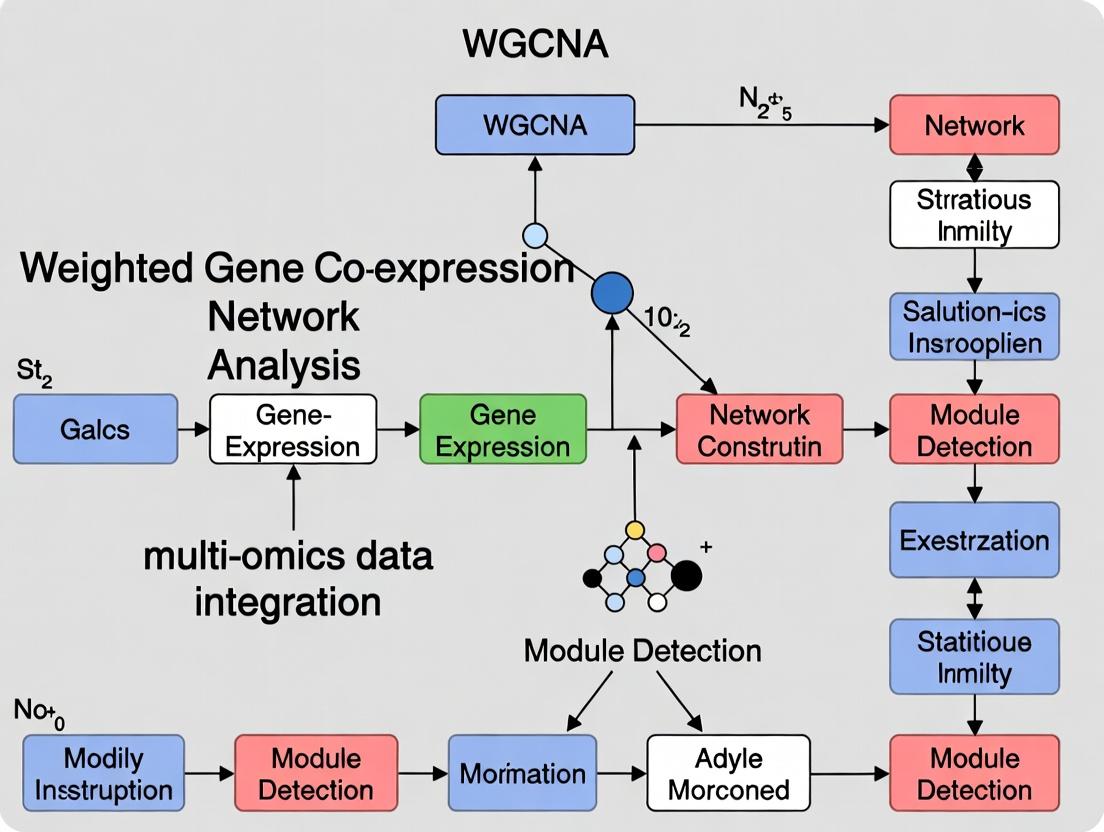
This comprehensive guide explores Weighted Gene Co-expression Network Analysis (WGCNA) as a powerful systems biology framework for multi-omics data integration.
WGCNA for Multi-Omics: Unraveling Biological Networks in Disease Research and Drug Discovery
Abstract
This comprehensive guide explores Weighted Gene Co-expression Network Analysis (WGCNA) as a powerful systems biology framework for multi-omics data integration. It provides researchers and drug development professionals with a detailed pathway from foundational concepts to advanced applications. The article covers the core principles of constructing robust co-expression networks from diverse omics layers (transcriptomics, proteomics, metabolomics), outlines practical step-by-step methodologies for identifying key driver modules and biological pathways, and addresses common computational challenges and optimization strategies. Furthermore, it examines critical validation approaches and compares WGCNA with alternative network inference methods. By synthesizing current best practices, this guide aims to empower users to effectively leverage WGCNA for uncovering complex biomarker signatures, therapeutic targets, and regulatory mechanisms underlying disease phenotypes, ultimately accelerating translational research.
Understanding WGCNA: Core Concepts and Multi-Omics Integration Fundamentals
What is WGCNA? From Gene Networks to Multi-Layer Biological Systems
WGCNA (Weighted Gene Co-expression Network Analysis) is a systems biology method for constructing robust gene co-expression networks from high-throughput transcriptomic data. It identifies modules (clusters) of highly correlated genes, relates them to phenotypic traits, and can be extended as a framework for integrating multi-omics data (e.g., proteomics, metabolomics) to model complex biological systems. This guide provides detailed application notes and protocols within the context of its use for multi-omics integration in drug discovery and systems biology research.
Application Notes & Key Concepts
Core Principles:
- Weighted Networks: Uses a soft-thresholding power (β) to emphasize strong correlations and penalize weak ones, leading to a scale-free topology.
- Module Detection: Hierarchical clustering coupled with dynamic tree cutting identifies modules of co-expressed genes.
- Module-Trait Associations: Correlates module eigengenes (MEs), representing the first principal component of a module, with external sample traits.
- Multi-Omic Extension: MEs from a "guide" omic (e.g., transcriptomics) can be used to relate to or construct networks from other omic layers (e.g., methylation, protein abundance).
Quantitative Data & Parameter Selection:
Table 1: Common Soft-Thresholding Power (β) Selection Criteria
| Dataset Size (Genes) | Recommended β Range | Scale-Free Topology Fit (R²) Goal | Mean Connectivity Goal |
|---|---|---|---|
| < 5000 | 5 - 9 | > 0.80 | 10 - 100 |
| 5000 - 20000 | 6 - 12 | > 0.85 | 50 - 500 |
| > 20000 | 10 - 20 | > 0.90 | 100 - 1000 |
Table 2: Key Output Metrics & Interpretation
| Output Metric | Description | Typical Target/Interpretation |
|---|---|---|
| Module Eigengene (ME) | 1st principal component of module expression matrix. | Represents module's expression profile. Used for trait correlation. |
| Module Membership (kME) | Correlation of a gene's expression with the ME. | High kME (>0.8) indicates a central "hub" gene within the module. |
| Gene Significance (GS) | Absolute correlation between gene expression and a trait. | Measures biological importance of the gene to the trait of interest. |
| Module Significance | Average absolute GS for all genes in a module. | Ranks modules by overall relevance to the trait. |
Detailed Experimental Protocols
Protocol 1: Standard WGCNA for RNA-seq Data
Objective: Construct a weighted gene co-expression network from RNA-seq count data and identify modules associated with a clinical trait.
Materials: See "The Scientist's Toolkit" below.
Methodology:
- Data Preprocessing & Input: Start with a normalized count matrix (genes x samples). Filter lowly expressed genes. The preferred input is often variance-stabilized or log2-transformed data (e.g., log2(CPM+1)).
- Network Construction:
a. Choose Soft Threshold (β): Calculate scale-free topology fit for a range of β powers (1-20). Plot fit indices vs. powers. Choose the lowest power where the scale-free topology fit index (R²) plateaus above 0.80-0.90.
b. Calculate Adjacency: Transform the pairwise gene correlation matrix (using biweight midcorrelation or Pearson) into an adjacency matrix using the chosen β: a_ij = |cor(x_i, x_j)|^β.
c. Create Topological Overlap Matrix (TOM): Calculate TOM from adjacency to measure network interconnectedness: TOM_ij = (Σ_u a_iu a_uj + a_ij) / (min(k_i, k_j) + 1 - a_ij), where k is connectivity.
d. Module Detection: Perform hierarchical clustering on the TOM-based dissimilarity (1-TOM). Use dynamic hybrid tree cutting (e.g.,
cutreeDynamicin R) to define gene modules. Merge highly similar modules (e.g., eigengene correlation > 0.75). - Relate Modules to Traits: Calculate module eigengenes (MEs). Correlate MEs with external sample traits (e.g., disease stage, drug response). Identify significant module-trait relationships (p-value < 0.05, adjusted).
- Downstream Analysis: Extract genes within significant modules. Perform functional enrichment analysis (GO, KEGG). Identify intramodular hub genes (genes with high kME and GS).
Protocol 2: Integrating Methylation Data Using WGCNA Framework
Objective: Identify co-methylation modules and test their relationship with transcriptomic modules.
Methodology:
- Construct Networks Separately: Perform standard WGCNA (Protocol 1) on both the gene expression matrix and a matrix of CpG site beta values (or M-values) from the same samples.
- Cross-Omic Module Analysis: Calculate pairwise correlations between all eigengenes from the methylation network and all eigengenes from the gene expression network.
- Identify Preserved/Associated Modules: Modules with strong significant correlations (e.g., |r| > 0.6, p.adj < 0.01) are considered associated. Preservation statistics (e.g.,
modulePreservationfunction) can quantify if a module in one dataset is present in the other. - Regulatory Inference: For associated module pairs, examine the correlation between hub CpG sites and hub genes within the same genomic region to hypothesize cis-regulatory relationships.
Visualizations
Diagram 1: WGCNA Core Workflow
Diagram 2: Multi-Omic Integration Strategy
The Scientist's Toolkit
Table 3: Essential Research Reagents & Software for WGCNA
| Item / Resource | Function / Purpose | Example / Notes |
|---|---|---|
| High-Quality RNA | Starting material for RNA-seq. Integrity is critical. | RIN > 8.0 for tissue samples. |
| RNA-seq Library Prep Kit | Prepares sequencing libraries from RNA. | Illumina TruSeq Stranded mRNA, NEBNext Ultra II. |
| Computational Environment | Software platform for analysis. | R (≥ v4.0) is standard. |
| WGCNA R Package | Core algorithms for network construction and analysis. | Available on CRAN and Bioconductor. |
| High-Performance Computing | Resources for memory-intensive matrix calculations. | Server with ≥ 32GB RAM for >20k genes. |
| Functional Annotation Database | For enrichment analysis of gene modules. | MSigDB, GO, KEGG, Reactome. |
| Multi-Omic Data Integration Tools | Extend WGCNA across data layers. | WGCNA functions, MixOmics, custom scripts. |
Application Notes
Scale-Free Topology in WGCNA
Scale-free topology is a critical network property where the connectivity distribution follows a power law. In WGCNA, this is approximated by ensuring the network's connectivity (k) follows P(k) ~ k^(-γ). A scale-free fit index (R²) > 0.80 is typically targeted for biological networks.
Table 1: Quantitative Benchmarks for Scale-Free Topology
| Parameter | Target Value | Typical Range in Transcriptomic Networks | Interpretation |
|---|---|---|---|
| Scale-Free Fit Index (R²) | > 0.80 | 0.75 - 0.95 | Higher values indicate stronger scale-free property. |
| Soft Power Threshold (β) | Determined by R² | 3 - 12 (β) | Power applied to adjacency matrix to achieve scale-free topology. |
| Slope (γ) | ~ -1 to -2 | -1.5 to -2.5 | Slope of the log-log plot of connectivity distribution. |
| Mean Connectivity | Dependent on β | 5 - 100 | Average number of connections per node. |
Module Eigengenes (MEs)
Module Eigengenes are defined as the first principal component of a module's expression matrix, representing the dominant expression pattern. They are used for dimensionality reduction and relating modules to external traits.
Table 2: Eigengene Properties and Applications
| Property | Calculation | Application in Multi-Omics | |
|---|---|---|---|
| Variance Explained | Typically > 50% of module variance. | Represents module's coordinated expression. | |
| Correlation with Traits | Pearson's r | Links modules to phenotypic, clinical, or other omics data. | |
| Eigengene Significance (ES) | cor(ME, trait) | Measures biological relevance of a module. | |
| Module Membership (kME) | cor(gene expression, ME) | Quantifies how well a gene belongs to its module. |
Network Connectivity Metrics
Connectivity quantifies the co-expression relationship strength of a gene with all other genes in the network.
Table 3: Key Connectivity Measures in WGCNA
| Measure | Formula (Conceptual) | Purpose |
|---|---|---|
| Adjacency (a_ij) | aij = |cor(xi, x_j)|^β | Weighted connection strength between gene i and j. |
| Topological Overlap (TO) | (Σu aiu auj + aij) / min(ki, kj) + 1 - a_ij | Measures network interconnectedness, robust to spurious correlations. |
| Intramodular Connectivity (kWithin) | Sum of adjacencies within a module. | Identifies hub genes within a module. |
| Total Connectivity (kTotal) | Sum of adjacencies with all genes. | Identifies global network hubs. |
Detailed Experimental Protocols
Protocol 2.1: Constructing a Scale-Free Co-Expression Network
Objective: To build a weighted gene co-expression network that approximates a scale-free topology. Input: Normalized gene expression matrix (e.g., FPKM, TPM, counts from RNA-seq).
- Calculate Pairwise Correlations: Compute the matrix of pairwise Pearson/Spearman correlations (S_ij) between all genes (i, j).
- Choose Soft Thresholding Power (β): a. Calculate scale-free topology fit (R²) for a range of powers (e.g., 1-20). b. Calculate mean connectivity for each power. c. Plot R² vs. power and mean connectivity vs. power. d. Select the lowest power where R² plateaus above 0.80.
- Construct Adjacency Matrix: Transform correlation matrix: aij = \|Sij\|^β.
- Convert to Topological Overlap Matrix (TOM): Compute TOM from adjacency to minimize noise and spurious connections. TOMij = (Σu aiu auj + aij) / (min(ki, kj) + 1 - aij), where ki = Σu a_iu.
- Calculate Dissimilarity: Dissimilarity = 1 - TOM.
Protocol 2.2: Identifying Modules and Module Eigengenes
Objective: To group genes into co-expression modules and extract their representative eigengenes. Input: TOM-based dissimilarity matrix.
- Hierarchical Clustering: Cluster genes using TOM dissimilarity with average linkage.
- Dynamic Tree Cut: Use the dynamic hybrid tree-cutting algorithm to define modules (branches of the dendrogram). Set parameters (e.g., deepSplit, minModuleSize) to optimize module detection.
- Merge Similar Modules: Calculate eigengenes for all initial modules. Merge modules whose eigengenes are highly correlated (e.g., cor > 0.75).
- Extract Module Eigengenes: For each final module: a. Isolate the expression matrix for genes in the module. b. Perform singular value decomposition (SVD) or PCA on this matrix. c. Define the Module Eigengene (ME) as the first principal component. This is a vector with one value per sample.
- Relate Modules to Traits: Calculate correlations (and p-values) between each ME and sample traits of interest.
Protocol 2.3: Quantifying Gene Connectivity and Identifying Hub Genes
Objective: To calculate connectivity measures and identify biologically central (hub) genes. Input: Final module assignments and adjacency matrix.
- Calculate Intramodular Connectivity (kWithin): For each gene, sum its adjacency (a_ij) with all other genes within the same module.
- Calculate Module Membership (kME): For each gene, compute the correlation between its expression profile and the module eigengene of its assigned module. High \|kME\| indicates a strong "core" member.
- Identify Hub Genes: Within each module, rank genes by kWithin or \|kME\|. The top 5-10 genes are candidate intramodular hubs. Global hubs are top-ranked by total connectivity (kTotal).
- Integrate with External Data: Overlay connectivity information (kWithin, kME) with gene significance (GS = cor(gene, trait)) to find key drivers—genes that are both highly connected and significantly related to a phenotype.
Mandatory Visualizations
WGCNA Core Workflow from Data to Modules
Scale-Free Network with Modules and Hub Gene
Eigengene Integration of Multi-Omics Data
The Scientist's Toolkit: Research Reagent Solutions
Table 4: Essential Materials & Tools for WGCNA Implementation
| Item | Function & Purpose | Example/Note |
|---|---|---|
| High-Quality RNA-seq Dataset | Primary input for network construction. Requires sufficient sample size (n > 15), depth, and normalization. | Illumina HiSeq, normalized counts/TPMs. |
| R Statistical Environment | Open-source platform for all WGCNA computations. | Version 4.2.0 or later. |
| WGCNA R Package | Core software suite implementing all algorithms. | Available on CRAN/Bioconductor. |
| High-Performance Computing (HPC) Resources | Enables analysis of large datasets (>20k genes) by parallelizing correlation/TOM calculations. | Linux cluster with ample RAM. |
| GO/KEGG Database Access | For functional enrichment analysis of identified modules. | Via R packages (clusterProfiler, GOstats). |
| Cytoscape Software | For advanced visualization and exploration of network graphs. | Useful for displaying subnetworks of key modules. |
| Phenotypic/Meta Data Table | Annotates samples with traits for module-trait correlation. | CSV file with clinical, treatment, or other omics data. |
Why Multi-Omics? The Rationale for Integrating Transcriptomics, Proteomics, and Metabolomics.
Integrating transcriptomics, proteomics, and metabolomics provides a systems-level view of biological processes, overcoming the limitations of single-omic analyses. When framed within a Weighted Gene Co-expression Network Analysis (WGCNA) approach, this integration enables the identification of multi-omic modules and key driver molecules that are central to phenotypic traits, offering unparalleled insights for biomarker discovery and therapeutic target identification.
Each omics layer provides a partial snapshot of cellular activity. Transcripts (mRNA) indicate potential protein production, proteomics identifies functional effectors and post-translational modifications, and metabolomics captures the ultimate biochemical phenotype. Discrepancies between these layers—due to regulatory mechanisms like translational control, protein turnover, and allosteric feedback—mean that single-omics studies often yield incomplete or misleading conclusions. Multi-omics integration is therefore essential for constructing causal, mechanistic models of health and disease.
Application Notes: WGCNA as an Integrative Framework
WGCNA, traditionally used for transcriptomics, can be extended to integrate multiple data types. Its power lies in constructing correlation-based networks where nodes represent molecules (genes, proteins, metabolites) and edges represent their pairwise correlations across samples. Modules of highly co-expressed molecules are then related to clinical traits.
Key Application Advantages:
- Data Reduction: Identifies multi-omic modules, reducing thousands of molecules to a few dozen functional units.
- Hub Identification: Pinpoints intramodular hub molecules (e.g., a key gene, protein, and metabolite within a module) that are potential master regulators.
- Trait Correlation: Discovers modules most significantly associated with a phenotype (e.g., disease severity, drug response).
- Causal Inference: When applied to temporal or intervention data, it can help infer directional relationships between omics layers.
Quantitative Data: Discrepancies Between Omics Layers
The following table summarizes typical concordance rates observed between omics layers, highlighting the need for integration.
Table 1: Observed Concordance Between Omics Layers in Mammalian Systems
| Comparison | Typical Concordance Range | Key Factors Influencing Discordance |
|---|---|---|
| mRNA vs. Protein Abundance | 20% - 40% (Pearson r) | Translational regulation, protein degradation rates, mRNA half-life, technical noise. |
| Protein vs. Metabolite (Pathway Level) | 30% - 50% (Spearman ρ) | Allosteric regulation, enzyme activity (PTMs), substrate availability, metabolic channeling. |
| mRNA vs. Metabolite | 10% - 30% (Spearman ρ) | Multiple layers of post-transcriptional and post-translational regulation. |
Experimental Protocols for Multi-Omic WGCNA
Protocol 4.1: Sample Preparation for Integrated Multi-Omics Analysis
Objective: To generate matched transcriptomic, proteomic, and metabolomic data from the same biological sample.
- Tissue Homogenization: Snap-frozen tissue (e.g., 50 mg) is homogenized in a dedicated lysis buffer (e.g., RIPA with protease/phosphatase inhibitors) using a bead mill homogenizer at 4°C.
- Aliquot for RNA: Immediately remove a portion of the homogenate (e.g., 20%) and mix with 5 volumes of QIAzol Lysis Reagent for subsequent RNA extraction using a kit (e.g., miRNeasy).
- Protein Precipitation: To the remaining homogenate, add 4 volumes of ice-cold acetone. Incubate at -20°C for 2 hours. Centrifuge at 15,000 x g for 15 min at 4°C. The pellet is for proteomics.
- Metabolite Extraction: Resuspend the protein pellet from Step 3 in 80% methanol/water with 0.1% formic acid. Vortex and centrifuge. The supernatant is for metabolomics; the pellet is washed and redissolved for proteomics.
- Proteomics Pellet Processing: Wash protein pellet with cold 80% acetone, dry, and solubilize in SDT buffer (4% SDS, 100mM Tris/HCl pH 7.6) for filter-aided sample preparation (FASP).
Protocol 4.2: Data Preprocessing and Normalization for WGCNA Integration
Objective: To generate clean, normalized, and comparable datasets from each omics platform.
- Transcriptomics: Process raw RNA-Seq reads (FASTQ) through a pipeline (e.g., STAR alignment -> featureCounts -> DESeq2 for variance stabilizing transformation). Filter lowly expressed genes (counts per million > 1 in at least 50% of samples).
- Proteomics (LC-MS/MS): Process raw spectra (e.g., using MaxQuant). Use LFQ intensity values. Filter proteins with >50% valid values across samples. Impute missing values using a k-nearest neighbors (KNN) algorithm. Log2-transform data.
- Metabolomics (LC-MS): Process raw data (e.g., using XCMS for peak picking/alignment). Normalize to internal standards and total ion current. Perform log-transformation and autoscaling (mean-centered and divided by the standard deviation of each variable).
- Common Sample Scaling: For each omics dataset, ensure samples are in columns and features (genes, proteins, metabolites) in rows. Apply a final scaling such that each sample has a median absolute deviation (MAD) of 1 to make datasets comparable.
Protocol 4.3: Integrated Multi-Omic WGCNA Analysis
Objective: To construct a consensus network identifying modules present across multiple omics layers.
- Construct Separate Networks: Use the WGCNA R package to build an unsigned correlation network for each omic dataset independently. Use a soft-power threshold (β) selected via the scale-free topology criterion.
- Calculate Topological Overlap Matrices (TOM): Generate a TOM for each dataset, quantifying network interconnectedness.
- Consensus Network Analysis: Use the
blockwiseConsensusModulesfunction in WGCNA. Input the TOMs from each omics dataset. SetconsensusQuantile(e.g., 0.5) to derive a consensus TOM. - Module Detection: Perform hierarchical clustering on the consensus TOM dissimilarity (1-consensusTOM) and use dynamic tree cutting to identify consensus modules.
- Module-Trait Association: Correlate the consensus module eigengenes (first principal component of a module) with phenotypic traits of interest (e.g., disease status, survival time).
- Hub Identification: For modules of interest, calculate intramodular connectivity (kWithin) for all molecules across all omics types. Identify the top hubs (genes, proteins, metabolites) as potential key drivers.
Visualizations
Title: Multi-Omic WGCNA Workflow from Sample to Insight
Title: Information Flow and Regulation Between Omics Layers
The Scientist's Toolkit: Key Reagent Solutions
Table 2: Essential Research Reagents for Multi-Omic Studies
| Reagent / Kit | Function in Multi-Omic Workflow |
|---|---|
| QIAGEN miRNeasy Mini Kit | Simultaneous purification of high-quality total RNA (for transcriptomics) and small RNAs from the same lysate, preserving sample for other omics. |
| PreOmics iST Kit | Integrated sample preparation for proteomics; enables rapid, reproducible protein digestion and peptide cleanup in a single tube. |
| Methanol (LC-MS Grade) with 0.1% Formic Acid | Standard solvent for metabolite extraction from cell/tissue pellets, compatible with downstream LC-MS metabolomics. |
| TripleTOF or Orbitrap Mass Spectrometer | High-resolution, high-mass-accuracy MS systems capable of both data-dependent acquisition (proteomics) and SWATH/DIA for synchronized multi-omic profiling. |
| Tris(2-carboxyethyl)phosphine (TCEP) | A reducing agent superior to DTT for proteomics, stabilizing protein disulfide bonds during lysis and preparation. |
| Ammonium Bicarbonate (MS Grade) | Essential buffer for protein digestion (trypsin) and peptide resuspension prior to LC-MS/MS injection. |
| Internal Standard Kits (e.g., Biocrates) | Contains labeled metabolite standards for absolute quantification and quality control in targeted metabolomics assays. |
| WGCNA R Package | The primary computational toolkit for constructing co-expression networks and performing consensus module analysis. |
Within a broader thesis on applying Weighted Gene Co-expression Network Analysis (WGCNA) to multi-omics research, robust pre-processing is the critical, non-negotiable foundation. WGCNA constructs networks based on correlation patterns, making it highly sensitive to technical noise, batch effects, and improper scaling. This document provides detailed application notes and protocols for essential pre-processing steps—normalization, filtering, and suitability checks—tailored for major omics data types prior to integrative WGCNA.
Omics Data Suitability Checklist for WGCNA
WGCNA requires specific data structure and quality. The following table outlines prerequisites for each omics layer.
Table 1: Suitability Checks for Omics Data Prior to WGCNA
| Omics Type | Minimum Recommended Sample Size | Required Data Structure | Key Suitability Metric | Threshold/Note |
|---|---|---|---|---|
| Transcriptomics (RNA-seq) | 15-20 | Matrix: Genes x Samples | Median Count/Power Threshold | >10-15 counts per gene for a sufficient number of samples |
| Microarray (Gene Expr.) | 15 | Matrix: Probesets x Samples | Signal Intensity Distribution | No significant skew; Shapiro-Wilk p > 0.05 for random sample |
| Proteomics (LFQ/MS) | 20 | Matrix: Proteins x Samples | Missing Value Rate | <20% missing per protein; requires imputation strategy |
| Metabolomics (LC-MS) | 15-20 | Matrix: Metabolites x Samples | Coefficient of Variation (CV) | QC Pool CV < 20-30% for detected features |
| Epigenomics (Methylation Array) | 20 | Matrix: CpG sites x Samples | Detection p-value | >95% sites with detection p < 0.01 across all samples |
| Universal Check | N/A | N/A | Sample Outlier (Network Z-score) | Z < -2.5 in sample network connectivity suggests removal |
Core Pre-processing Protocols
Protocol: RNA-seq Count Data Normalization for WGCNA
Objective: To remove library size and composition biases, enabling meaningful correlation calculations.
- Filtering: Remove genes with near-zero expression.
keep <- rowSums(cpm(y) > 1) >= min(ncol(y)/2, 10)whereyis the DGEList. - Normalization: Apply trimmed mean of M-values (TMM) normalization using
edgeR::calcNormFactors. - Transformation: Convert normalized counts to a log2 scale. Use
log2(cpm(y, normalized.lib.sizes=TRUE) + k)wherekis a small pseudo-count (e.g., 1). - Batch Correction (if needed): Use
sva::ComBaton the log2-CPM matrix, specifying known batch variables. - Output: A continuous, approximately normally distributed matrix for WGCNA
datExprinput.
Protocol: Proteomics Label-Free Quantification (LFQ) Pre-processing
Objective: Handle missing data and normalize for protein abundance.
- Filtering: Remove proteins only identified in one sample. Retain proteins with valid values in ≥70% of samples in at least one experimental group.
- Imputation: Perform data-driven imputation (e.g.,
missForestfor random forest-based imputation ormicefor MICE) or left-censored imputation (e.g., MinProb method viaimputeLCMD). - Normalization: Apply quantile normalization or variance stabilizing normalization (VSN) using the
vsnpackage. - Log Transformation: Ensure data is on a log2 scale (often done by upstream software).
- Batch Adjustment: Utilize
limma::removeBatchEffectif technical batches are known.
Protocol: Metabolomics Peak Table Pre-processing
Objective: Correct for systematic variation and scaling differences.
- Filtering by QC: Remove features with high relative standard deviation (RSD) >30% in quality control (QC) samples.
- Missing Value Imputation: For metabolic features, use k-nearest neighbor (KNN) imputation or replace with 1/5 of the minimum positive value.
- Normalization: Apply probabilistic quotient normalization (PQN) to correct for dilution effects. This is implemented in the
NOREVAR package orpmrpackage. - Scaling: For WGCNA, use unit variance scaling (autoscaling) to give all metabolites equal weight. This is done via
scale()function in R (mean=0, sd=1). - Drift Correction: If using LC-MS, apply quality control-based robust locally estimated scatterplot smoothing (LOESS) signal correction.
Visualization of the Multi-Omics WGCNA Pre-processing Workflow
Title: Multi-Omics Data Pre-processing Flow for WGCNA
The Scientist's Toolkit: Essential Research Reagent Solutions
Table 2: Key Reagents and Tools for Omics Pre-processing
| Item/Category | Specific Product/Software Example | Function in Pre-processing |
|---|---|---|
| RNA-seq Library Prep | Illumina Stranded mRNA Prep, Ligation Kit | Generates sequencing libraries; choice impacts GC content normalization needs. |
| Proteomics Sample Prep | S-Trap or FASP Digestion Kits | Efficient protein digestion; minimizes contaminants affecting quantification. |
| Metabolomics Internal Standards | MSK-ERC-010 (MS-RESOLVE Kit) | Aids in retention time alignment, peak picking, and semi-quantification in LC-MS. |
| QC Reference Material | HEK293 Proteome Standard (Pierce) | Serves as inter-laboratory and inter-batch QC for proteomics normalization. |
| DNA Methylation Control | Infinium HD Methylation Quality Control Kit (Illumina) | Assesses bisulfite conversion efficiency for methylation array data. |
| Normalization Software | edgeR (R), vsn (R), NOREVA (R/Python) |
Executes statistical algorithms for removing technical variance. |
| Batch Correction Tool | sva/ComBat (R), Harmony (R/Python) |
Algorithmically removes batch effects while preserving biological signal. |
| Imputation Package | missForest (R), imputeLCMD (R) |
Handles missing data with advanced model-based methods. |
Pathway of Data Integrity Checks
Title: Data Integrity Check Pathway Pre-WGCNA
Normalization Method Selection Guide
Table 3: Normalization Method by Omics Type and Data Characteristic
| Omics Data Type | Primary Recommended Method | Alternative Method | When to Use Alternative |
|---|---|---|---|
| Bulk RNA-seq (Gene Counts) | TMM (edgeR) + log2(CPM) | DESeq2's Median of Ratios | For very low sample numbers (<10), though WGCNA itself is not advised. |
| Single-Cell RNA-seq | SCTransform (glmGamPoi) | Log-Normalize (Seurat) | If computational resources are limited for large cell numbers. |
| Global Proteomics (LFQ) | VSN Normalization | Quantile Normalization | When assumption of same intensity distribution across samples holds. |
| Targeted Proteomics/MRM | Median Centering | Linear Scaling to Reference | When stable internal standards are spiked-in for each peptide. |
| Untargeted Metabolomics | Probabilistic Quotient (PQN) | Cubic Spline Normalization | For severe nonlinear batch effects over analysis run time. |
| DNA Methylation (Beta-values) | Noob (preprocessNoob) | SWAN (minfi) | For Infinium arrays, to correct type I/II probe design bias. |
| Post-Normalization Check | SD/Mean Plot | PCA of QC Samples | Verify reduction of technical variance. |
Formulating a precise biological question and testable hypothesis is the critical first step in any network analysis, including Weighted Gene Co-expression Network Analysis (WGCNA) within multi-omics research. A well-defined hypothesis guides experimental design, omics data selection, analytical parameters, and the interpretation of network biology, transforming data exploration into targeted discovery.
Core Principles for Hypothesis Formulation in WGCNA
From Broad Inquiry to Testable Hypothesis
A biological question must be refined into a specific, falsifiable statement that a network analysis can address.
Table 1: Evolution of a Biological Question into a WGCNA-Testable Hypothesis
| Biological Inquiry | Refined Biological Question | Testable WGCNA Hypothesis |
|---|---|---|
| What happens in disease X? | How does the transcriptomic landscape differ between healthy and disease X states? | Specific gene co-expression modules (e.g., "blue module") will be significantly associated with the disease state and enriched for known disease-related pathways. |
| How does a drug work? | What are the coordinated multi-omic changes induced by Drug Y in target cells? | Treatment with Drug Y will significantly alter the connectivity (module eigengenes) of modules associated with cell proliferation compared to vehicle control. |
| What is the role of Gene Z? | With which biological processes is Gene Z co-expressed across a diverse panel of tissues/conditions? | Gene Z will be a high-connectivity hub gene (high intramodular connectivity, kWithin) within a module enriched for a specific biological function (e.g., immune response). |
Integrating Multi-Omics Layers
Hypotheses can span multiple molecular layers, leveraging WGCNA's extension to traits and other omics datasets.
Table 2: Multi-Omic Hypothesis Frameworks for WGCNA
| Hypothesis Type | Core Question | Analytic Approach |
|---|---|---|
| Driver Identification | Do changes in DNA methylation (CpG islands) drive specific co-expression modules? | Correlate module eigengenes (MEs) from RNA-seq WGCNA with methylation beta-values from array/seq data. |
| Post-Translational Validation | Are hub proteins in a disease-associated module also key phospho-sites? | Overlap hub gene list from transcriptomic WGCNA with phosphoproteomic data to identify conserved key regulators. |
| Phenotypic Linkage | Which gene modules explain variance in a complex clinical trait (e.g., drug resistance score)? | Correlate MEs with external clinical traits; perform gene significance (GS) vs. module membership (MM) plots. |
Experimental Protocols
Protocol 1: Formulating and Testing a Module-Trait Association Hypothesis
Objective: To test the hypothesis that a specific gene co-expression module is associated with a binary clinical trait (e.g., tumor vs. normal).
Materials:
- Normalized gene expression matrix (e.g., FPKM, TPM from RNA-seq).
- Clinical trait data (binary, continuous, or categorical).
- R statistical environment with WGCNA package installed.
Procedure:
- Construct Co-expression Network: Use the
blockwiseModulesfunction with appropriate soft-thresholding power (β) determined via scale-free topology fit. - Calculate Module Eigengenes (MEs): The first principal component of each module, representing the module's expression profile.
- Correlate MEs with Traits: Use the
corandcorPvalueStudentfunctions to compute correlation and significance between each ME and the clinical trait. - Visualize Association: Generate a Module-Trait Relationship heatmap.
- Validate Specificity: For the significantly associated module, plot Gene Significance (GS) for the trait against Module Membership (MM) for genes in that module. A high correlation suggests the module is functionally relevant to the trait.
Protocol 2: Multi-Omic Integration via Module Eigengene Correlation
Objective: To test the hypothesis that a transcriptomic module's activity is correlated with a metabolomic profile.
Materials:
- Transcriptomic-derived Module Eigengenes (from Protocol 1, Step 2).
- Normalized metabolomic abundance matrix (e.g., peak intensities).
- Metadata linking transcriptomic and metabolomic samples.
Procedure:
- Data Alignment: Match samples between transcriptomic (ME matrix) and metabolomic datasets using shared sample IDs.
- Bivariate Correlation: For each transcriptomic ME and each metabolite, compute Pearson or Spearman correlation coefficients and p-values. Apply multiple testing correction (e.g., FDR).
- Identify Significant Correlations: Filter for correlation pairs meeting significance thresholds (e.g., \|r\| > 0.7, FDR < 0.05).
- Functional Interpretation: Perform pathway enrichment on metabolites significantly correlated with the transcriptomic module of interest to find convergent biology.
Visualizations
Title: Hypothesis-Driven WGCNA Workflow
Title: Multi-Omic Hypothesis Integration Model
The Scientist's Toolkit: Research Reagent Solutions
Table 3: Essential Materials for Hypothesis-Driven WGCNA
| Item / Reagent | Function in Hypothesis Testing | Example / Provider |
|---|---|---|
| High-Throughput Sequencing Service | Generates primary transcriptomic (RNA-seq) or epigenomic data for network construction. | Illumina NovaSeq, BGI DNBSEQ. |
| R Statistical Software with WGCNA | Core computational environment for network construction, module detection, and trait association. | CRAN: WGCNA package (v1.72-5+). |
| Bioconductor Annotation Packages | Maps gene identifiers (e.g., Ensembl ID) to symbols and functional annotations for enrichment. | org.Hs.eg.db, clusterProfiler. |
| Clinical Phenotype Database | Provides quantitative or categorical traits for Module-Trait Relationship analysis. | In-house patient records, TCGA, GEO datasets. |
| Multi-Omics Data Integration Platform | Facilitates correlation of MEs with other molecular data (proteomics, metabolomics). | OmicsNet, MixOmics R package. |
| Pathway Analysis Software | Interprets biological meaning of significant modules (hub genes) from WGCNA. | Metascape, GSEA, Ingenuity Pathway Analysis (IPA). |
| siRNA/shRNA or CRISPR Library | For experimental validation of hub genes identified as critical by network analysis. | Dharmacon, Sigma-Aldrich, Synthego. |
Step-by-Step WGCNA Pipeline: From Raw Data to Biological Insight in Multi-Omics Studies
The construction of a biologically meaningful adjacency matrix is the foundational step in Weighted Gene Co-expression Network Analysis (WGCNA). This initial phase transforms high-dimensional, multi-omics data (e.g., transcriptomics, proteomics) into a network framework by quantifying pairwise co-expression relationships between genes or features. The critical parameter in this step is the soft-thresholding power (β), which determines the weighting of co-expression similarities to satisfy the scale-free topology criterion—a property commonly observed in biological networks. Proper execution of this step is essential for downstream module detection and systems-level integration in multi-omics studies.
Theoretical Basis & Key Parameters
The adjacency matrix (aij) is constructed from the matrix of pairwise co-expression similarities (sij), typically calculated as the absolute value of the Pearson correlation coefficient between gene expression profiles: sij = |cor(xi, xj)|.
The soft-thresholding approach raises this similarity to a power β: aij = sijβ
This transformation emphasizes strong correlations at the expense of weaker ones, promoting a scale-free network topology where the probability of a node having k connections follows a power law: P(k) ~ k-γ. The goal is to choose the lowest β that achieves an approximate scale-free topology (typically measured by the scale-free topology fit index R² > 0.80-0.90).
Table 1: Impact of Soft-Thresholding Power (β) on Network Properties
| β Value | Mean Connectivity | Median Connectivity | Scale-free Topology Fit (R²) | Network Density | Typical Use Case |
|---|---|---|---|---|---|
| 1 (unsigned) | Very High | Very High | Low (e.g., 0.3-0.5) | Very High | Linear networks, exploratory analysis |
| 4-6 | High | Moderate | Moderate (e.g., 0.6-0.8) | High | Standard RNA-seq datasets (n > 20) |
| 8-12 (Recommended Range) | Moderate | Low | High (e.g., 0.8-0.9) | Moderate | Most applications; balances topology and biological meaning |
| >14 | Low | Very Low | Saturated (e.g., >0.9) | Low | Very large sample sizes (n > 100) or noisy data |
| NA (Signed Hybrid) | Variable | Variable | Variable | Variable | When distinguishing positive/negative correlations is critical |
Detailed Protocol: Choosing β and Constructing the Adjacency Matrix
Prerequisites and Data Preparation
- Input Data: A normalized, filtered expression matrix (genes/features × samples). For multi-omics, ensure proper batch correction and integration prior to this step.
- Software: R (recommended) with
WGCNApackage installed and enabled.
Step-by-Step Protocol
Day 1: Data Loading and Pre-processing
- Load the expression data into R. Ensure the data is in a matrix format with row names as gene identifiers and column names as sample IDs.
- Check for excessive missing data and outliers. The
goodSamplesGenesfunction can be used for a basic check. - Optionally, perform a sample clustering dendrogram to identify and remove obvious outliers.
Day 2: Network Topology Analysis
- Choose a set of candidate soft-thresholding powers (β). A typical range is 1 to 20 for unsigned networks, or 1 to 30 for signed networks.
- Use the
pickSoftThresholdfunction to analyze scale-free topology and mean connectivity for each candidate power. - The function returns a list containing the fit indices for scale-free topology (R²) and the mean connectivity for each power.
Day 3: Visualization and Power Selection
- Plot the results to visualize the relationship between β, scale-free fit, and mean connectivity.
- Selection Criterion: Choose the lowest power where the scale-free topology fit index (R²) flattens out above a threshold (commonly 0.80-0.90). The mean connectivity should ideally be above 50-100 to avoid overly sparse networks but can be lower for very large datasets.
- Record the selected β value.
Day 4: Adjacency Matrix Construction
- Using the selected β, calculate the adjacency matrix.
- (Optional but recommended) Transform the adjacency matrix into a Topological Overlap Matrix (TOM) to minimize noise and spurious connections.
- Save the adjacency and/or TOM matrix for downstream module detection.
Workflow Diagram
Title: WGCNA Step 1: β Selection & Adjacency Matrix Construction Workflow
The Scientist's Toolkit: Research Reagent Solutions
Table 2: Essential Computational Tools & Packages for WGCNA Step 1
| Item | Function/Description | Key Feature | Resource/Link |
|---|---|---|---|
| R Statistical Software | Open-source platform for statistical computing and graphics. The primary environment for running WGCNA. | Extensive package ecosystem, reproducibility. | https://www.r-project.org/ |
| WGCNA R Package | Comprehensive collection of R functions for performing all steps of WGCNA. | Implements pickSoftThreshold, adjacency, and TOMsimilarity functions. |
https://horvath.genetics.ucla.edu/html/CoexpressionNetwork/Rpackages/WGCNA/ |
| High-Performance Computing (HPC) Cluster | For large datasets (e.g., >20,000 genes, >500 samples), adjacency/TOM calculation is memory and CPU intensive. | Parallel computing support (e.g., enableWGCNAThreads()). |
Institutional HPC resources (e.g., SLURM, SGE). |
| RStudio IDE | Integrated development environment for R. Facilitates code development, visualization, and project management. | Interactive plotting, debugging, and project workspace. | https://posit.co/products/open-source/rstudio/ |
| Normalized Expression Matrix | The primary input data. Must be properly normalized (e.g., TPM/FPKM for RNA-seq, log2 transformed, batch-corrected). | Quality determines network biological relevance. | Generated from upstream pipelines (e.g., STAR/featureCounts, DESeq2). |
| ggplot2 / gridExtra R Packages | For creating publication-quality figures of scale-free topology and connectivity plots beyond base R plots. | Enhanced customization and multi-panel figures. | https://ggplot2.tidyverse.org/ |
Application Notes: From Dissimilarity to Modules
Following the construction of a co-expression network and calculation of a topological overlap-based dissimilarity matrix (Step 1), Step 2 focuses on identifying modules—clusters of highly interconnected genes. This is a critical unsupervised learning step that defines the functional units for downstream analysis. The standard pipeline employs hierarchical clustering coupled with the Dynamic Tree Cut algorithm, followed by an optional merging step. This process transforms a distance matrix into biologically meaningful gene sets correlated with phenotypes or omics traits.
Core Algorithm Comparison
| Algorithm/Step | Primary Function | Key Parameters | Output | Advantage for WGCNA |
|---|---|---|---|---|
| Hierarchical Clustering | Groups genes based on dissimilarity matrix using a bottom-up approach. | Dissimilarity matrix, Linkage method (average, complete), Distance measure (1-TOM). | Dendrogram showing nested gene relationships. | Provides a global structure of gene relationships, essential for visualizing module hierarchy. |
| Dynamic Tree Cut | Automatically detects clusters (modules) in the dendrogram by analyzing branch shape. | deepSplit (0-4), minClusterSize (e.g., 30), cutHeight. |
Initial module assignments for each gene. | Detects irregularly shaped clusters, is more robust than static height cutting, and adapts to dendrogram structure. |
| Module Merging | Merges highly correlated module eigengenes to reduce redundancy. | mergeCutHeight (e.g., 0.25, representing 75% correlation). |
Final, consolidated set of co-expression modules. | Reduces noise and yields more distinct, biologically interpretable modules. |
Quantitative Data from a Representative Analysis
The following table illustrates typical outcomes from each stage of the module detection process in a study analyzing 10,000 genes.
| Analysis Stage | Number of Clusters/Modules | Median Module Size (Genes) | Range of Module Size (Genes) | Key Metric Value |
|---|---|---|---|---|
| Post Dynamic Tree Cut | 42 | 180 | 32 - 950 | cutHeight = 0.99, minClusterSize = 30 |
| Post Module Merging | 27 | 245 | 42 - 1100 | mergeCutHeight = 0.25 (ME cor > 0.75 merged) |
| Grey Module | 1 (Always present) | 1250 | N/A | Contains genes not assigned to any co-expression module. |
Experimental Protocols
Protocol 1: Hierarchical Clustering and Dynamic Tree Cutting
This protocol details the generation of gene modules from a Topological Overlap Matrix (TOM)-based dissimilarity.
Materials:
- R statistical environment (version 4.3.0 or higher).
- WGCNA R package (version 1.72-5 or higher).
- Input:
dissTOMmatrix (from Step 1).
Procedure:
- Generate Gene Dendrogram:
- Visualize Initial Dendrogram:
- Apply Dynamic Tree Cut:
- Assign Module Colors:
- Visualize Module Assignments:
Protocol 2: Module Eigengene Calculation and Merging of Similar Modules
This protocol merges modules whose expression profiles are highly correlated to reduce redundancy.
Materials:
- Normalized gene expression matrix (from Step 1).
- Initial module color assignments from Protocol 1.
Procedure:
- Calculate Module Eigengenes (MEs):
- Quantify Module Similarity:
- Cluster Module Eigengenes:
- Set Merge Threshold and Merge:
- Visualize Final Result:
Mandatory Visualizations
WGCNA Module Detection Workflow
Dynamic vs. Static Clustering on Dendrogram
The Scientist's Toolkit: Research Reagent Solutions
| Item | Function in Module Detection |
|---|---|
| R with WGCNA Package | Core software environment providing all statistical functions for hierarchical clustering, dynamic tree cutting, and eigengene calculation. |
| High-Performance Computing (HPC) Cluster | Essential for clustering large-scale omics datasets (>20,000 features) due to the O(n²) memory and O(n³) computational complexity of hierarchical clustering. |
| Dynamic Tree Cut Algorithm | The key "reagent" for intelligent, shape-sensitive partitioning of the dendrogram, superior to fixed-height cutting. |
| Module Eigengene (ME) | Serves as a representative proxy for the entire module's expression profile, enabling correlation-based module merging and downstream trait association. |
Merge Cut Height Parameter (mergeCutHeight) |
A critical threshold determining the stringency of module consolidation; lower values create more distinct, fewer modules. |
| Color Label Assignment | Provides a standardized system (via labels2colors) to visually track modules through plots and across analyses. |
Application Notes
Correlation analysis between module eigengenes (MEs) and measured clinical or physiological traits is the critical step in WGCNA that translates network topology into biological insight. This step identifies modules of co-expressed genes whose expression profiles are significantly associated with traits of interest, thereby pinpointing candidate biomarkers or therapeutic targets.
Core Principles: The module eigengene, defined as the first principal component of a module's expression matrix, serves as a representative profile for the entire module. Calculating the Pearson (or Spearman) correlation between each ME and each external trait generates a Module-Trait Relationship (MTR) matrix. High absolute correlation values (e.g., |r| > 0.5) and statistically significant p-values (e.g., p < 0.05, adjusted for multiple testing) highlight modules of primary interest for downstream functional analysis and multi-omics integration.
Multi-Omic Integration Context: Within a broader WGCNA-based multi-omics thesis, MTR analysis is not confined to gene expression. The same correlational framework can be applied to relate meta-modules (derived from integrated omics layers) to traits, or to correlate eigengenes from a gene co-expression network with summary profiles from other molecular layers (e.g., metabolite abundance, chromatin accessibility modules).
Table 1: Example Module-Trait Correlation Matrix
| Module (Color) | Module Eigengene | Trait A (e.g., Disease Severity) | Trait B (e.g., Drug Response) | Trait C (e.g., Survival Time) |
|---|---|---|---|---|
| MEblue | PC1 (32% variance) | r = 0.85, p = 2e-12 | r = -0.10, p = 0.45 | r = -0.72, p = 5e-08 |
| MEbrown | PC1 (28% variance) | r = 0.15, p = 0.23 | r = 0.78, p = 4e-10 | r = 0.05, p = 0.70 |
| MEturquoise | PC1 (41% variance) | r = -0.65, p = 3e-06 | r = 0.22, p = 0.09 | r = 0.91, p = 1e-15 |
| MEgrey | PC1 (8% variance) | r = 0.02, p = 0.86 | r = -0.04, p = 0.75 | r = 0.01, p = 0.93 |
Note: MEgrey typically contains genes not assigned to any cohesive module. Significant correlations (example p < 0.001) are highlighted in bold.
Experimental Protocols
Protocol 1: Calculating Module-Trait Relationships
Objective: To quantify associations between gene co-expression modules and clinical/experimental traits.
Materials: Normalized gene expression matrix, module assignment vector (from previous WGCNA steps), trait data matrix (rows=samples, columns=traits).
Procedure:
- Compute Module Eigengenes: For each module, calculate the first principal component (PC1) of the standardized expression matrix for all genes within that module. This yields one eigengene vector per module.
- Correlation Calculation: Perform a correlation test (Pearson recommended for normally distributed data) between each module eigengene (ME) and each trait.
- Multiple Testing Adjustment: Apply a false discovery rate (FDR) correction (e.g., Benjamini-Hochberg) to the matrix of p-values.
- Visualization: Generate a heatmap of the Module-Trait correlation matrix, annotated with significance stars.
Protocol 2: Gene Significance and Module Membership Analysis
Objective: To validate module-trait associations internally by linking trait-related gene importance (Gene Significance) to intramodular connectivity (Module Membership).
Procedure:
- Calculate Gene Significance (GS): For a trait of interest, GS is defined as the absolute value of the correlation between the gene's expression profile and the trait.
GS = |cor(gene, trait)|. - Calculate Module Membership (MM): Also known as kME, MM for a gene in a given module is the correlation between the gene's expression and the module's eigengene. High |kME| indicates the gene is a central hub within its module.
- Relate GS to MM: For genes within a module significantly correlated with the trait, a strong positive correlation between GS and MM is expected. This confirms that hub genes within the module are also highly associated with the trait.
Table 2: Research Reagent Solutions Toolkit
| Item | Function in MTR Analysis | Example/Note |
|---|---|---|
| WGCNA R Package | Provides all core functions for eigengene calculation, correlation, and visualization. | moduleEigengenes(), corPvalueStudent() |
| Clinical Metadata Database | Structured repository of phenotype/trait data matched to expression sample IDs. | REDCap, Sample Manager LIMS. Must ensure precise sample matching. |
| Statistical Software | Platform for performing correlation tests, PCA, and multiple testing corrections. | R Stats, Python SciPy/StatsModels |
| High-Performance Computing (HPC) Cluster | Resources for computationally intensive correlation calculations on large datasets. | Essential for multi-omics (10,000+ features) or large sample sizes (n > 1000). |
| Data Visualization Library | Creates publication-quality Module-Trait heatmaps and scatter plots (GS vs. MM). | R ggplot2, pheatmap; Python seaborn, matplotlib |
Diagram: Module-Trait Correlation Analysis Workflow
Diagram: Multi-Omics Module-Trait Correlation Extension
Application Notes
In WGCNA, hub genes/features are defined as those with high intramodular connectivity (kWithin) and high correlation with the module eigengene (Module Membership, MM). These features are central to a module's structure and are strong candidates for key regulatory elements or biomarkers. This step is critical for transitioning from network-level analysis to targeted biological validation.
Key Metrics and Interpretation
- Intramodular Connectivity (kWithin): A measure of how well-connected a node is to all other nodes within its assigned module. It is calculated as the sum of connection strengths (absolute correlation coefficients raised to a power β) with all other nodes in the module.
- Module Membership (MM): Also known as kME (eigengene-based connectivity). It is defined as the correlation between a node's expression profile and the module eigengene (the first principal component of the module). High absolute MM indicates the node is centrally representative of the module's expression pattern.
The identification of hubs relies on the strong correlation between kWithin and MM. True hubs exhibit high values for both metrics.
Table 1: Quantitative Thresholds for Hub Identification
| Metric | Typical High-Value Threshold | Calculation Method | Biological Implication |
|---|---|---|---|
| Intramodular Connectivity (kWithin) | Top 10-20% within module or > median + 2*MAD | Sum of adjacency (a_ij) to all nodes j in the same module. | Indicates high local influence within the module's network topology. |
| Module Membership (MM) | Absolute value > 0.8 | Pearson cor(gene expression, module eigengene). | Indicates strong concordance with the module's global expression pattern. |
| Hub Significance (p-value) | < 0.05 (after multiple test correction) | p-value for the MM correlation. | Statistical confidence that the gene belongs to the module. |
Table 2: Comparison of Hub Gene Identification Methods
| Method | Pros | Cons | Best For |
|---|---|---|---|
| Top kWithin | Pure topological measure, unbiased by eigengene. | Can be sensitive to module size and density. | Finding locally connected "cores" within a module. |
| Top MM (kME) | Strong biological interpretation (correlation with signature). | May miss hubs with non-linear relationships to eigengene. | Finding genes most representative of the module's expression pattern. |
| Composite Score (e.g., kWithin * |MM|*) | Balances topology and representativeness. | Requires setting arbitrary weightings. | A balanced, consensus list of high-confidence hubs. |
Experimental Protocols
Protocol 1: Calculating Intramodular Connectivity and Module Membership in R
Objective: To compute kWithin and MM for all genes/features across all modules in a WGCNA network.
Materials: R environment (v4.3+), WGCNA package (v1.72+), correlation network (adjacency or TOM matrix), module assignment vector, expression matrix.
Procedure:
- Load Data: Import the expression matrix (
datExpr), module colors/labels (moduleLabels), and the network adjacency matrix (adjMat) or topological overlap matrix (TOM). - Calculate Module Eigengenes:
- Compute Module Membership (MM or kME):
- Compute Intramodular Connectivity (kWithin):
- Identify Hub Genes: Merge data and apply thresholds.
Protocol 2: Experimental Validation of Hub Genes via siRNA Knockdown
Objective: Functionally validate a putative hub gene's central role in its co-expression module.
Materials: Cultured cell line relevant to the study phenotype, siRNA targeting hub gene, non-targeting siRNA control, transfection reagent, RNA extraction kit, qRT-PCR system, primers for hub gene and module "driver" genes.
Procedure:
- Design: Seed cells in 12-well plates. Perform triplicate transfections with: a) Hub-gene siRNA, b) Non-targeting siRNA, c) Mock transfection.
- Transfection: Use optimized protocol for your cell line. Harvest cells 48-72 hours post-transfection.
- RNA Extraction & qRT-PCR: Extract total RNA. Synthesize cDNA. Perform qPCR for:
- The targeted hub gene (confirmation of knockdown).
- 5-10 high-MM genes from the same module.
- 2-3 genes from unrelated modules as negative controls.
- Housekeeping genes (GAPDH, ACTB).
- Analysis: Calculate ∆∆Ct values. The functional validation hypothesis is that knockdown of the hub gene will significantly downregulate the expression of other high-MM genes within its module, but not control genes from other modules.
Visualizations
Workflow for Hub Gene Identification
Relationship Between MM and kWithin for Hub Definition
The Scientist's Toolkit
Table 3: Essential Research Reagents & Solutions for Hub Gene Analysis
| Item | Function in Analysis | Example/Details |
|---|---|---|
| WGCNA R Package | Core software for computing all network metrics, including kWithin and MM. | intramodularConnectivity(), moduleEigengenes(), corPvalueStudent() functions. |
| High-Performance Computing (HPC) Resources | Enables calculation of connectivity metrics for large (N>20k features) datasets. | Cloud instances (AWS, GCP) or local clusters with sufficient RAM for large matrix operations. |
| R/Bioconductor Packages for Visualization | Creates diagnostic plots (MM vs. kWithin scatterplots) to identify hubs. | ggplot2, plotly for interactive plots, DOSE/clusterProfiler for enrichment of hub lists. |
| siRNA or sgRNA Libraries | Essential for experimental validation of hub gene function via knockdown/knockout. | Commercially available libraries (e.g., Dharmacon, Sigma) targeting coding genes. |
| qRT-PCR Assays | Validates hub gene knockdown and its downstream effect on module gene expression. | TaqMan assays or SYBR Green primers designed for hub and high-MM module genes. |
| Co-Expression Database | Provides external validation of hub relationships in larger, public datasets. | Databases like COXPRESdb, GeneMANIA, or GTEx Portal for human data. |
Application Notes: Integration Strategies in Multi-Omics WGCNA
Integrating multi-omics data (e.g., transcriptomics, proteomics, methylation) via WGCNA presents two primary strategic paradigms: Layer-Specific Analysis and Combined Analysis. Consensus WGCNA provides a framework to identify preserved modules across multiple data sets.
Layer-Specific Analysis involves constructing independent co-expression networks for each omics layer, followed by comparative analysis to find relationships (e.g., mRNA-protein module correlations). It preserves data-specific variance but may miss cross-layer interactions.
Combined Analysis merges features from all omics layers into a single matrix to build one network, forcing modules to contain features from different data types. It directly reveals multi-optic modules but can be confounded by technical biases between platforms.
Consensus WGCNA is applied within Layer-Specific or Combined frameworks to find robust, reproducible modules across multiple sample sets (e.g., different cohorts or treatments). It calculates a consensus topological overlap matrix (TOM) and identifies modules preserved across datasets.
Quantitative Comparison of Strategies
Table 1: Strategic Comparison of Multi-Omics WGCNA Approaches
| Strategy | Primary Input | Key Output | Advantages | Disadvantages | Typical Module Count (Example: 100 samples) |
|---|---|---|---|---|---|
| Layer-Specific | Separate data matrices per omics type. | Independent module sets per layer; inter-layer correlations. | Preserves data-type specific noise structure; clearer technical interpretation. | Cross-layer interactions are indirect, inferred post-hoc. | mRNA: 15-30; miRNA: 8-15; Protein: 10-20 |
| Combined (Full Integration) | Single combined matrix (e.g., mRNA+protein). | Single set of multi-omics modules. | Direct identification of mixed-feature modules; simpler downstream analysis. | Highly sensitive to data scaling; may create technically-driven artefacts. | Combined: 20-35 modules |
| Consensus (Across Datasets) | Multiple datasets (layer-specific or combined). | Consensus modules preserved across inputs. | Identifies robust, reproducible biological signals; reduces study-specific noise. | Requires multiple datasets; complex computation. | Varies by preservation threshold (e.g., 10-15 consensus modules). |
Experimental Protocols
Protocol 2.1: Layer-Specific Network Construction & Integration
Objective: To construct independent WGCNA networks for transcriptomics and proteomics data from the same samples and integrate results.
Materials: Normalized mRNA expression matrix (e.g., TPM) and normalized protein abundance matrix (e.g., LFQ intensity). Matrices must have matched sample identifiers.
Procedure:
- Separate Network Construction:
- For each matrix, choose a soft-thresholding power (β) using the
pickSoftThresholdfunction to achieve scale-free topology fit (R² > 0.85). - Calculate adjacency, TOM, and perform hierarchical clustering with dynamic tree cut to define modules.
- Assign module eigengenes (MEs), the first principal component of a module.
- For each matrix, choose a soft-thresholding power (β) using the
- Module Correspondence Analysis:
- Correlate MEs from the mRNA network with MEs from the protein network across samples (Pearson correlation).
- Identify significant mRNA-protein module pairs (e.g., p < 0.01, |r| > 0.6).
- Intra-Modular Analysis:
- For correlated module pairs, calculate gene/protein significance (GS) for a trait (e.g., disease status).
- Identify key drivers (hubs) by intra-modular connectivity (kWithin).
- Functional Enrichment: Perform pathway analysis (e.g., GO, KEGG) on the features of correlated pairs independently.
Protocol 2.2: Combined Multi-Omics WGCNA
Objective: To construct a single co-expression network from concatenated transcriptomics and proteomics data.
Materials: Normalized mRNA and protein matrices with matched samples.
Procedure:
- Data Preprocessing & Merging:
- For each omics layer, select the top 5000 most variable features (e.g., by variance) to reduce dimensionality.
- Use ComBat or other batch correction methods to remove platform-specific batch effects.
- Quantile normalize each data type to the same distribution.
- Column-bind the processed matrices to create a combined
nsamples x(mRNA + protein)features matrix.
- Network Construction:
- Choose a unified soft-thresholding power for the combined matrix.
- Proceed with standard WGCNA: adjacency, TOM, module detection.
- Resulting modules will contain mixtures of mRNA and protein features.
- Module Interpretation:
- Annotate modules by the proportion of feature types (e.g., "Module 1: 80% mRNA, 20% protein").
- Calculate module trait associations using MEs.
- For functional analysis, split modules by feature type for enrichment or use multi-optic enrichment tools.
Protocol 2.3: Consensus WGCNA for Multiple Cohorts
Objective: To identify consensus modules preserved across two independent transcriptomics cohorts.
Materials: Two normalized gene expression matrices from independent studies of the same tissue/disease.
Procedure:
- Set-Up: Use the
blockwiseConsensusModulesfunction in R. - Individual TOM Calculation: Specify network construction parameters (soft power, minModuleSize) for each dataset. The function calculates a per-dataset TOM.
- Consensus TOM Calculation: Define the consensus using a percentile (e.g.,
consensusQuantile = 0.3). The consensus TOM for a pair of genes is the percentile (e.g., 30th) of their TOM values across the input datasets. This conservative approach requires strong co-expression in all datasets. - Module Detection: Perform hierarchical clustering on the consensus TOM dissimilarity (1-consensusTOM) and cut the tree to define consensus modules.
- Preservation Statistics: Calculate Zsummary preservation statistics (
modulePreservationfunction) to quantify how well modules from one dataset are reproduced in another (Zsummary > 10 implies strong preservation).
Visualizations
Diagram 1: Layer-Specific Analysis Workflow (78 chars)
Diagram 2: Combined Analysis Workflow (60 chars)
Diagram 3: Consensus WGCNA Across Datasets (75 chars)
The Scientist's Toolkit
Table 2: Key Research Reagent Solutions for Multi-Omics WGCNA
| Item / Reagent | Provider / Example | Function in Multi-Omics WGCNA |
|---|---|---|
| R Statistical Environment | R Project (cran.r-project.org) | Primary platform for running WGCNA and related statistical analyses. |
| WGCNA R Package | Peter Langfelder, Steve Horvath (CRAN/Bioconductor) | Core software for constructing weighted co-expression networks, identifying modules, and calculating preservation statistics. |
| sva R Package (ComBat) | Jeffrey Leek, et al. (Bioconductor) | Removes batch effects when integrating data from different platforms or studies for combined analysis. |
| MultiAssayExperiment R Package | M. Ramos, et al. (Bioconductor) | Manages and coordinates multiple omics datasets from the same set of biological specimens. |
| clusterProfiler R Package | G. Yu, et al. (Bioconductor) | Performs functional enrichment analysis (GO, KEGG) on gene/protein lists from identified modules. |
| High-Performance Computing (HPC) Cluster | Local institutional / Cloud (AWS, GCP) | Handles intensive computation of TOMs and consensus analyses for large multi-omics datasets. |
| Normalized Multi-Omics Datasets | Public Repositories (TCGA, CPTAC, GEO, PRIDE) | Provide standardized, clinically-annotated data for method application and validation. |
| Cytoscape with CytoHubba | Cytoscape Consortium | Visualizes complex multi-omics networks and identifies hub nodes within WGCNA modules. |
Application Note: WGCNA in Multi-Omics Research Weighted Gene Co-expression Network Analysis (WGCNA) is a systems biology method for constructing gene co-expression networks from high-throughput data. When applied to multi-omics datasets (e.g., transcriptomics, proteomics, methylomics), it identifies modules (clusters) of highly correlated molecules across omics layers. These modules are then correlated with phenotypic traits, enabling the identification of key drivers and pathways in complex diseases. This application note details its use in oncology, neurology, and other complex diseases.
Table 1: Key WGCNA Case Studies in Complex Diseases
| Disease Area | Study Focus | Omics Data Used | Key Module/Trait Correlation | Identified Hub Gene/Pathway | Validation Approach |
|---|---|---|---|---|---|
| Glioblastoma (Cancer) | Identifying master regulators of tumor subtypes | RNA-Seq (TCGA), DNA methylation | 'Blue module' correlated with mesenchymal subtype (r=0.82, p=1e-12) | STAT3, C/EBPβ; NF-κB signaling | siRNA knockdown → reduced invasion & temozolomide resistance |
| Alzheimer's Disease (Neurology) | Discovering conserved modules across species | Transcriptomics (human post-mortem, mouse models) | 'M16' module correlated with amyloid plaque density (r=0.75, p=5e-08) | APOE, TREM2; microglial phagocytosis pathway | Immunohistochemistry in model mice confirmed protein upregulation |
| Rheumatoid Arthritis (Complex) | Integrating genetics with gene expression | GWAS SNPs, Blood RNA-Seq | 'Turquoise' module correlated with disease activity score (DAS28) (r=0.69, p=3e-10) | PTPRC (CD45), CXCR4; JAK-STAT signaling | Flow cytometry on patient PBMCs showed increased protein levels |
Protocol 1: Multi-Omic WGCNA for Disease Biomarker Discovery Objective: To identify consensus gene-protein modules associated with clinical severity from paired transcriptomic and proteomic data.
- Data Preprocessing: Normalize RNA-seq count data (e.g., using DESeq2's varianceStabilizingTransformation) and proteomic abundance data (log2 transformation, quantile normalization). Merge datasets by gene symbol.
- Network Construction & Module Detection: For each omics layer separately, use the
blockwiseModulesfunction in R WGCNA package with a soft-thresholding power (β) chosen via scale-free topology fit >0.85. Use a deepSplit=2, minModuleSize=30. - Consensus Network Analysis: Use the
blockwiseConsensusModulesfunction to find modules preserved across transcriptomic and proteomic networks. SetminKMEtoStay= 0.5. - Module-Trait Association: Calculate eigengenes (1st principal component) for each consensus module. Correlate with clinical traits (e.g., tumor grade, survival score) using Pearson correlation. Significant modules: p-value < 0.01, |r| > 0.5.
- Hub Molecule Identification: Calculate module membership (kME) and gene significance (GS). Hub molecules are defined as those with kME > 0.8 and GS > 0.6 in the trait-correlated module.
- Functional Enrichment & Validation: Perform pathway enrichment (KEGG, GO) on hub molecules using clusterProfiler. Prioritize candidates for orthogonal validation (e.g., IHC, ELISA, knock-down assays).
Protocol 2: WGCNA with scRNA-seq Data for Neurology Applications Objective: To identify cell-type-specific co-expression modules from single-nucleus RNA-seq data from post-mortem brain tissue.
- Cell Clustering & Annotation: Process snRNA-seq data (CellRanger → Seurat). Cluster cells and annotate major types (e.g., excitatory neurons, microglia, astrocytes) using canonical markers.
- Cell-Type-Specific Expression Matrix: Extract all cells belonging to the microglia cluster. Aggregate normalized expression counts per sample (patient) to create a pseudo-bulk expression matrix.
- WGCNA on Pseudo-bulk Data: Perform standard WGCNA (as in Protocol 1, Step 2) on the microglial expression matrix. Use a higher soft-threshold power (β=12-16) typical for smaller sample sizes.
- Correlation with Neuropathology: Correlate module eigengenes with quantitative neuropathology traits (e.g., tau tangle density, amyloid plaque load) from the same donors.
- Regulatory Inference: Use the
exportNetworkToCytoscapefunction to create the trait-correlated module's network. Overlap network hubs with Alzheimer's disease GWAS risk loci to identify potential causal regulators. - Spatial Validation: Validate the spatial expression pattern of top hub genes using spatial transcriptomics or multiplex fluorescent in situ hybridization on adjacent tissue sections.
Scientist's Toolkit: Essential Reagents for WGCNA Validation
| Research Reagent / Material | Function in Validation |
|---|---|
| siRNA or shRNA Lentiviral Particles | For in vitro knockdown of identified hub genes to test functional impact on phenotypes (e.g., invasion, metabolism). |
| Phospho-Specific Antibodies | To assess activation states of signaling pathways (e.g., p-STAT3, p-AKT) predicted by module enrichment analysis via Western blot. |
| Multiplex Immunofluorescence Kit (e.g., Opal) | For simultaneous spatial validation of multiple hub protein expressions in formalin-fixed paraffin-embedded (FFPE) tissue sections. |
| CRISPRa/i Screening Library | For high-throughput functional validation of entire gene modules in relevant cellular models. |
| Proximity Ligation Assay (PLA) Kit | To experimentally validate physical interactions between proteins encoded by highly connected genes within a module. |
| ELISA/Meso Scale Discovery (MSD) Assays | To quantify secreted hub proteins (e.g., cytokines, growth factors) in patient serum/plasma and correlate with module eigengene values. |
Diagram 1: WGCNA Multi-Omic Integration Workflow
WGCNA Multi-Omic Analysis Pipeline
Diagram 2: Module-Pathway Crosstalk in Glioblastoma
GBM Mesenchymal Module Drives Aggressive Traits
Solving Common WGCNA Challenges: Optimization, Pitfalls, and Best Practices for Robust Networks
Application Notes: Mitigating Data-Specific Challenges in Multi-Omics WGCNA
Integrating multi-omics data via Weighted Gene Co-expression Network Analysis (WGCNA) is powerful for identifying coherent biological modules and hub drivers. However, batch effects, outliers, and small sample sizes systematically confound network inference and module detection, leading to spurious correlations and non-reproducible findings. These notes detail protocols to address these issues within a WGCNA framework.
Table 1: Impact and Diagnostic Indicators of Data-Specific Issues in WGCNA
| Issue | Primary Impact on WGCNA | Key Diagnostic Method | Typical Quantitative Indicator |
|---|---|---|---|
| Batch Effects | Inflated correlation within batches, masking true biology. | Principal Component Analysis (PCA) on sample. | >25% of variance in PC1/PC2 explained by batch. |
| Outliers | Skew correlation distribution, dominate hub gene identification. | Sample Network Connectivity (Z.k) & IAC. | Z.k < -2 or IAC < 0.8 (for samples). |
| Small Sample Size | Unstable correlation estimates, overfitted networks. | Power Scale Free Topology Fit (R^2) vs. Soft Threshold. | R^2 plateau < 0.8 at high soft thresholds. |
Experimental Protocols
Protocol 1: Batch Effect Correction Pre-WGCNA
Objective: To remove technical variation while preserving biological signal prior to adjacency matrix calculation.
Materials:
- Normalized multi-omics data matrices (e.g., gene expression, protein abundance).
- Sample metadata detailing batch, processing date, and lane.
Methodology:
- Diagnosis: Perform PCA on the expression matrix. Color samples by batch. A strong batch cluster indicates a significant effect.
- Correction: Apply ComBat (from sva R package) for parametric adjustment or limma’s
removeBatchEffectfor non-parametric adjustment. - Verification: Re-run PCA on the corrected matrix. Batch clusters should be diminished. Biological condition groups should become the primary source of variance.
- Proceed to WGCNA: Use the corrected matrix for downstream network construction.
Protocol 2: Systematic Outlier Detection and Removal
Objective: To identify and exclude samples or extreme features that unduly influence network topology.
Materials:
- Batch-corrected expression matrix.
- WGCNA R package.
Methodology:
- Sample Outlier Detection: a. Construct a preliminary network using a soft-thresholding power (e.g., β=12). b. Calculate whole-network connectivity (k.total) for each sample. c. Standardize connectivity to Z-scores (Z.k). Samples with Z.k < -2 are considered outliers.
- Gene Outlier Detection: a. Calculate variance across samples. Remove genes in the bottom quartile (low variance). b. Visually inspect the sample dendrogram and trait heatmap for anomalous clustering.
- Iteration: Remove identified outliers and repeat the outlier detection step on the new matrix until no outliers are found.
Protocol 3: WGCNA Parameter Optimization for Small Sample Sizes (n < 20)
Objective: To enhance network stability and biological interpretability when sample numbers are low.
Materials:
- Cleaned expression matrix (post-batch/outlier correction).
- WGCNA R package.
Methodology:
- Soft Thresholding Power Selection: a. Test a lower range of powers (e.g., 3 to 10). b. Choose the lowest power where the scale-free topology fit index (R^2) plateaus, even if R^2 < 0.8. Prioritize mean connectivity plots to ensure sufficient edges.
- Use the Blockwise Consensus Approach: a. Split the dataset by omics type (e.g., mRNA, miRNA) or functionally related gene sets. b. Construct networks block-by-block to reduce computational demand and improve stability.
- Increase Network Density: Use a lower
mergeCutHeight(e.g., 0.15) to merge similar modules, reducing over-splitting. - Robust Correlation Metric: Consider using biweight midcorrelation (
bicor) instead of Pearson, as it is more robust to outliers. - Validation: Use functional enrichment (GO, KEGG) on derived modules to confirm biological coherence. Perform sensitivity analysis by jackknifing samples.
Visualizations
Title: Workflow for Robust Multi-Omics WGCNA Analysis
Title: Small-n Challenges & WGCNA Solutions
Table 2: Key Reagent Solutions for Robust WGCNA Implementation
| Item / Resource | Provider / Package | Function in Context |
|---|---|---|
| sva R Package | Bioconductor | Contains ComBat algorithm for parametric adjustment of batch effects in high-throughput data. |
| limma R Package | Bioconductor | Provides removeBatchEffect function for non-parametric batch correction. |
| WGCNA R Package | CRAN / Peter Langfelder | Core toolkit for constructing weighted co-expression networks, detecting modules, and calculating connectivity. |
| biweight midcorrelation (bicor) | WGCNA bicor function |
Robust correlation metric less sensitive to outliers than Pearson, recommended for small n. |
| Sample Network Z.k Statistic | WGCNA goodSamples functions |
Identifies outlier samples based on standardized network connectivity. |
| Blockwise Consensus WGCNA | WGCNA blockwiseModules |
Enables network construction on large datasets in blocks, improving stability for small sample sizes. |
| Functional Enrichment Tools | clusterProfiler, Enrichr | Validates module biological relevance via GO, KEGG pathway over-representation analysis. |
| Integrated Multi-Omics Database | TCGA, GEO, CPTAC | Public repositories for obtaining datasets to augment sample size via meta-analysis. |
In the broader thesis of applying Weighted Gene Co-expression Network Analysis (WGCNA) to multi-omics integration, module stability is a critical, yet often overlooked, metric. A module—a group of highly correlated genes, proteins, or metabolites identified by WGCNA—is only biologically meaningful if it is robust to sampling variation and not an artifact of a particular dataset. This document provides detailed application notes and protocols for assessing module stability using resampling techniques, specifically bootstrapping and sub-sampling. These methods are essential for establishing confidence in network modules before downstream analyses, such as hub biomarker identification or cross-omics relationship mapping, in drug development and systems biology research.
Core Methodologies and Quantitative Framework
- Bootstrapping: Involves creating numerous replicate datasets (e.g., B=200) by randomly sampling N samples from the original dataset of size N with replacement. This assesses the impact of sample-level variability on module composition.
- Sub-Sampling (or Jackknife): Involves creating numerous replicate datasets by randomly sampling a fraction (e.g., 80%) of the original samples without replacement. This assesses module robustness to the removal of a subset of data.
Key Stability Metrics
Stability is quantified by comparing the module membership of features (e.g., genes) across all resampling iterations to the modules defined in the original, full dataset.
| Metric | Formula / Description | Interpretation | Ideal Value |
|---|---|---|---|
| Module Recovery Rate (MRR) | MRR = (Number of features in module M that are assigned to the corresponding module in iteration i) / (Size of module M) | Measures how well the original module is reconstructed in each iteration. | Close to 1.0 |
| Average Module Recovery (AMR) | AMRM = (1/B) * Σ MRRi | The mean MRR for a module M across all B iterations. | > 0.8 indicates high stability |
| Jaccard Similarity Index | J(OrigM, IterM) = |OrigM ∩ IterM| / |OrigM ∪ IterM| | Measures overlap between the original module and its counterpart in an iteration. | Close to 1.0 |
| Cluster-wise Stability (CWS) | CWS = 1 - (Average proportion of features in module M that are not assigned to the same module across all pairs of iterations). | A global measure of consistency across all resampling runs. | > 0.7 indicates robust clustering |
Quantitative Stability Benchmark Table
The following table summarizes typical stability outcomes from a bootstrap analysis (B=200) on a WGCNA run from a transcriptomic dataset with ~20,000 genes and 100 samples. Modules are color-labeled per WGCNA convention.
| Module Label (Color) | Original Size (Genes) | Average Module Recovery (AMR) | Mean Jaccard Index | Cluster-wise Stability (CWS) | Interpretation for Multi-Omics |
|---|---|---|---|---|---|
| MEturquoise | 3200 | 0.92 | 0.85 | 0.89 | Highly Stable. A reliable candidate for correlating with proteomic modules or clinical traits. |
| MEblue | 1850 | 0.88 | 0.80 | 0.82 | Stable. Suitable for prioritization in integrative analysis. |
| MEbrown | 950 | 0.75 | 0.65 | 0.71 | Moderately Stable. Results involving this module should be treated with caution; require biological validation. |
| MEyellow | 400 | 0.45 | 0.30 | 0.40 | Unstable. Likely a sampling artifact. Should be excluded from downstream multi-omics integration. |
Detailed Experimental Protocols
Protocol 3.1: Bootstrapping for Module Stability Assessment
Objective: To evaluate the robustness of WGCNA modules to sample-based variance.
Input: Normalized multi-omics expression matrix (e.g., genes × samples).
Software: R (recommended: WGCNA, dynamicTreeCut, foreach, parallel packages).
Procedure:
- Original Network Construction: Perform standard WGCNA on the full dataset to define "reference" modules. Record module assignments (module labels) for all features.
- Bootstrap Iteration Loop (for b = 1 to B, where B >= 200): a. Resample: Draw a bootstrap sample of the samples (columns) with replacement, creating a new expression matrix of the same dimension. b. Reconstruct Network: Re-run the WGCNA module detection steps (soft-thresholding, topological overlap matrix calculation, hierarchical clustering, and dynamic tree cutting) using the same parameters (soft power, minModuleSize, mergeCutHeight) as in Step 1. c. Map Modules: For each module found in the bootstrap iteration, find its best-match reference module from Step 1 by maximizing the Jaccard Index or overlap count. d. Calculate Metrics: For each reference module, compute MRR and Jaccard Index for this iteration b.
- Aggregate Results: After B iterations, compute summary statistics (AMR, mean Jaccard, CWS) for each reference module.
- Decision Threshold: Classify modules as stable if AMR ≥ 0.8 and CWS ≥ 0.7. Unstable modules (AMR < 0.6) should be flagged for exclusion from integrative analyses.
Protocol 3.2: Sub-Sampling for Module Stability Assessment
Objective: To evaluate module robustness against the loss of a subset of data, simulating smaller study sizes.
Procedure:
- Original Network Construction: Identical to Protocol 3.1, Step 1.
- Sub-Sampling Iteration Loop (for s = 1 to S, where S >= 200): a. Sub-Sample: Randomly select a fraction (e.g., 80%) of the original samples without replacement. b. Reconstruct Network: Re-run the complete WGCNA module detection on this subset using the original parameters. c. Map & Calculate: Map the subset modules to reference modules and calculate stability metrics as in Protocol 3.1, Steps 2c-2d.
- Aggregate and Interpret: Compute summary statistics. This protocol often yields stricter stability estimates than bootstrapping and is useful for power analysis for future studies.
Visualizations
Diagram 1: Workflow for Assessing Module Stability
Title: Stability Assessment Workflow
Diagram 2: Module Mapping & Metric Calculation Logic
Title: Stability Metric Calculation Logic
The Scientist's Toolkit: Essential Research Reagent Solutions
| Item / Solution | Function in Stability Assessment | Example / Note |
|---|---|---|
| High-Throughput Computing Cluster | Enables parallel processing of hundreds of bootstrap/sub-sampling iterations. | Essential for B > 100. Use R parallel or future packages. |
R WGCNA Package (v1.72-5+) |
Core software for constructing correlation networks and detecting modules. | Must be used consistently with same parameters across all iterations. |
| Dynamic Tree Cut Algorithm | Provides objective, reproducible module detection in hierarchical clustering. | Implemented via dynamicTreeCut package; prevents manual cut bias. |
| Jaccard Index Function | Custom script to calculate pairwise similarity between modules across iterations. | Core metric for module matching and overlap quantification. |
| Result Aggregation Scripts | Custom R/Python scripts to collate metrics (MRR, Jaccard) from all iterations into summary tables. | Critical for generating final stability reports like Table 2.3. |
| Data Visualization Suite | Tools (ggplot2, pheatmap) to create stability plots (e.g., AMR bar plots, consensus heatmaps). | Needed for clear communication of results to multi-omics teams. |
Application Notes
This document provides detailed protocols for optimizing three critical parameters in Weighted Gene Co-expression Network Analysis (WGCNA) within a multi-omics research framework. Precise tuning of these parameters is essential for constructing biologically relevant, robust, and reproducible co-expression networks that can be integrated with other omics layers (e.g., proteomics, metabolomics) for systems biology insights and therapeutic target discovery.
1. Soft Thresholding Power (β) Optimization
Objective: To select the optimal soft-thresholding power that scales the adjacency matrix to achieve an approximate scale-free topology, maximizing network connectivity while minimizing noise. Theoretical Context: The soft thresholding power (β) determines the weight assigned to each gene-gene correlation (aij = |cor(xi, x_j)|^β). A higher β emphasizes strong correlations and penalizes weak ones, promoting a scale-free topology, which is a hallmark of many biological networks.
Protocol 1.1: Determining Scale-Free Topology Fit
- Input Data: Pre-processed, normalized multi-omics expression matrix (e.g., RNA-seq TPM/FPKM counts). Ensure batch effects have been corrected.
- Parameter Sweep: Calculate network topology for a range of soft thresholding powers (β). A typical range is 1 to 20 for unsigned networks.
- Metrics Calculation: For each β, compute:
- Scale-Free Topology Fit Index (R²): The squared correlation between log(p(k)) and log(k) for the network connectivity distribution. The closer R² is to 1, the more scale-free the network.
- Mean Connectivity: The average number of connections per gene.
- Decision Rule: Plot R² and mean connectivity against β. Choose the lowest β where the R² curve reaches a high plateau (typically >0.80 or 0.85). This balances scale-free topology preservation with retention of meaningful biological connections.
Table 1: Example Soft Thresholding Power Analysis
| β | Scale-Free Topology Fit (R²) | Mean Connectivity | Decision Note |
|---|---|---|---|
| 4 | 0.75 | 45.2 | Below threshold |
| 6 | 0.88 | 28.7 | Acceptable plateau |
| 8 | 0.89 | 18.1 | Optimal (R² plateau) |
| 10 | 0.90 | 12.3 | High R², but low connectivity |
| 12 | 0.90 | 8.9 | Excessive penalization |
2. Deep Split Parameter for Dynamic Tree Cutting
Objective: To control the sensitivity of the dynamic hybrid tree-cutting algorithm in splitting large, heterogeneous branches of the hierarchical clustering dendrogram into distinct modules. Theoretical Context: The deepSplit parameter (0–4) influences the detection of nested co-expression clusters. Higher values lead to more, smaller modules by splitting branches more aggressively. This is crucial for multi-omics integration, as overly large modules may obscure specific regulatory relationships.
Protocol 2.1: Evaluating Module Granularity
- Fixed Inputs: Use the adjacency matrix generated with the optimized β from Protocol 1.1.
- Parameter Variation: Perform hierarchical clustering and dynamic tree cutting with a fixed mergeCutHeight (e.g., 0.25) while varying deepSplit (0, 1, 2, 3, 4).
- Output Analysis: For each deepSplit value, record:
- Number of modules detected (excluding the "grey" unassigned module).
- Median module size.
- Module eigengene (ME) preservation statistics (if comparing datasets).
- Decision Rule: Plot the number of modules versus deepSplit. Choose a value where the increase in module count begins to plateau, avoiding excessive fragmentation. Validate by assessing the biological coherence (e.g., Gene Ontology enrichment) of resulting modules.
Table 2: Impact of deepSplit on Module Detection
| deepSplit | Number of Modules | Median Module Size | GO Enrichment p-value (Top Module) |
|---|---|---|---|
| 0 | 12 | 850 | 1.2e-10 |
| 1 | 18 | 420 | 3.5e-12 |
| 2 | 25 | 210 | 2.1e-09 |
| 3 | 32 | 105 | 4.7e-07 |
| 4 | 45 | 62 | 1.8e-05 |
3. Merge Cut Height (MCH) Optimization
Objective: To determine the dendrogram height threshold for merging highly correlated module eigengenes, thereby reducing redundancy and consolidating biologically similar co-expression modules. Theoretical Context: MCH defines the maximum dissimilarity (1 - correlation) between module eigengenes for merging. A lower threshold creates more, specific modules; a higher threshold creates fewer, broader modules.
Protocol 3.1: Merging Similar Modules
- Input: Module eigengenes calculated from the modules generated in Protocol 2.1.
- Correlation & Dissimilarity: Calculate the correlation matrix of all module eigengenes. Convert to dissimilarity (1 - cor).
- Hierarchical Clustering: Cluster module eigengenes based on their dissimilarity.
- Parameter Application: Apply a series of mergeCutHeight thresholds (e.g., 0.10, 0.15, 0.20, 0.25, 0.30) to cut the eigengene dendrogram.
- Validation: For each merged module set, calculate:
- Final number of modules.
- Average module eigengene correlation within merged modules.
- Biological interpretability via enrichment analysis.
- Decision Rule: Select the highest MCH that does not force the merger of modules with distinct, well-supported biological themes (assessed via enrichment). Typically, MCH between 0.15 and 0.25 is effective.
Table 3: Effect of Merge Cut Height on Module Consolidation
| Merge Cut Height | Final # Modules | Avg. ME Correlation in Merged Clusters | Key Biological Themes Merged? |
|---|---|---|---|
| 0.10 | 25 | 0.92 | No (Themes distinct) |
| 0.15 | 22 | 0.90 | No |
| 0.20 | 18 | 0.88 | Yes (2 immune pathways) |
| 0.25 | 15 | 0.85 | Yes (Multiple related pathways) |
| 0.30 | 12 | 0.82 | Yes (Loss of critical specificity) |
Visualizations
WGCNA Parameter Tuning Workflow
Parameter Impact on Downstream Multi-omics Integration
The Scientist's Toolkit: Essential Research Reagents & Materials
| Item / Solution | Function in WGCNA Parameter Tuning Context |
|---|---|
| High-Quality RNA/DNA/Protein Extracts | Fundamental input material. Integrity directly impacts correlation structure and network robustness. |
| RNA-Seq Library Prep Kits (e.g., Illumina TruSeq) | Generate standardized sequencing libraries for accurate gene expression quantification, the primary input matrix. |
| Normalization & Batch Correction Software (e.g., ComBat, sva R package) | Critical for pre-processing to ensure technical artifacts do not drive spurious co-expression signals. |
| R Statistical Environment with WGCNA Package | Core software platform for all calculations, from adjacency matrices to dynamic tree cutting. |
| High-Performance Computing (HPC) Cluster Access | Essential for computing large correlation and TOM matrices in multi-omics studies with >10k features. |
| Gene Ontology & Pathway Databases (e.g., MSigDB, KEGG) | Used for biological validation of modules post-tuning to assess parameter choice efficacy. |
| Multi-Omics Integration Tools (e.g., mixOmics, MOFA) | For validating WGCNA modules against proteomic, metabolomic, or phenotypic data, guiding parameter selection. |
| Visualization Software (e.g., Cytoscape, ggplot2) | For rendering hierarchical clustering dendrograms, module-trait heatmaps, and network plots. |
1. Introduction Within a thesis on advancing Weighted Gene Co-expression Network Analysis (WGCNA) for multi-omics integration, efficient computational resource management is paramount. Modern studies amalgamate genomics, transcriptomics, proteomics, and metabolomics, resulting in datasets where sample count (n) is often dwarfed by feature dimensionality (p). For example, a multi-omic cohort of 500 samples can easily exceed 500,000 molecular features. Naïve WGCNA application, with its O(p^2) memory complexity for correlation matrices, becomes intractable. This document outlines application notes and protocols for managing memory and runtime, enabling large-scale, robust network construction.
2. Quantitative Landscape of Large-Scale Multi-Omics Data The table below summarizes typical data scales and their computational implications for WGCNA.
Table 1: Data Scale and Computational Demands for WGCNA
| Data Type | Typical Features (p) | Sample Size (n) | Naïve Correlation Matrix Size | Approx. Memory (Float64) | Key Challenge |
|---|---|---|---|---|---|
| Bulk RNA-seq | 20,000 genes | 100 - 1,000 | 20k x 20k | ~3.2 GB | Moderate memory |
| Single-cell RNA-seq | 30,000 genes x 5,000 cells | 5 - 50 samples* | 30k x 30k | ~7.2 GB | High memory, sparse data |
| Methylation Array | 850,000 CpG sites | 100 - 2,000 | 850k x 850k | ~5.4 TB | Prohibitive memory |
| Proteomics (LC-MS) | 10,000 proteins | 100 - 500 | 10k x 10k | ~800 MB | Moderate runtime |
| Multi-Omics Integration | 100,000 - 1M+ aggregated features | 500 - 2,000 | 100k x 100k to 1M x 1M | 74 GB to 7.4 TB | Memory & runtime prohibitive |
Note: scRNA-seq samples often refer to aggregated cellular profiles (e.g., pseudo-bulk).
3. Core Protocols for Resource Management
Protocol 3.1: Feature Preselection and Dimensionality Reduction
Objective: Reduce p to a computationally manageable level without losing biological signal.
Procedure:
- Variance Filtering: For each omics layer, retain only the top
Nfeatures (e.g., top 10,000 by variance or median absolute deviation). This is critical for methylation and SNP data. - Biological Prioritization: Use annotation (e.g., promoter CpGs, exonic SNPs) or pathway databases to filter features.
- Independent Component Analysis (ICA) or Non-negative Matrix Factorization (NMF): Apply to each high-dimensional data layer (e.g., methylation).
- Input: Normalized matrix (samples x features).
- Tool:
scikit-learn(FastICA,NMF). - Set number of components to retain ~95% of variance or a fixed number (e.g., 500).
- Output: Reduced matrix (samples x components). These components become the "features" for WGCNA. Runtime/Memory Note: Dimensional reduction on 850k x 500 matrix is feasible on a high-RAM node (~64-128GB); the output 500 x 500 correlation matrix is trivial.
Protocol 3.2: Blockwise Network Construction in WGCNA
Objective: Construct a gene co-expression network without computing a full p x p correlation matrix.
Procedure:
- Software & Setup: Use the
WGCNA::blockwiseModulesfunction in R or thewgcnaxPython package. - Parameter Configuration:
maxBlockSize: The largest block size your system's memory can handle. Determine via:> memory.limit() / (8 * 1024^3)in R (for size in GB). Set conservatively (e.g., 8000 for 16GB RAM).power: Soft-thresholding power, determined viapickSoftThreshold.networkType:signedorunsigned.TOMType:signedorunsigned. UsesaveTOMs=TRUEto save for later use.
- Execution: The function automatically splits the feature set into sequential blocks, computes correlations, Topological Overlap Matrices (TOM), and performs module detection within each block. It then clusters module eigengenes from all blocks to merge similar modules.
- Post-hoc: Relate merged modules to external traits using
moduleTraitCorrelation.
Protocol 3.3: Out-of-Core and Parallel Computing Strategies Objective: Leverage high-performance computing (HPC) architectures. Procedure:
- Embarrassingly Parallel Tasks:
- Use
WGCNA::corwithnThreadsargument orWGCNA::corParallel. - For
blockwiseModules, setnThreads = availableCores - 1. - On an HPC cluster, submit array jobs where each job runs
blockwiseModuleson a different omics dataset or prefiltered chunk.
- Use
- Out-of-Core Correlation: For feature counts > 100k, use disk-backed matrices.
- Tool:
bigcorfunction (from thebigstatsrpackage ecosystem) or Python'sdask.array. - Data is chunked, correlations computed block-by-block, and results written to disk.
- Tool:
- Approximate Linear Algebra: For TOM calculation, use sparse matrix approximations if the correlation matrix is thresholded.
4. Visualizing Computational Workflows
Diagram Title: Multi-Omics WGCNA Computational Management Workflow
5. The Scientist's Toolkit: Research Reagent Solutions
Table 2: Essential Computational Tools & Resources
| Tool/Resource | Function | Use Case in Protocol |
|---|---|---|
R WGCNA Package |
Core functions for correlation, TOM, module detection. | Protocol 3.2, primary analysis. |
Python wgcnax/netZooPy |
Python implementation of WGCNA and network analysis. | Protocol 3.2, for Python-centric pipelines. |
bigstatsr / bigmemory R Packages |
Provides file-backed matrix objects for out-of-core computation. | Protocol 3.3, for p > 100k. |
Dask / Ray (Python) |
Parallel computing frameworks for scaling to clusters. | Protocol 3.3, parallelizing correlation & TOM. |
Snakemake / Nextflow |
Workflow management systems for reproducible, scalable pipelines. | Orchestrating all protocols on HPC. |
| High IOPS SSD Storage | Fast read/write storage for swapping data chunks. | Protocol 3.3, essential for out-of-core operations. |
| SLURM / SGE Scheduler | Job scheduling for HPC clusters. | Protocol 3.3, managing array and parallel jobs. |
| Conda / Bioconda / Docker | Environment and container management for reproducibility. | Ensuring consistent software versions across all runs. |
6. Concluding Application Note
Effective multi-omics WGCNA shifts the bottleneck from statistical methodology to computational engineering. The protocols emphasize a tiered strategy: aggressively reduce p using biological and statistical filters (Protocol 3.1), employ the blockwise algorithm as the core engine (Protocol 3.2), and engage parallel/distributed computing resources for scale (Protocol 3.3). This structured approach makes the integrative analysis of datasets with >500,000 features across thousands of samples feasible, unlocking the systems biology potential central to modern drug development and biomarker discovery.
Application Notes: Causal Inference in WGCNA-Based Multi-Omics Networks
Weighted Gene Co-expression Network Analysis (WGCNA) identifies modules of highly correlated genes across omics datasets (e.g., transcriptomics, proteomics). While powerful for generating hypotheses, results are inherently correlational. Establishing causality requires rigorous, orthogonal experimental validation. Over-interpreting module-trait associations as direct causal relationships is a prevalent pitfall.
Key Quantitative Challenges & Guidelines
Table 1: Common Correlation Metrics vs. Causal Evidence in WGCNA
| Metric | Typical WGCNA Output | Limitation for Causality | Required Complementary Evidence |
|---|---|---|---|
| Module Eigengene (ME) | Correlation (r) with trait: e.g., r = 0.65, p = 1e-05 | Confounding; bidirectional influence | Mendelian Randomization (MR) on module hub genes; Genetic colocalization. |
| Gene Significance (GS) | GS = 0.8 (max correlation with trait) | Identifies association, not driver status | CRISPR-based Perturbation: Log2 fold change in trait measurement post-perturbation. |
| Module Membership (kME) | kME > 0.85 (high intramodular connectivity) | Confirms centrality, not function | Pharmacological Inhibition: Dose-response curves (IC50/EC50) for trait modulation. |
| Cross-Omics Overlap | Jaccard Index = 0.3 (module overlap) | Shared variance ≠ causal pathway | Cross-Omics Causal Prioritization (e.g., SMR, TWAS integration). |
Table 2: Statistical Thresholds for Minimizing Over-Interpretation
| Analysis Step | Recommended Threshold | Rationale |
|---|---|---|
| Network Construction | Soft power β: Scale-free topology fit R² > 0.85 | Ensures biologically plausible network structure. |
| Module-Trait Association | p-value < 0.01 (Bonferroni-corrected) | Controls for multiple module testing. |
| Hub Gene Identification | kME > 0.8 AND GS p < 0.001 | Selects genes strongly linked to module and trait. |
| Candidacy for Validation | Combined score (kME*|GS|) > 0.7 | Prioritizes high-confidence candidates. |
Experimental Protocols for Establishing Causality
Protocol 1: In Vitro Functional Validation of a WGCNA Hub Gene
Objective: To test if a hub gene identified in a disease-associated module causally influences a cellular phenotype. Materials: See "Research Reagent Solutions" below. Procedure:
- Cell Line Selection: Use a relevant human primary or immortalized cell line. Perform STR authentication and mycoplasma testing.
- CRISPR-Cas9 Knockout/Knockdown:
- Design 3 sgRNAs targeting the hub gene using the CRISPick tool.
- Clone sgRNAs into lentiviral vector (e.g., lentiCRISPR v2).
- Produce lentivirus in HEK293T cells via polyethylenimine (PEI) transfection.
- Transduce target cells with MOI=3, select with puromycin (1-2 µg/mL) for 72 hours.
- Phenotypic Assay: 7 days post-selection, assay the trait linked to the WGCNA module (e.g., proliferation via Incucyte confluence, apoptosis via Caspase-3/7 glow assay, metabolite uptake via LC-MS).
- Multi-Omics Confirmation:
- Extract RNA and protein from engineered cells.
- Perform qRT-PCR (PrimeTime assay) and western blot to confirm hub gene depletion.
- Perform RNA-seq on knockout vs. control (n=4 biological replicates). Map reads with STAR, quantify with featureCounts.
- Analysis:
- Differential expression (DESeq2, adj. p < 0.05).
- Core module genes from original WGCNA should be significantly enriched among differentially expressed genes (Fisher's exact test, p < 0.01).
- Trait-associated phenotype change must correlate with hub gene loss and module dysregulation.
Protocol 2: Cross-Omics Causal Prioritization Using Mendelian Randomization (MR)
Objective: To use genetic variants as instrumental variables to infer causality between module expression and a complex trait. Procedure:
- Instrument Selection: Extract cis-expression quantitative trait loci (cis-eQTLs, p < 5e-08) for all hub genes in the candidate module from a relevant GTEx or eQTLGen Consortium dataset.
- Outcome Data: Obtain genome-wide association study (GWAS) summary statistics for the trait of interest.
- Two-Sample MR Analysis:
- Harmonize eQTL and GWAS data (alleles, effect directions).
- Perform Inverse-Variance Weighted (IVW) MR as primary analysis.
- Conduct sensitivity analyses: MR-Egger (intercept test for pleiotropy), Weighted Median.
- Interpretation: A significant IVW result (p < 0.05/NumberofModules) suggests a causal effect of genetically predicted module/hub gene expression on the trait, strengthening WGCNA findings.
Visualizations
WGCNA to Causal Inference Workflow
Mendelian Randomization Causal Diagram
The Scientist's Toolkit: Research Reagent Solutions
Table 3: Essential Materials for Causal Validation Experiments
| Item | Function in Validation | Example Product/Catalog # (Representative) |
|---|---|---|
| lentiCRISPR v2 Vector | All-in-one vector for sgRNA expression and Cas9 delivery. Essential for hub gene knockout. | Addgene #52961 |
| Polyethylenimine (PEI) | High-efficiency transfection reagent for lentiviral production in packaging cell lines. | Polysciences #24765-1 |
| Puromycin Dihydrochloride | Selection antibiotic for cells transduced with puromycin-resistance carrying lentivectors. | Gibco #A1113803 |
| PrimeTime qPCR Assays | Predesigned, validated probe-based assays for precise quantification of hub gene expression post-perturbation. | Integrated DNA Technologies |
| Caspase-Glo 3/7 Assay | Luminescent assay to measure apoptosis, a common functional readout for disease-related modules. | Promega #G8091 |
| TruSeq Stranded mRNA Kit | Library preparation for transcriptomic confirmation (RNA-seq) following genetic perturbation. | Illumina #20020595 |
| RNeasy Mini Kit | Reliable total RNA isolation for downstream qRT-PCR and sequencing. | Qiagen #74104 |
| Anti-Hub Gene Primary Antibody | For western blot validation of hub gene protein-level depletion. (Target-specific) | CST or Abcam listings |
| GTEx/eQTLGen Datasets | Public resources of genetic variants associated with gene expression levels, used for MR instrumental variables. | gtexportal.org; eqtlgen.org |
Within the framework of a thesis on applying Weighted Gene Co-expression Network Analysis (WGCNA) to multi-omics research, establishing robust reproducibility practices is non-negotiable. This document outlines detailed application notes and protocols for ensuring that complex, multi-step bioinformatics analyses can be independently verified, reused, and built upon.
Foundational Reproducibility Protocols
Computational Environment & Code Management Protocol
Objective: To create a self-contained, executable computational environment for WGCNA-based multi-omics integration.
Materials & Software:
- Computing hardware (server/PC with sufficient RAM for large matrices).
- R (≥4.0.0) and RStudio or Jupyter Lab.
- Key R packages:
WGCNA,igraph,DESeq2,limma,biomaRt,tidyverse. - Containerization tool: Docker or Singularity.
- Version control system: Git.
Procedure:
- Initialize Project Structure: Create a root directory with subdirectories:
/code,/data,/results,/docs,/figures. - Version Control Setup:
- Environment Capture: Use
renv(for R) orconda(for mixed Python/R) to record package versions. - Containerization (Optional but Recommended): Build a Dockerfile specifying the base R image, OS dependencies, and copying the
renv.lockfile to install exact package versions. - Script Modularity: Write code in modular scripts (e.g.,
01_data_preprocessing.R,02_WGCNA_network_construction.R,03_module_trait_correlation.R). Each script must accept command-line arguments for key parameters. - Code Documentation: Use R Markdown or Jupyter Notebooks to interweave narrative, code, and outputs for exploratory phases. Final analytical pipelines should be documented, executable scripts.
Version Control Protocol for Collaborative Analysis
Objective: To manage changes to code, documentation, and analysis parameters systematically.
Procedure:
- Repository Hosting: Create a private repository on GitHub, GitLab, or Bitbucket. Do not commit large raw data files.
- Branching Strategy: Use a feature-branch workflow.
mainbranch contains the stable, production-ready analysis pipeline.- Create a new branch for each major analysis feature (e.g.,
feature/rnaseq-wgcna,bugfix/parameter-adjustment).
- Commit Standards: Write clear, concise commit messages in the imperative mood (e.g., "Fix log2 transformation parameter in preprocessing script").
- Tagging Releases: Upon achieving major milestones (e.g., "Version 1.0 - RNA-seq Co-expression Network"), create a tagged release in the repository. Associate this with a DOI via Zenodo.
Reporting Standards & Metadata Protocol
Objective: To ensure all analyses are accompanied by sufficient metadata and reporting detail to allow precise replication.
Procedure:
- Project-Level README: Create a
README.mdfile in the project root detailing the project aim, repository structure, software requirements, and instructions to replicate the full analysis from raw data. - Analysis-Specific Metadata: For each WGCNA run, generate a YAML file (
analysis_metadata.yml) capturing:- Date of execution.
- Software versions (WGCNA, R).
- Key parameters:
networkType(signed/unsigned),power(soft-thresholding),minModuleSize,mergeCutHeight. - Input data identifiers and version (e.g., GEO accession GSE12345).
- Results Documentation: Use structured tables (see below) to summarize key outputs. All figures must have captions specifying the data and parameters used to generate them.
Table 1: Representative WGCNA Parameter Selection for Multi-Omics Integration
| Parameter | Typical Value for RNA-seq | Rationale for Multi-Omics Context | Impact on Reproducibility |
|---|---|---|---|
| Soft Thresholding Power (β) | 6 (signed network) | Chosen via scale-free topology fit (R² > 0.85). Must be reported. | Critical for network construction. Must be explicitly stated. |
| Minimum Module Size | 20-30 genes | Balances biological meaning with statistical power. | Affects module granularity and downstream enrichment. |
| Module Merging Cut Height | 0.25 | Dendrogram cut height to merge similar modules. | Directly alters final module count and interpretation. |
| Data Transformation | Variance-stabilizing (DESeq2) | Normalizes count data for co-expression calculation. | Method must be documented to prevent technical artifacts. |
Table 2: Essential Metadata for Reproducible WGCNA Run
| Metadata Category | Required Information | Storage Format (Recommended) |
|---|---|---|
| Input Data | Public accession ID, sample list, preprocessing steps (filtering, normalization). | CSV file in /data |
| Key Parameters | power, networkType, TOMType, minModuleSize, deepSplit, mergeCutHeight. |
YAML file in /results |
| Session Information | Output of sessionInfo() in R, captured at end of script execution. |
.txt file in /results |
| Output Files | List of all generated files (e.g., geneTree.pdf, moduleMembership.csv). |
MANIFEST.csv in /results |
Visual Workflow and Relationships
Workflow for Reproducible WGCNA Analysis
Three Pillars of Reproducible Research
The Scientist's Toolkit: Research Reagent Solutions
| Item/Category | Function in Reproducible WGCNA Analysis | Example/Note |
|---|---|---|
| Version Control System | Tracks all changes to code, manuscripts, and analysis parameters. | Git with GitHub/GitLab. Essential for collaboration and audit trail. |
| Containerization Tool | Encapsulates the complete software environment (OS, libraries, code). | Docker or Singularity. Guarantees identical software across all executions. |
| Package Manager | Records and restores the exact versions of all programming language packages. | renv (R), conda (Python). Creates a dependency manifest (lockfile). |
| Literate Programming Notebook | Interweaves narrative, code, and results in a single document. | R Markdown, Jupyter Notebook. Enhances clarity but final pipeline should be script-based. |
| Metadata Schema | Standardized format to describe the experimental and analytical process. | YAML or JSON files to capture parameters, sample info, and software versions. |
| Persistent Identifier | Provides a permanent, citable link to a specific version of code/data. | DOI from Zenodo or Figshare. Attached to repository tags for publication. |
| Project Structure Template | Pre-defined directory layout to organize all project components uniformly. | CookieCutter for Data Science. Enforces consistency across projects. |
Validating and Benchmarking WGCNA: Ensuring Biological Relevance and Comparing Methodologies
Within a thesis on Weighted Gene Co-expression Network Analysis (WGCNA) for multi-omics research, biological validation is the critical step that translates computational findings into credible biological insights. Relying solely on the initial discovery dataset risks overfitting and identifying false-positive associations. This document outlines rigorous validation strategies employing independent datasets and direct experimental follow-up to confirm the role of key driver genes and modules identified via WGCNA.
Strategy 1: Validation with Independent Cohorts
Application Notes
Validation using independent, publicly available datasets is a cost-effective and rapid first step. It tests whether module-trait relationships, hub genes, or network structures are reproducible across different patient populations, platforms, or experimental conditions.
Key Considerations:
- Dataset Source: Utilize repositories like GEO, TCGA, ArrayExpress, or dbGaP.
- Compatibility: Ensure the validation dataset assays a comparable biological system (e.g., same tissue, similar disease stage).
- Preprocessing: Apply consistent normalization and batch effect correction methods between discovery and validation sets.
Protocol: Cross-Validation of Hub Gene Expression
Objective: To validate the correlation between a candidate hub gene (identified by WGCNA) and a clinical trait of interest using an independent expression dataset.
Materials & Software: Independent gene expression matrix (e.g., .txt, .csv), corresponding clinical metadata, statistical software (R recommended).
Procedure:
- Data Acquisition: Download the target validation dataset and its clinical annotations.
- Gene Extraction: Isolate the expression values for the hub gene(s) of interest from the validation matrix.
- Trait Association: Perform a statistical test correlating hub gene expression with the relevant clinical trait (e.g., Pearson/Spearman correlation for continuous traits, t-test/ANOVA for categorical groups).
- Significance Assessment: Apply appropriate multiple testing correction (e.g., Benjamini-Hochberg) if testing multiple genes. A statistically significant association (p.adj < 0.05) in the same direction as the discovery analysis supports validation.
- Survival Analysis (If applicable): For time-to-event data (e.g., overall survival), conduct Kaplan-Meier analysis and log-rank test using the hub gene expression dichotomized by median or optimal cutpoint.
Table 1: Example Validation Results for Hub Genes in Metastasis
| Hub Gene | Discovery Cohort (n=150) | Independent Validation Cohort (n=90) |
|---|---|---|
| Correlation with Metastasis Score (p-value) | Correlation with Metastasis Score (p-value) | |
| GENE_A | r = 0.72 (p = 2.1e-08) | r = 0.61 (p = 4.3e-05) |
| GENE_B | r = -0.65 (p = 1.5e-06) | r = -0.58 (p = 1.2e-04) |
| GENE_C | r = 0.48 (p = 3.0e-04) | r = 0.22 (p = 0.12) |
Strategy 2: Direct Experimental Follow-up
Application Notes
Experimental validation provides causative evidence. The strategy depends on the biological hypothesis generated by WGCNA (e.g., a key driver gene promotes disease progression).
Protocol 1:In VitroFunctional Validation via siRNA Knockdown
Objective: To assess the functional impact of a candidate hub gene on a relevant cellular phenotype.
Materials:
- Cell line model relevant to the disease.
- siRNA targeting the hub gene and non-targeting control siRNA.
- Transfection reagent.
- Assay kits for phenotype measurement (e.g., MTT for proliferation, Boyden chamber for invasion).
Procedure:
- Cell Seeding: Plate cells in appropriate culture vessels.
- Transfection: Transfect cells with target-specific or control siRNA per manufacturer’s protocol.
- Knockdown Confirmation: 48-72 hours post-transfection, harvest cells for qPCR and/or western blot to confirm mRNA/protein knockdown.
- Phenotypic Assay: Perform functional assays (proliferation, migration, apoptosis, etc.) on transfected cells.
- Analysis: Compare phenotypic outcomes between target siRNA and control groups using statistical tests (e.g., Student's t-test).
Protocol 2: Orthogonal Molecular Validation via qPCR
Objective: To technically validate gene expression changes observed in the high-throughput discovery data (e.g., microarray/RNA-seq) for genes within a significant WGCNA module.
Materials: Original biological samples (or aliquots), RNA extraction kit, cDNA synthesis kit, gene-specific primers, qPCR system.
Procedure:
- Sample Selection: Select a representative subset of samples from discovery cohort (e.g., high vs. low trait groups).
- RNA Isolation: Extract total RNA and assess quality (RIN > 7).
- cDNA Synthesis: Generate cDNA from equal amounts of RNA.
- qPCR: Run triplicate reactions for target genes and housekeeping controls (e.g., ACTB, GAPDH).
- Data Analysis: Calculate ΔΔCt values. Correlate qPCR expression levels with both the original platform data and the clinical trait.
Table 2: Research Reagent Solutions for Experimental Validation
| Reagent / Material | Function in Validation | Example / Note |
|---|---|---|
| Validated siRNAs or sgRNAs | Specific gene knockdown (siRNA) or knockout (CRISPR sgRNA). | Use from commercial libraries with published efficiency data. |
| Antibodies for Western Blot/IHC | Confirm protein-level expression of hub genes. | Choose antibodies with citations for specific applications. |
| In Vivo Model Systems (e.g., PDX, transgenic mice) | Validate gene function in a whole-organism context. | Match the model genetics to the human disease context. |
| Multi-omics Assay Kits (spatial transcriptomics, ATAC-seq) | Provide orthogonal molecular evidence. | Confirms regulatory role suggested by network. |
Visualizing Validation Workflows
Title: Two-Pronged Validation Strategy Post-WGCNA
Title: In Vitro Functional Validation Protocol Flow
Within a thesis on Weighted Gene Co-expression Network Analysis (WGCNA) for multi-omics research, rigorous statistical validation is paramount. Establishing that identified module-trait associations are not due to random chance is a critical step. Permutation testing provides a robust, non-parametric method for assessing the significance of these links, forming the foundation for credible downstream biological interpretation and translational applications in drug development.
Core Concepts: Permutation Testing for WGCNA
Rationale
In WGCNA, a module eigengene (ME) is used to summarize the expression profile of a co-expression module. The correlation (or regression coefficient) between an ME and a clinical or physiological trait is the primary statistic of interest. A permutation test assesses significance by repeatedly shuffling the trait labels relative to the sample order, recalculating the association statistic each time, thereby generating a null distribution.
Table 1: Key Statistics Calculated During Permutation Testing
| Statistic | Description | Formula/Interpretation |
|---|---|---|
| Observed Correlation (r_obs) | The Pearson (or biweight midcorrelation) between the module eigengene and the true trait values. | r_obs = cor(ME, Trait) |
| Permuted Correlation (r_perm) | The correlation calculated after randomly permuting the trait values across samples. | r_perm_i = cor(ME, Trait_permuted_i) |
| Null Distribution | The collection of all r_perm values from many permutations (e.g., 2,000-10,000). |
Used to estimate the sampling distribution under the null hypothesis. |
| Empirical p-value | The proportion of permutations where the absolute permuted statistic equals or exceeds the absolute observed statistic. | p = (count(|r_perm| >= |r_obs|) + 1) / (n_permutations + 1) |
| Permutation FDR | False Discovery Rate estimated across multiple module-trait tests using permuted p-values. | Benjamini-Hochberg procedure applied to empirical p-values. |
Table 2: Recommended Permutation Parameters for Robust Assessment
| Parameter | Typical Setting | Rationale |
|---|---|---|
| Number of Permutations | 2,000 - 10,000 | Balances computational cost with precision of p-value estimation (especially for p < 0.01). |
| Permutation Type | Vector (Trait) Shuffling | Preserves the structure of the expression matrix and module assignments while breaking the trait relationship. |
| Random Seed | Fixed Integer | Enserves reproducibility of the null distribution generation. |
| Association Measure | Pearson / Biweight Midcorrelation / Regression Beta | Choice depends on trait type (continuous/categorical) and robustness desired. |
Detailed Experimental Protocols
Protocol 3.1: Permutation Test for a Single Module-Trait Correlation
Objective: To compute an empirical p-value for the association between one module eigengene and one trait.
Materials: R statistical environment, WGCNA package, a data frame of module eigengenes (rows=samples, columns=modules), a vector of trait values for the same samples.
Procedure:
- Calculate Observed Statistic:
- Initialize Permutation:
- Run Permutation Loop:
- Calculate Empirical p-value:
- Visualize Result:
Plot a histogram of
perm_stats(the null distribution) and add a vertical line atr_obs.
Protocol 3.2: Genome-Wide Significance Assessment for All Module-Trait Links
Objective: To assess significance and estimate FDR for a full module-trait correlation matrix.
Materials: As above, but with a full module eigengene matrix (M) and a trait data frame (T).
Procedure:
- Calculate Observed Correlation Matrix:
- Perform Block-wise Permutation:
- Compute Empirical p-value Matrix:
- Adjust for Multiple Testing:
- Result Interpretation: Modules with FDR < 0.05 (or a chosen threshold) are considered significantly associated with the trait after genome-wide correction.
Visualizations
Diagram 1: Permutation test workflow for a single module-trait link.
Diagram 2: Logical basis of permutation testing for module-trait links.
The Scientist's Toolkit
Table 3: Essential Research Reagent Solutions for WGCNA Validation
| Item | Function & Relevance to Protocol | Example/Specification |
|---|---|---|
| R Statistical Software | Primary computational environment for executing WGCNA, permutation tests, and statistical analysis. | Version 4.3.0 or later; available from CRAN. |
| WGCNA R Package | Provides core functions for network construction, module detection, and eigengene calculation. | Version 1.72-5 or later; available from CRAN. |
| High-Performance Computing (HPC) Cluster Access | Permutation tests (especially genome-wide) are computationally intensive; parallel processing is essential. | Slurm or SGE job scheduler with multi-core nodes. |
| Parallel Processing R Packages | Enables parallel execution of permutation loops, drastically reducing computation time. | doParallel, foreach, future packages. |
| Reproducibility Suite | Tools to fix random seeds and document the complete analysis environment. | set.seed() function, sessionInfo() output, RMarkdown/Quarto notebooks. |
| Visualization Packages | For creating histograms of null distributions and heatmaps of significant module-trait correlations. | ggplot2, pheatmap, ComplexHeatmap packages. |
| Multi-omics Data Integration Platform | For correlating gene modules with traits from other layers (e.g., proteomics, metabolomics). | mixOmics, MOFA2 packages for extended validation. |
Within the broader thesis on WGCNA for multi-omics research, it is critical to contextualize its performance and application against other established network inference methods. This section provides a comparative analysis and practical protocols for Weighted Gene Co-expression Network Analysis (WGCNA), Pathway-Level Analysis (PLA), Algorithm for the Reconstruction of Accurate Cellular Networks (ARACNE), and other prominent tools.
Table 1: Core Comparison of Network Inference Methods
| Feature | WGCNA | PLA (e.g., PLS, PCA-based) | ARACNE | GENIE3 | CLR |
|---|---|---|---|---|---|
| Core Principle | Correlational network based on co-expression; scale-free topology assumption. | Dimensionality reduction to find latent variables representing pathway activity. | Mutual information estimation with Data Processing Inequality to prune indirect edges. | Tree-based ensemble (Random Forest) to infer regulatory links. | Context Likelihood of Relatedness; uses mutual information within background context. |
| Network Type | Undirected, weighted. | Usually undirected, relationship between components and pathway score. | Undirected, weighted (after MI thresholding). | Directed, weighted (importance score). | Undirected, weighted (Z-score of MI). |
| Primary Use Case | Identify modules of co-expressed genes; relate modules to traits. | Infer activity of pre-defined pathways or biological processes from omics data. | Reconstruct transcriptional regulatory networks; identify direct interactions. | Reconstruct gene regulatory networks (GRNs). | Reconstruct GRNs; identify functional associations. |
| Data Input | Gene expression matrix (microarray, RNA-seq). | Gene expression matrix + pre-defined gene sets (e.g., KEGG, GO). | Gene expression matrix. | Gene expression matrix (with optional TF list). | Gene expression matrix. |
| Handling of Multi-omics | Can integrate via module-trait correlations or module eigengene networks. | Can integrate multiple omics layers into pathway activity scores. | Designed primarily for single-omics (transcriptomics). | Single-omics focus. | Single-omics focus. |
| Computational Demand | Moderate. | Low to Moderate. | High (MI calculation). | Very High (ensemble learning). | High (MI calculation per gene pair). |
| Key Strength | Module detection, biological interpretability, integration with external traits. | Utilizes prior knowledge; directly links to functional pathways. | Effective at filtering out indirect interactions. | High accuracy in GRN challenges; models directionality. | Robust to noise; accounts for network context. |
Table 2: Performance Metrics from Recent Benchmarking Studies (2023-2024)
| Method | Average Precision (DREAM4 in silico) | Recall (DREAM5 Challenge) | Specificity | Scalability to >10k Genes | Run Time (10k genes, 500 samples) |
|---|---|---|---|---|---|
| WGCNA | 0.18 | High for co-expression modules | Moderate | Excellent | ~5 minutes |
| ARACNE | 0.22 | Moderate | High | Good | ~2 hours |
| GENIE3 | 0.30 | High | Moderate | Poor | ~24 hours |
| CLR | 0.25 | Moderate | High | Good | ~3 hours |
| PLSR (for PLA) | N/A (different output) | N/A | N/A | Excellent | ~1 minute |
Detailed Experimental Protocols
Protocol 3.1: WGCNA for Multi-omics Integration
Objective: Construct a co-expression network from RNA-seq data, identify modules, and correlate module eigengenes with proteomic or metabolomic traits.
Materials & Software: R (≥4.2), WGCNA package, clean RNA-seq count matrix, trait data matrix (e.g., protein abundances).
Steps:
- Data Preparation: Normalize RNA-seq counts (e.g., using DESeq2's varianceStabilizingTransformation). Remove lowly expressed genes.
- Network Construction:
- Choose a soft-thresholding power (
pickSoftThresholdfunction) to achieve approximate scale-free topology (R² > 0.85). - Construct the adjacency matrix using the selected power and a signed network type.
- Convert adjacency to Topological Overlap Matrix (TOM) and calculate corresponding dissimilarity (1-TOM).
- Choose a soft-thresholding power (
- Module Detection:
- Perform hierarchical clustering on the TOM dissimilarity matrix.
- Use dynamic tree cut (
cutreeDynamic) to identify gene modules. Merge similar modules (mergeCutHeight ≈ 0.25). - Calculate module eigengenes (1st principal component of each module).
- Integration with External Omics Traits:
- Correlate module eigengenes with the provided trait matrix (e.g., metabolite levels).
- Identify modules highly correlated with traits of interest (p-value & adjusted p-value < 0.05).
- Export the gene list within significant modules for downstream functional enrichment analysis.
Protocol 3.2: ARACNE for Transcriptional Network Inference
Objective: Reconstruct a high-confidence transcriptional regulatory network from gene expression data.
Materials & Software: R/Matlab, ARACNE algorithm (from minet R package or standalone), expression matrix.
Steps:
- Data Input: Input a normalized expression matrix (genes x samples). Log2 transformation is often recommended.
- Mutual Information Estimation: Compute the Mutual Information (MI) matrix for all gene pairs using Gaussian kernel estimator or empirical estimator.
- Statistical Thresholding: Apply a significance threshold (p-value < 0.05 after Bonferroni correction) to the MI values to remove statistically insignificant edges.
- DPI Application: Apply the Data Processing Inequality (DPI) with a tolerance parameter (ε = 0.08-0.10) to prune the network. For every triplet of genes (i, j, k), if MI(i,j) < min(MI(i,k), MI(j,k)), the edge i-j is removed as it likely represents an indirect interaction.
- Network Output: Save the final adjacency matrix (MI values for remaining edges) for visualization in Cytoscape or further analysis.
Protocol 3.3: Pathway-Level Analysis (PLS-based)
Objective: Derive latent pathway activity scores from gene expression data using pre-defined gene sets.
Materials & Software: R, pls or mixOmics package, gene expression matrix, pathway gene sets (e.g., MSigDB).
Steps:
- Pathway Definition: For a pathway of interest, create a sub-matrix X of expression data for the
pgenes in that pathway acrossnsamples. - Model Training: Use Partial Least Squares (PLS) regression. The matrix X is the predictor. A dummy outcome Y can be a vector of ones or a relevant phenotypic trait.
- The goal is to extract components that explain covariance between X and Y.
plsr(Y ~ X, ncomp = 1, scale = TRUE)
- Score Extraction: The first latent component (
$scores[,1]) for each sample represents the inferred activity score for that pathway. - Validation: Correlate the pathway activity score with an independent measure (e.g., pathway-specific phospho-protein level) or use in survival analysis.
Visualizations and Workflows
Title: Workflow Comparison of Network Inference Methods
Title: ARACNE's Data Processing Inequality (DPI) Principle
The Scientist's Toolkit: Essential Research Reagents & Solutions
Table 3: Key Reagents and Materials for Network Inference Experiments
| Item | Function in Analysis | Example Product/Kit |
|---|---|---|
| High-Quality Total RNA Isolation Kit | Obtain intact, degradation-free RNA for accurate expression profiling. Essential for all transcriptomic inputs. | Qiagen RNeasy Mini Kit, Zymo Quick-RNA Miniprep Kit. |
| RNA-seq Library Prep Kit (Poly-A Selection) | Prepare sequencing libraries from mRNA for gene expression quantification. | Illumina Stranded mRNA Prep, NEBNext Ultra II RNA. |
| Reverse Transcription Master Mix | For qPCR validation of key genes identified from network modules or pathways. | Bio-Rad iScript, Takara PrimeScript RT. |
| Pathway Reporter Assay | Functional validation of pathway activity predicted by PLA (e.g., luciferase-based). | Qiagen Cignal Reporter Assay, Pathway-Specific TF Kits. |
| Co-Immunoprecipitation (Co-IP) Kit | Validate predicted protein-protein interactions from integrated networks. | Pierce Classic Magnetic Co-IP Kit, Protein A/G Magnetic Beads. |
| Chromatin Immunoprecipitation (ChIP) Kit | Validate direct transcriptional regulation predicted by ARACNE or GENIE3. | Cell Signaling Technology ChIP Kit, Abcam ChIP Kit. |
| Metabolite Extraction Solvent | For LC-MS/MS metabolomics to generate trait data for WGCNA integration. | Methanol:Acetonitrile:Water (40:40:20) with internal standards. |
| Statistical Software & Libraries | Core computational environment for analysis. | R (WGCNA, mixOmics, minet), Python (SCNIKE, GRNBoost2). |
1. Introduction Within the broader thesis on WGCNA for multi-omics research, a critical question arises: when is its specific analytical paradigm the optimal choice? This document provides application notes and protocols to guide researchers in strategically selecting WGCNA by evaluating its core strengths and inherent limitations against contemporary integration tools.
2. Comparative Landscape of Multi-Omics Integration Tools The table below summarizes key quantitative and functional characteristics of WGCNA relative to other common integration approaches.
Table 1: Comparative Analysis of Multi-Omics Integration Methodologies
| Tool/Method | Core Approach | Primary Output | Optimal Data Type | Handles >2 Omics Layers | Key Strength | Key Limitation |
|---|---|---|---|---|---|---|
| WGCNA | Correlation network inference | Modules of highly correlated features (e.g., genes, proteins), module-trait associations | Continuous, normally-distributed data (e.g., RNA-seq, proteomics) | Yes, via consensus networks | Identifies robust, biologically interpretable co-regulation modules; excellent for trait correlation. | Sensitive to outliers; assumes scale-free network topology; less ideal for sparse data (e.g., metabolomics). |
| MOFA/MOFA+ | Factor analysis | Latent factors capturing shared variance across omics | Handles heterogeneous data types (continuous, binary, counts) | Yes, natively designed for it | Unsupervised discovery of co-variation across any number of omics layers; handles missing data. | Factors can be statistically abstract and require downstream biological interpretation. |
| Integration (e.g., Seurat, Harmony) | Dimensionality reduction & alignment | Integrated low-dimensional embedding for clustering | High-dimensional single-cell data | Limited typically to 2-3 layers | Superior for batch correction and cell-type identification in single-cell multi-omics. | Primarily designed for single-cell resolution, not bulk tissue sample networks. |
| sCCA/sparseCCA | Canonical correlation analysis | Pairs of linear combinations (components) maximally correlated between two omics sets | Two-view data (e.g., Transcriptomics + Methylation) | No, typically pairwise | Directly models correlation between two specific omics datasets; promotes sparse, feature selection. | Strictly pairwise; extensions to >2 views are complex. |
| PLS-R/Pathway-based | Regression or enrichment | Predictive models or pathway over-representation scores | Any, but often gene-centric | Via meta-analysis | Direct link to clinical outcomes (PLS-R) or leveraging prior knowledge (Pathway). | PLS-R can overfit; Pathway methods depend on database completeness. |
3. Decision Framework and Application Protocols
3.1. Protocol: Decision Tree for Tool Selection
- Step 1: Define Primary Goal. Is the aim to find internally correlated modules within an omics layer linked to traits (Choose WGCNA), or to find shared variance across inherently different omics layers (Consider MOFA+)?
- Step 2: Assess Data Structure. Are data continuous and approximately normal? WGCNA is suitable. Are they mixed (counts, binary, continuous)? MOFA+ is preferable.
- Step 3: Determine Analysis Scale. Is the focus on sample-level patterns (WGCNA, MOFA+) or single-cell-level integration (Seurat)?
- Step 4: Consider Trait Correlation. Is correlating modules to continuous or categorical clinical traits a central need? This is a signature strength of WGCNA.
3.2. Protocol: Executing a WGCNA-Centric Multi-Omics Integration This protocol details a "WGCNA-led" integration strategy, where one omics layer (e.g., transcriptomics) forms the network, and others are related to its modules.
A. Primary Network Construction (Transcriptomics)
- Reagents/Materials: Normalized gene expression matrix (FPKM, TPM), clinical trait data table, R statistical environment, WGCNA package.
- Procedure:
- Soft-Thresholding: Use
pickSoftThresholdfunction to determine the power (β) that approximates scale-free topology. Aim for scale-free fit index > 0.85. - Network Construction: Construct adjacency matrix using
blockwiseModuleswith chosen soft power, recommended deepSplit=2, minModuleSize=30, and mergeCutHeight=0.25. - Module-Trait Association: Correlate module eigengenes (MEs) with clinical traits. Calculate correlations and p-values. Identify significant modules.
- Soft-Thresholding: Use
B. Integration of Secondary Omics Data (e.g., Proteomics)
- Reagents/Materials: Normalized protein abundance matrix, module assignment and eigengene data from Step A.
- Procedure:
- Projection: Calculate the correlation between each protein's abundance and each transcriptomic module eigengene (ME). This yields a protein-module relationship matrix.
- Validation: For proteins assigned to a module (high correlation to its ME), test if the corresponding gene was a hub in the original transcriptomic network. This cross-omics hub validation strengthens findings.
- Functional Integration: Perform pathway enrichment on the combined gene and protein lists for key modules.
Diagram 1: Tool Selection Decision Tree (100 chars)
Diagram 2: WGCNA-Led Multi-Omics Workflow (95 chars)
4. The Scientist's Toolkit: Essential Research Reagents & Solutions
Table 2: Key Reagents and Computational Tools for WGCNA-Based Multi-Omics
| Item | Function/Description | Example/Format |
|---|---|---|
| High-Quality RNA-seq Library Prep Kit | Generates strand-specific, ribosomal RNA-depleted libraries for accurate transcript abundance measurement. | Illumina TruSeq Stranded Total RNA. |
| Normalized Expression Matrix | Input for WGCNA. Must be normalized for library depth and distribution (e.g., log2(TPM+1)). | Tab-delimited text file: rows=genes, columns=samples. |
| Clinical Trait Data Table | Quantitative or categorical phenotypes for module-trait association. Essential for WGCNA's applied strength. | CSV file with sample IDs matching expression matrix. |
| R Statistical Environment & WGCNA Package | Core software for all network analyses, module detection, and trait correlations. | R >=4.0, WGCNA >=1.72. |
| Functional Annotation Database | For biological interpretation of derived modules (e.g., Gene Ontology, KEGG). | R packages: clusterProfiler, org.Hs.eg.db. |
| Secondary Omics Quantification Platform | Provides the orthogonal data layer for integration (e.g., mass spectrometer for proteomics). | LC-MS/MS system with label-free or TMT quantification software. |
Application Notes
The integration of WGCNA-derived gene modules with Machine Learning (ML) and Genome-Wide Association Studies (GWAS) represents a powerful paradigm for translating co-expression networks into predictive models and actionable biological insights. This synergistic approach moves beyond correlation to establish predictive power and causal inference, crucial for biomarker discovery and therapeutic target validation.
Key Integration Paradigms:
- WGCNA-ML Integration: Module eigengenes (MEs) or hub gene expression profiles serve as robust, dimensionality-reduced feature sets for ML classifiers (e.g., Random Forest, SVM, neural networks) to predict disease status, patient survival, or drug response. This mitigates overfitting and enhances biological interpretability compared to using all genes.
- WGCNA-GWAS Integration: GWAS-derived significant SNPs are mapped to WGCNA modules via gene annotation (positional or eQTL-based). Modules enriched for GWAS signals ("module-trait" significance coupled with genetic evidence) highlight priority pathways with a potential causal role in the trait or disease.
- Triangulation Approach: Convergent findings from WGCNA (co-expression), ML (predictive importance), and GWAS (genetic association) provide strong, multi-layered evidence for master regulator genes and pathways, de-risking them for downstream functional validation and drug development.
Quantitative Data Summary:
Table 1: Comparison of Integration Methods
| Integration Type | Primary Input from WGCNA | Complementary Analysis | Key Output | Typical Validation Metric |
|---|---|---|---|---|
| Predictive Modeling | Module Eigengenes, Hub Gene Expression | Machine Learning (Supervised) | Diagnostic/Prognostic Classifier | AUC-ROC, Accuracy, F1-Score |
| Feature Selection | Gene Significance, Module Membership | Machine Learning (Feature Importance) | Prioritized Gene Subset | Permutation Importance, SHAP Value |
| Genetic Prioritization | Module Assignment per Gene | GWAS (SNP p-values) | Genetically Enriched Modules | Enrichment p-value (Hypergeometric/Fisher's Test) |
| Causal Inference | Key Driver Nodes | GWAS + Mendelian Randomization | Putative Causal Genes & Pathways | MR p-value (IVW, Egger) |
Table 2: Example Outcomes from an Integrated Study (Hypothetical)
| WGCNA Module (Color) | Association with Trait (p-value) | Top ML Feature (Importance Score) | GWAS Gene Enrichment (FDR) | Integrated Priority Gene |
|---|---|---|---|---|
| Blue (n=450 genes) | Coronary Artery Disease: 2.1e-08 | GATA4 (0.92) | 0.03 | GATA4 |
| Turquoise (n=1200 genes) | Alzheimer's Disease: 5.7e-05 | APOE (0.87) | 1.4e-06 | APOE |
| Brown (n=780 genes) | Drug Response: 1.2e-03 | CYP3A4 (0.81) | 0.15 | CYP3A4 |
Experimental Protocols
Protocol 2.1: Integrating WGCNA Modules as Features for Machine Learning Classification
Objective: To construct a classifier for disease state using WGCNA module eigengenes as input features.
Materials: Normalized gene expression matrix, sample phenotype metadata, R/Python environment.
Procedure:
- WGCNA Module Construction: Perform standard WGCNA (soft-power selection, network construction, module detection via dynamic tree cut) on the training set expression data.
- Feature Extraction: Calculate the module eigengene (1st principal component) for each module. Create a sample-by-ME matrix.
- Train-Test Split: Split samples into training (e.g., 70%) and hold-out test (30%) sets, preserving class balance (stratification).
- Classifier Training: On the training set, train a classifier (e.g., Random Forest). Use the MEs as features and the disease status as the label. Optimize hyperparameters via cross-validation.
- Model Evaluation: Apply the trained model to the test set MEs. Generate a confusion matrix and calculate AUC-ROC, accuracy, sensitivity, and specificity.
- Biological Interrogation: Identify modules with high feature importance in the model. Extract hub genes from these modules for pathway analysis.
Protocol 2.2: Prioritizing WGCNA Modules via GWAS Signal Enrichment
Objective: To identify WGCNA modules significantly enriched for genetic associations from a GWAS.
Materials: WGCNA module assignment list (gene + module), GWAS summary statistics (SNP p-values with genomic positions), gene annotation file (e.g., Ensembl).
Procedure:
- Gene-to-SNP Mapping: For each gene, define a genomic region (e.g., ±50 kb from TSS/TES). Map all GWAS SNPs to genes based on positional overlap.
- Assign SNP p-value to Gene: For each gene, assign the minimum SNP p-value within its defined region.
- Module Enrichment Test: For each WGCNA module, perform a competitive enrichment test (e.g., one-sided Fisher's exact test or gene set enrichment analysis (GSEA)) to determine if genes within the module have significantly lower GWAS p-values than genes outside the module.
- Multiple Testing Correction: Adjust enrichment p-values for all modules using the False Discovery Rate (FDR) method.
- Validation: Annotate top SNPs within prioritized modules for known regulatory functions (eQTLs) using public databases (GTEx, eQTLGen).
Protocol 2.3: Triangulation for Target Gene Prioritization
Objective: To generate a high-confidence gene list by intersecting leads from WGCNA, ML, and GWAS.
Materials: Outputs from Protocols 2.1 and 2.2.
Procedure:
- Compile Evidence Layers:
- Layer 1 (WGCNA): List genes with high Gene Significance (GS) for the trait and high Module Membership (MM) in the relevant module(s). (Threshold: |GS| > 0.5, |MM| > 0.8).
- Layer 2 (ML): List genes from high-importance modules that are also top hub genes (intramodular connectivity).
- Layer 3 (GWAS): List genes within GWAS-enriched modules that are themselves mapped from GWAS lead SNPs (p < 5e-08) or are strong eQTL targets.
- Intersection: Take the union of genes appearing in at least two of the three evidence layers.
- Functional Scoring: Rank intersected genes by an aggregated score (e.g., sum of standardized GS, ML feature importance, and -log10(GWAS p-value)).
- Pathway & Network Analysis: Subject the high-priority gene list to over-representation analysis (ORA) and protein-protein interaction (PPI) network analysis to identify functional clusters.
Visualizations
WGCNA-ML-GWAS Integration Workflow
Triangulation Logic for Gene Prioritization
The Scientist's Toolkit
Table 3: Essential Research Reagent Solutions for Integrated Analysis
| Item Name | Provider/Example | Function in Integration Protocol |
|---|---|---|
R WGCNA Package |
CRAN / Peter Langfelder | Core software for constructing weighted co-expression networks, detecting modules, and calculating module eigengenes. |
| scikit-learn / caret | Python / R Libraries | Provides a unified interface for training and evaluating multiple machine learning classifiers (Random Forest, SVM, etc.) with cross-validation. |
| PLINK / FUMA | Broad Institute / FUMA | Command-line toolset and web platform for processing GWAS data, performing gene mapping, and basic set enrichment tests. |
| MAGMA | CTG Lab, VU Amsterdam | Tool for gene-set and gene-property analysis using GWAS summary data, specifically designed for competitive enrichment testing of WGCNA modules. |
| igraph / Cytoscape | R/Python / Desktop App | Network analysis and visualization tools for exploring WGCNA networks, identifying subnetworks, and integrating PPI data. |
| GTEx Portal API | GTEx Consortium | Programmatic access to genotype-tissue expression (eQTL) data to link GWAS SNPs to target gene expression in relevant tissues. |
| TwoSampleMR R Package | MR-Base | Performs Mendelian Randomization analyses to infer causal relationships between genetically predicted module activity and complex traits. |
| SHAP (SHapley Additive exPlanations) | Python Library | Explains the output of any ML model, quantifying the contribution of each ME feature to individual predictions, aiding interpretability. |
Application Notes
1. Single-Cell WGCNA (scWGCNA) scWGCNA adapts the classical bulk-tissue WGCNA framework for single-cell RNA sequencing (scRNA-seq) data. Its primary application is identifying gene co-expression modules within specific, homogeneous cell types or states, moving beyond averaged population signals to uncover intra-cellular type regulatory networks.
Key Applications:
- Cell Type-Specific Driver Gene Identification: Discerns key regulatory genes (hub genes) within a particular cell type that are obscured in bulk analysis.
- Pseudotime Network Dynamics: Constructs co-expression networks along a trajectory of cellular differentiation or activation, revealing stage-specific gene programs.
- Integration with scATAC-seq: Links scRNA-seq co-expression modules to cis-regulatory elements from single-cell assay for transposase-accessible chromatin (scATAC-seq) data, inferring transcription factor-regulon networks.
Critical Considerations & Challenges:
- Data Sparsity: ScRNA-seq data is zero-inflated. Preprocessing steps like high-depth pooling of similar cells (metacells), advanced imputation, or using zero-inflated negative binomial models are essential.
- Scale Independence: The standard scale-free topology assumption of WGCNA often does not hold for single-cell data. Using the signed hybrid network or focusing on the Topological Overlap Matrix (TOM) for module detection is recommended.
- Computational Intensity: Analyzing thousands of cells requires efficient algorithms and substantial memory.
2. Time-Series Multi-Omics Network Analysis This approach integrates longitudinal data from multiple omics layers (e.g., transcriptomics, proteomics, metabolomics) using WGCNA-derived principles to model dynamic, system-level responses to perturbations, development, or disease progression.
Key Applications:
- Causal Inference and Network Rewiring: Identifies temporal precedence and directional relationships between omics layers, suggesting potential causality (e.g., transcription factor expression preceding target protein level changes).
- Biomarker Discovery: Discovers early-warning network signatures or conserved response modules across time points that are more robust than single time-point biomarkers.
- Drug MoA Elucidation: Maps the temporal impact of a drug treatment across multiple molecular layers, distinguishing primary effects from secondary adaptations.
Core Analytical Strategies:
- Time-Lagged Correlation: Calculates correlations between omics features across staggered time points to infer potential regulatory relationships.
- Consensus Multi-Omics WGCNA: Constructs separate co-expression networks for each omics data type at each time point, then performs consensus module analysis to find preserved modules across time and data layers.
- Integrated TOM Analysis: Builds a single, large block-wise TOM incorporating all features from all omics layers and time points, allowing direct correlation of, for example, a metabolite at time T1 with a gene at time T3.
Table 1: Comparison of scWGCNA Strategies and Performance Metrics
| Strategy | Description | Recommended Cell # (Post-Clustering) | Key Metric (e.g., Module Robustness) | Typical Module Size Range |
|---|---|---|---|---|
| Metacell Averaging | Group cells into super-cells (metacells) based on similarity, then run standard WGCNA. | 50-500 metacells | Mean Silhouette Width of metacells > 0.25 | 50-300 genes |
| Pseudo-bulk Aggregation | Aggregate expression per cell type/cluster across samples/patients. | 10-50 aggregated samples | Intra-class correlation (ICC) > 0.7 for hub genes | 100-500 genes |
| Direct Sparse Matrix | Apply WGCNA directly to sparse matrix using specialized correlation (e.g., biweight midcorrelation). | 500-5,000 cells | Scale-free Topology Fit Index (optional) | 30-150 genes |
Table 2: Time-Series Multi-Omics Study Design Parameters
| Parameter | Typical Specification | Impact on Network Inference |
|---|---|---|
| Time Points (n) | 4-8 time points | More points enable finer-grained dynamics modeling (e.g., spline fitting). |
| Time Interval | Minutes (signaling) to Days (development) | Determines feasible lag for time-lagged correlation analysis. |
| Omics Layers | ≥2 layers (e.g., RNA + Protein, or RNA + ATAC + Metabolite) | Enables distinction between regulatory levels. |
| Replicates | ≥3 biological replicates per time point | Critical for assessing significance of temporal changes and network edges. |
| Primary Analysis Goal | Causal Inference / Dynamic Biomarker / Network Rewiring | Guides choice of main algorithm (e.g., time-lagged vs. consensus). |
Experimental Protocols
Protocol 1: scWGCNA Using a Metacell Approach
- Input Data Preparation: Start with a processed (normalized, batch-corrected) scRNA-seq count matrix and cell type annotations from a tool like Seurat or Scanpy.
- Subset & Metacell Formation: Isolate a cell type of interest. Use the
MetacellRorSCopepackage to group these cells into ~100 metacells based on transcriptional similarity. - Averaging: Calculate the average expression (geometric or arithmetic mean) for each gene across all cells within each metacell, creating a dense metacell-by-gene matrix.
- Network Construction & Module Detection: Follow standard WGCNA pipeline in R:
- Soft Thresholding: Use
pickSoftThresholdto choose a soft-thresholding power (β). For signed networks, aim for scale-free topology fit R² > 0.8, but accept lower values if needed. - TOM Calculation: Calculate adjacency and Topological Overlap Matrices using
blockwiseModuleswithTOMType = "signed"or"signed hybrid". - Module Detection: Perform hierarchical clustering on the TOM dissimilarity (1-TOM) and dynamically cut the dendrogram using
cutreeDynamicwithdeepSplit=2andminClusterSize=30.
- Soft Thresholding: Use
- Downstream Analysis: Calculate module eigengenes (MEs), correlate MEs with external traits, and identify intramodular hub genes. Validate modules using functional enrichment analysis.
Protocol 2: Time-Series Multi-Omics Integration via Consensus WGCNA
- Data Alignment & Formatting: For each omics layer (e.g., RNA, Protein), create a separate expression matrix where columns are samples (aligned across omics) and rows are features. Organize data into a time-series list object.
- Individual Network Construction: For each omics data type and each individual time point (or a combined matrix per omics type), construct a signed co-expression network using standard WGCNA. Use the same soft-thresholding power across comparable datasets for consistency.
- Consensus Module Analysis: Use the
blockwiseConsensusModulesfunction in WGCNA.- Supply the multi-omics, multi-time point dataset list.
- Set
consensusQuantile(e.g., 0.8) to require high agreement across input networks for an edge to be retained in the consensus TOM. - Identify consensus modules present across time and omics layers.
- Temporal and Cross-Omics Integration:
- Calculate the consensus module eigengene (ME) for each module.
- Plot ME expression trajectories across time points for each omics layer.
- Perform cross-correlation analysis between MEs of different omics layers with a time lag to infer potential regulatory cascades (e.g., transcriptome module precedes proteome module).
Visualizations
Title: scWGCNA Workflow from Single-Cell Data to Modules
Title: Time-Series Multi-Omics Network Inference Strategies
The Scientist's Toolkit
Table 3: Essential Research Reagent Solutions for Featured Analyses
| Item / Solution | Function / Purpose | Example Product/Platform |
|---|---|---|
| 10x Genomics Chromium Single Cell Gene Expression Flex | Enables scalable, accessible scRNA-seq library prep from varied sample types (including nuclei), essential for generating scWGCNA input data. | 10x Genomics, #1000269 |
| Cell Hashing Antibodies (TotalSeq) | Allows multiplexing of samples in a single scRNA-seq run, improving throughput and reducing batch effects for pseudo-bulk aggregation strategies. | BioLegend, TotalSeq-A |
| CITE-seq Antibody Panels | Simultaneously profile surface protein abundance with transcriptome in single cells, providing a ready-made second omics layer for integrated analysis. | BioLegend, TotalSeq-C |
| Single-Cell Multiome ATAC + Gene Expression Kit | Provides paired, simultaneous measurement of gene expression and chromatin accessibility from the same single nucleus, ideal for direct regulatory network inference. | 10x Genomics, #1000285 |
| Isobaric Labeling Reagents (TMTpro) | Enables multiplexed, high-throughput quantitative proteomics across 16+ time points or conditions, generating the dense proteomic data required for time-series multi-omics networks. | Thermo Fisher Scientific, A44520 |
| WGCNA R Software Package | The core computational tool for constructing weighted co-expression networks, performing module detection, and conducting consensus analysis. | CRAN: WGCNA |
| Metacell R Package | Specialized toolkit for grouping single cells into representative metacells to reduce sparsity prior to scWGCNA. | GitHub: tanaylab/metacell |
Conclusion
WGCNA has evolved from a gene-centric tool into a versatile framework for multi-omics integration, offering a powerful lens to decipher the complex, interconnected machinery of biological systems in health and disease. By mastering its foundational concepts, methodological pipeline, optimization strategies, and validation requirements, researchers can robustly identify co-expressed modules that serve as functional units, revealing critical biomarkers, therapeutic targets, and disease mechanisms. The future of WGCNA in multi-omics lies in its continued adaptation to newer data types (e.g., single-cell, spatial omics), integration with causal inference and deep learning models, and application in large-scale biobanks for personalized medicine. Embracing best practices for computational rigor and biological validation will be paramount in translating network-based discoveries into tangible clinical insights and innovative drug development strategies, solidifying WGCNA's role as a cornerstone of systems biology in the multi-omics era.